- Plants
- ›Vascular Plants
- ›flowering plants
- ›Dicots
- ›Woodsorrels, Quandongs, and Allies
- ›Woodsorrel Family
- ›Oxalis
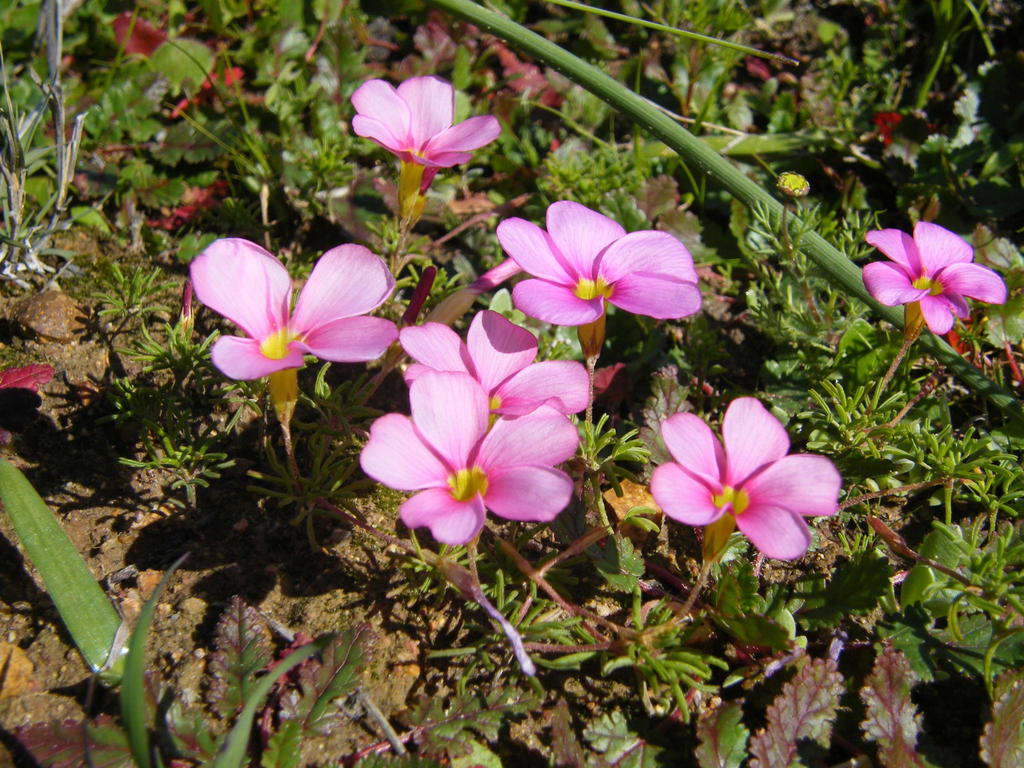
Carpet Sorrel
Oxalis glabra
Oxalis glabra is a member of the wood-sorrel family, Oxalidaceae. It is only one of the 800 total species belonging to this family. The plant is commonly known as finger-leaf due to its trifoliate leaf structure. This trifoliate structure can be seen in variations throughout all members of the genus Oxalis. However, the particularly narrow leaflets of the glabra plant look more like fingers rather than a common clover. The plant is native to South Africa and can be found carpeting the ground of woodlands and bushlands.
From the article Oxalis glabra on Wikipedia (CC BY-SA), quoted section by section
Range & habitat
Oxalis glabra originates from southern Africa in Cape Province and is now concentrated in the southwestern region of Australia. It can be found in the Darling Scarp from Bunbury to Augusta and inland to Narrogin and Toodyay, as well as in the Avon Wheatbelt, Geraldton Sandplain, Jarrah Forest, Swan Coastal Plain, and Warren. Bulbs can be easily spread via water, contaminated soil or organism interactions, such as ants. Though spread throughout Western Australia, no seeds from the plant have been found in the region. It will be able to establish itself best in environments that are already disturbed.
Wikipedia: “Distribution”
At the table
The leaves of the plant are edible, and will yield a sour taste due to production of oxalic acid.
Wikipedia: “Edibility”
How it is grown
The growing period can be affected by location, however the plant generally begins to produce flowers in May and can last through to October with an active growth period between April and November. The plant remains dormant throughout the winter months, and can also slip into dormancy during the summer if conditions are too hot. It is one of the fewer species in the genus to propagate with the use of bulbs, bulbils and stolons. The bulbs begin sprouting in the falling temperatures of autumn months and spread underground with a system of lateral stems, facilitating the persistent nature of this species. The bulbs themselves are tiny, measuring only 5-9mm in length. They are ovoid in shape, often with pointed tips and surrounded by a brown papery cover.
Soil requirements. Oxalis glabra favors heavy soils and clay. However, it will grow easily in sandy and laterite soils.
Wikipedia: “Propagation & growth”
Where it lives
Recorded sightings
—
geo-referenced records in GBIF, from museums, herbaria and field observers.
Drag the globe to turn it. Dots are where records exist, not a range map; darker means more records.
In the stacks
Searching the stacks…
Every page naming Oxalis glabra in the Biodiversity Heritage Library →
This page is assembled live from iNaturalist, GBIF, Wikipedia, the Source Library and the Internet Archive. It is not yet part of the hand-edited codex. iNaturalist taxon 119470.