- Plants
- ›Vascular Plants
- ›flowering plants
- ›Dicots
- ›Gentians, Dogbanes, Madders, and Allies
- ›logania family
- ›Spigelia
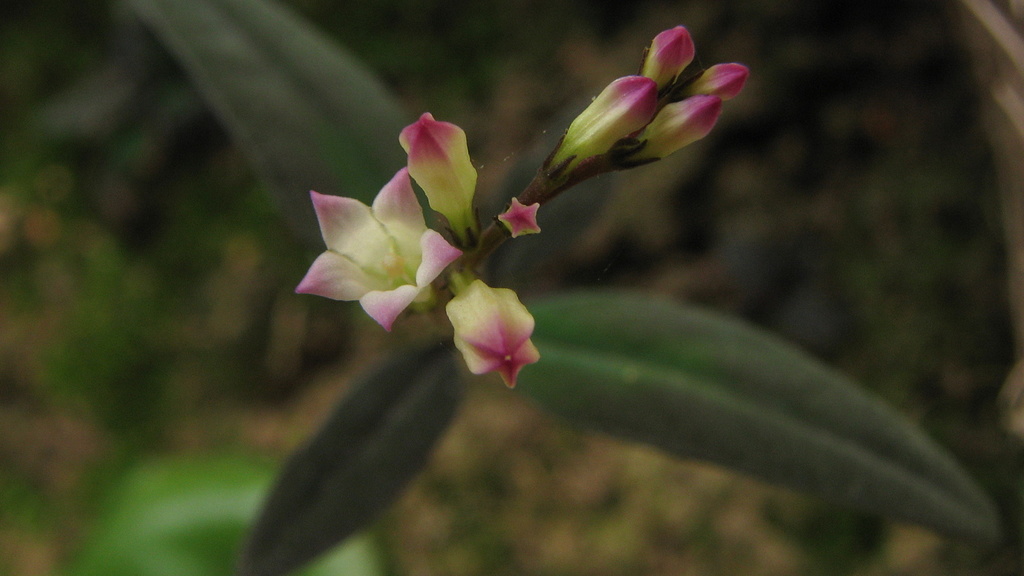
Spigelia genuflexa
Spigelia genuflexa is a species of annual herb of the family Loganiaceae from Bahia state, Brazil, which was described in 2011. It is unusual in that the stems bend down after flowering to deposit the seeds in the soil (geocarpy).
From the article Spigelia genuflexa on Wikipedia (CC BY-SA), quoted section by section
Description
Spigelia genuflexa shows two growth forms. In one, inflorescences are produced after the first three pairs of leaves, when the plant is around 1 centimetre (0.4 in) tall; in the other, four or five pairs of leaves precede the inflorescence, by which time the plant is 10–25 cm (4–10 in) tall. The leaves are oppositely arranged, 6–20 mm (0.24–0.79 in) long and 2–5 mm (0.08–0.20 in) wide, and elliptic to ovate in shape. The inflorescences are composed of up to 7 flowers, and the corollas of the flowers are 4–8 mm (0.16–0.31 in) long. The stems are somewhat red-coloured, and have 4 to 6 prominent ribs running down from the leaf bases.
What it does
Spigelia genuflexa grows in residual stands of Atlantic forest in the Rio do Negro valley in Bahia state (12°1′S 38°2′W), at an altitude of 150 metres (490 ft), and about 30 kilometres (19 mi) from the Atlantic coast. It flowers during the rainy season, and almost disappears during the dry season. It is able to self-pollinate, with anthesis lasting less than a day. After pollination, the plant stem bends, and in the lower growth form, deposits the seeds in the soil; the taller growth form remains some distance above the soil surface.
Wikipedia: “Ecology”
Where it lives
Recorded sightings
—
geo-referenced records in GBIF, from museums, herbaria and field observers.
Drag the globe to turn it. Dots are where records exist, not a range map; darker means more records.
In the stacks
Searching the stacks…
Every page naming Spigelia genuflexa in the Biodiversity Heritage Library →
This page is assembled live from iNaturalist, GBIF, Wikipedia, the Source Library and the Internet Archive. It is not yet part of the hand-edited codex. iNaturalist taxon 119249.