- Plants
- ›Vascular Plants
- ›flowering plants
- ›Dicots
- ›proteas, lotuses, planes, and allies
- ›Protea family
- ›Singlet Proteas
- ›Nutseed Proteoid Clade
- ›Cape Nutseed Proteoids
- ›Mimetes
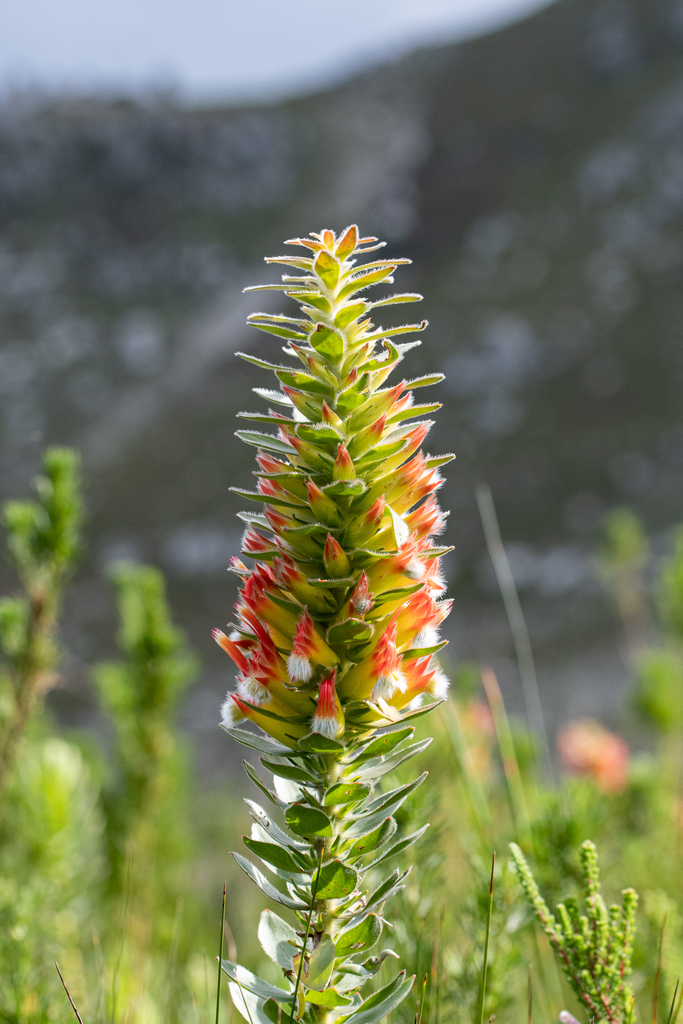
Marsh Pagoda-bush
Mimetes hirtus
Mimetes hirtus is an upright, evergreen shrub of 1½–2 m (5–6½ ft) high from the family Proteaceae. It has upright, overlapping, (broadly) lance-shaped leaves, without teeth, but with one thickened pointy tip. It has cylindric inflorescences topped by a pineapple-like tuft of pinkish-brownish, smaller and more or less horizontal leaves. The flowerheads are tightly enclosed by yellow, red-tipped bracts, only the 9–14 long red styles and the whitish silky tips of the perianth sticking out. It is primarily pollinated by the Cape sugarbird. It is an endemic species of the southwest of the Western Cape province of South Africa, and grows in wet zones at the base of south-facing mountain slopes. Flower heads may be found from May to November, but peaks in July and August. The species has several vernacular names of which marsh pagoda seems to be used most.
From the article Mimetes hirtus on Wikipedia (CC BY-SA), quoted section by section
Description
Mimetes hirtus is an evergreen, well-branched, upright shrub of 1½–2 m (5–6½ ft) high, that develops from a single trunk of up to 7½ cm (3 in) thick, covered with a sooth red bark. The stiffly upright branches are initially covered in dense felty or woolly hairs, but these soon wear off. The leaves are set alternately along the branches, at an upward angle and overlapping. They have a lance-shaped to broadly lance-shaped outline, are 2½–4½ cm (1.0–1.8 in) long and ½–1¾ cm (0.2–0.7 in) wide, with a pointy thickened tip, and initially carry some felty hairs and a row of felty hairs along the entire margin, which later wear off. The inflorescences are broadly cylinder-shaped, 8–14 cm (3¼–5¾ in) long and 8–9 cm (3¼–3½ in) in diameter, with a tuft of smaller, pinkish, not very upright leaves. It consists of up to fourteen flower head that each contain nine to fourteen individual flowers and sit in the axil of an ordinary flat green leaf. The outer whorl of bracts that encircle the flower heads are bright yellow with red tips, pointy lance-shaped, 1½–4 cm (0.6–1.6 in) long and ½–1¼ cm (0.2–0.5 in) wide, papery in consistency, mostly hairless but sometime with a few silky hairs, the margins towards the tip with a row of silky hairs, and are tightly enveloping the flowers. …
Range & habitat
The marsh pagoda is an endemic species that grows along the foot of the coastal mountains on the southern coast of the Western Cape province of South Africa. In the west, it grows in the wild on the Cape Peninsula, between Buffelsbaai and Silvermine Nature Reserve. Previously however, it could be found as far north as Rondebosch. Further east, it can be found from Hangklip near Pringle Bay, along the foot of the Kogelberg Nature Reserve at Betty's Bay and Kleinmond, Hermanus, and the southern foot of the hills towards Elim, where it reaches its southeastern limit. It seldom grows at an altitude exceeding 50 m (165 ft), except for the populations Silvermine and Highlands that occur at about 400 m (1300 ft) elevation. The marsh pagoda prefers a swampy habitat or the bank of streams, where it may form dense stands and forms a vegetation together with species such as Osmitopsis asteriscoides, Erica perspicua and Psoralea aphylla. Like other Mimetes species, the marsh pagoda is adapted to pollination by birds, in this case in particular the Cape sugarbird. This species sits on top of the inflorescence and brushes against the pollen presenters. Visits of the orange-breasted sunbird are less effective because this species sits below the inflorescence and so largely avoids the pollen presenters. …
Wikipedia: “Distribution, habitat and ecology”
Where it lives
Recorded sightings
—
geo-referenced records in GBIF, from museums, herbaria and field observers.
Drag the globe to turn it. Dots are where records exist, not a range map; darker means more records.
In the stacks
Searching the stacks…
Every page naming Mimetes hirtus in the Biodiversity Heritage Library →
This page is assembled live from iNaturalist, GBIF, Wikipedia, the Source Library and the Internet Archive. It is not yet part of the hand-edited codex. iNaturalist taxon 119224.