- Plants
- ›Vascular Plants
- ›flowering plants
- ›Dicots
- ›Buttercups, Poppies, and Allies
- ›buttercup family
- ›goldenseal subfamily

goldenseals
Hydrastis
Goldenseal (Hydrastis canadensis), also called orangeroot or yellow puccoon, is a perennial herb in the buttercup family Ranunculaceae, native to North America. It may be distinguished by its thick, yellow knotted rootstock. The stem is purplish and hairy above ground and yellow below ground where it connects to the yellow rhizome. Goldenseal reproduces both clonally through the rhizome and sexually, with clonal division more frequent than asexual reproduction. It takes between 4 and 5 years for a plant to reach sexual maturity, i.e. the point at which it produces flowers. Plants in the first stage, when the seed erupts and cotyledons emerge, can remain in this state one or more years. The second vegetative stage occurs during years two and three (and sometimes longer) and is characterized by the development of a single leaf and absence of a well developed stem. Finally, the third stage is reproductive, at which point flowering and fruiting occurs. This last stage takes between 4 and 5 years to develop.
A second species from Japan, previously listed as Hydrastis palmatum, is now usually classified in another genus, as Glaucidium palmatum.
1 branches of this genus, most-observed first
See this branch on the Wheel of Life →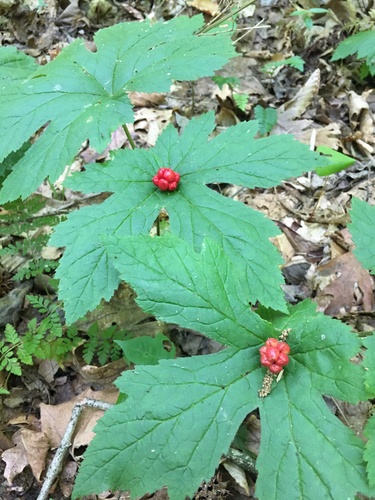
Where it lives
Recorded sightings
—
geo-referenced records in GBIF, from museums, herbaria and field observers.
Drag the globe to turn it. Dots are where records exist, not a range map; darker means more records.
In the stacks
Searching the stacks…
Every page naming Hydrastis in the Biodiversity Heritage Library →
This page is assembled live from iNaturalist, GBIF, Wikipedia, the Source Library and the Internet Archive. It is not yet part of the hand-edited codex. iNaturalist taxon 118769.