- Plants
- ›Vascular Plants
- ›flowering plants
- ›monocots
- ›Agaves, Orchids, Irises, and Allies
- ›agave and allies
- ›Hyacinth subfamily
- ›poison squill tribe
- ›Drimia
- ›Charybdis
- ›Drimia maritima
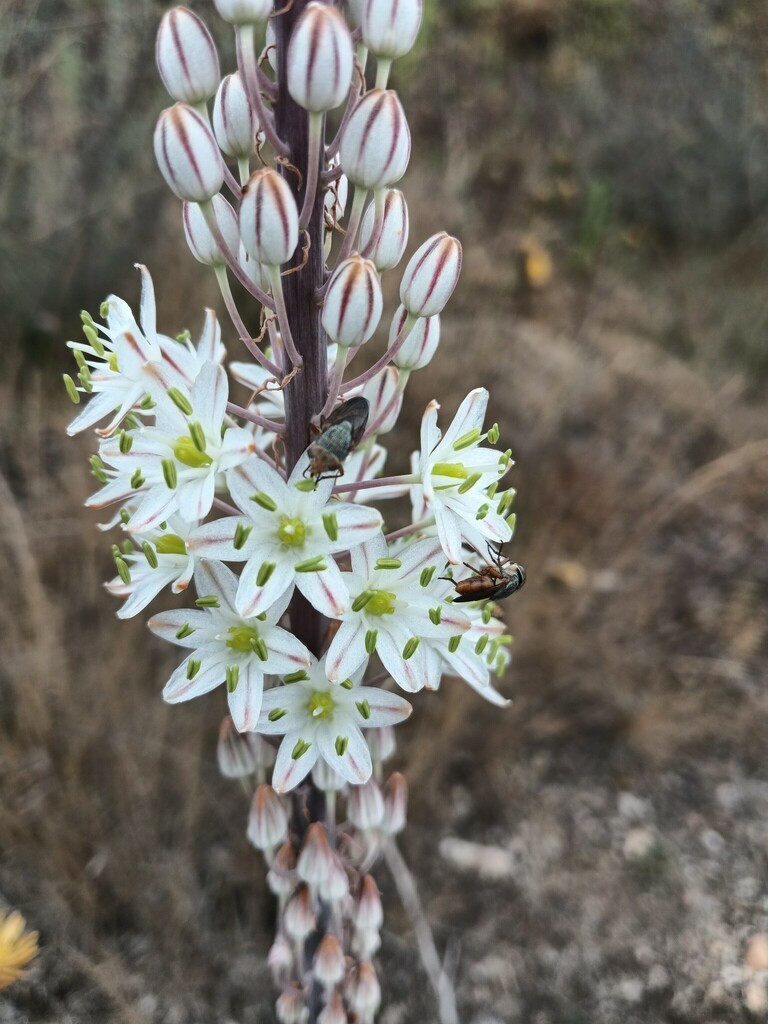
sea squill
Drimia maritima
Drimia maritima (syn. Urginea maritima) is a species of flowering plant in the family Asparagaceae, subfamily Scilloideae (formerly the family Hyacinthaceae). This species is known by several common names, including squill, sea squill, sea onion, and maritime squill. It may also be called red squill, particularly a form which produces red-tinged flowers instead of white, though it is likely the red color noted is actually referring to the bulb itself, not the flowers. It is native to southern Europe, western Asia, and northern Africa.
From the article Drimia maritima on Wikipedia (CC BY-SA), quoted section by section
Description
This plant grows from a large bulb which can be up to 20 cm (7.9 in) wide and weigh 1 kg (2.2 lb). Bailey reported weights of up to fifteen pounds (seven kilograms), probably referring to a clump. Several bulbs may grow in a clump and are usually just beneath the surface of the soil. In the spring, each bulb produces a rosette of about ten leaves each up to a meter long. They are dark green in color and leathery in texture. They die away by autumn, when the bulb produces a tall, narrow raceme of flowers. This inflorescence can reach 1.5–2 m (4 ft 11 in – 6 ft 7 in) in height. The flower is about 1.5 cm (0.59 in) wide and has six tepals each with a dark stripe down the middle. The tepals are white, with the exception of those on the red-flowered form. The fruit is a capsule up to 1.2 cm (0.47 in) long.
What it does
This plant often grows in rocky coastal habitat, especially in the Mediterranean Basin, where it is common. It occurs in many other types of habitat, except for the driest deserts. It can grow in open and also in very shady areas. Its habit of producing leaves in the spring and flowers in the fall is an adaptation to the Mediterranean climate of its native range, where the summers are hot and dry. This species has two different pollination syndromes, entomophily and anemophily; it is pollinated by insects and wind. Insect pollinators include the western honey bee (Apis mellifera), the Oriental hornet (Vespa orientalis), and the paper wasp species Polistes gallicus.
Wikipedia: “Ecology”
At the table
The plant has been used as a poison and as a medicinal remedy. The main active compounds are cardiac glycosides, including unique bufadienolides such as glucoscillaren A, proscillaridine A, scillaren A, scilliglaucoside and scilliphaeoside. The plant can have a cardiac glycoside content of up to 3%. Scilliroside, the most important of the toxic compounds, is present in all parts of the plant. The broad leaves of this plant, when they completely dry out, lose their toxicity and are consumed by cattle and sheep. In Palestine and Israel, Arab farmers are known to use the plant to mark the butts and bounds of farm land, on account of the plant's distinct features. In Israel, it is traditionally considered a "harbinger of fall", and its Hebrew name "hatzav" shares a linguistic root with the words to dig or quarry, much like the bulb digs its roots into the ground.
Medicine. This species has been used as a medicinal plant since ancient times. It is noted in the Ebers Papyrus of the 16th century BC, one of the oldest medical texts of ancient Egypt. Pythagoras wrote about it in the 6th century BC. Hippocrates used it to treat jaundice, convulsions, and asthma. Theophrastus was also familiar with it. Its primary medicinal use was as a treatment for edema, then called dropsy, because of the diuretic properties of the cardiac glycosides. …
Wikipedia: “Uses”
Where it lives
Recorded sightings
—
geo-referenced records in GBIF, from museums, herbaria and field observers.
Drag the globe to turn it. Dots are where records exist, not a range map; darker means more records.
In the old herbals & bestiaries

Herbarius latinus (with French synonyms)
1486 · p.281

Garden of Health
Jacob Meydenbach · 1491 · p.432

Herbal of Virtues
1499 · p.279

Book of Herbs
Hieronymus Bock (Tragus) · 1546 · p.718

On the Names of Plants
Hieronymus Bock (Tragus) · 1552 · p.976

Commentaries on the Six Books of Pedanius Dioscorides on Medical Matter
Pietro Andrea Mattioli · 1565 · p.776
In the stacks
Searching the stacks…
Every page naming Drimia maritima in the Biodiversity Heritage Library →
This page is assembled live from iNaturalist, GBIF, Wikipedia, the Source Library and the Internet Archive. It is not yet part of the hand-edited codex. iNaturalist taxon 118535.