- Plants
- ›Vascular Plants
- ›flowering plants
- ›Dicots
- ›honeysuckles, moschatels, and allies
- ›honeysuckle family
- ›Scabious subfamily
- ›Dipsacus
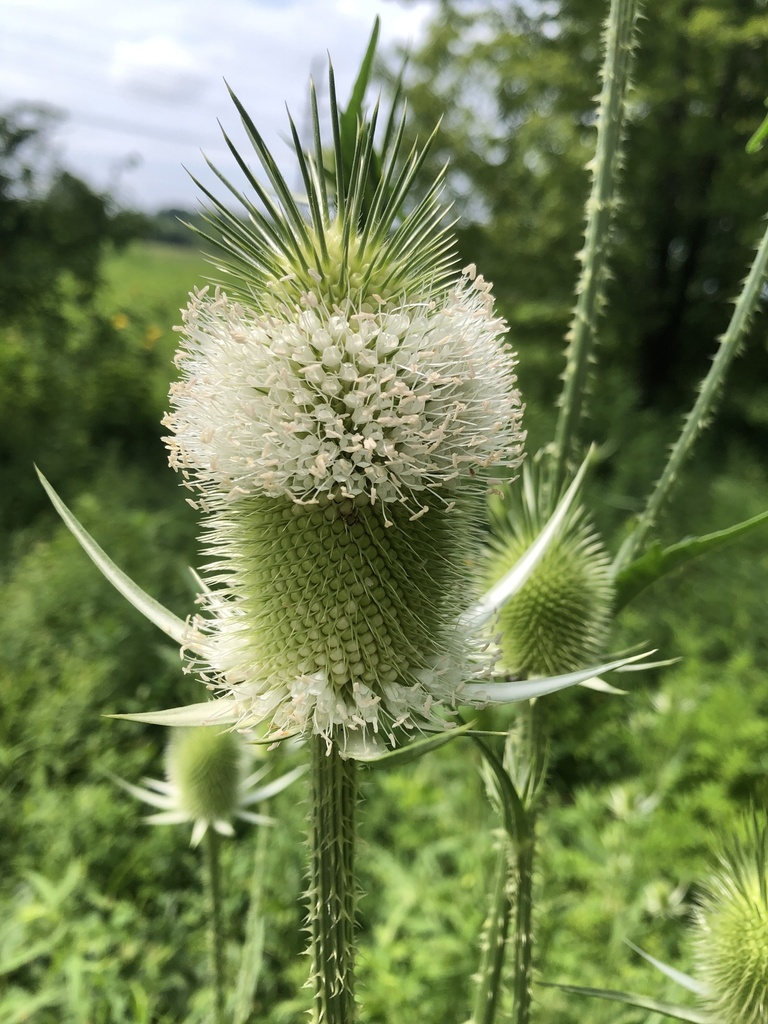
cutleaf teasel
Dipsacus laciniatus
Dipsacus laciniatus is a species of flowering plant in the honeysuckle family known by the common name cutleaf teasel. It is native to Europe and Asia. It is present in North America as an introduced species and invasive weed.
This plant is a perennial herb that may grow up to two to three meters in height. The erect, branching stem is hollow and prickly. The leaves are oppositely arranged, each leaf pair joined around the stem and clasping it, their bases forming a cup which often collects water. The species is monocarpic, living for multiple years but only flowering once before dying. The inflorescence is an egg-shaped head subtended by long bracts. The head may contain up to 1500 flowers. Each individual flower lasts one day. The middle of the head blooms first and then the upper and lower parts. The fruit is an achene just under a centimeter long. The plant reproduces only by seed. This teasel may be distinguished from its relative, common teasel (Dipsacus fullonum) by flower color and leaf shape. Cutleaf teasel has white flowers and deeply cut leaves, while common teasel has purple flowers and toothed or wavy-edged leaves.
Where it lives
Recorded sightings
—
geo-referenced records in GBIF, from museums, herbaria and field observers.
Drag the globe to turn it. Dots are where records exist, not a range map; darker means more records.
In the stacks
Searching the stacks…
Every page naming Dipsacus laciniatus in the Biodiversity Heritage Library →
This page is assembled live from iNaturalist, GBIF, Wikipedia, the Source Library and the Internet Archive. It is not yet part of the hand-edited codex. iNaturalist taxon 117438.