- Plants
- ›Vascular Plants
- ›flowering plants
- ›Dicots
- ›pinks, cactuses, and allies
- ›Pussypaw Family
- ›Claytonia
- ›Claytonia
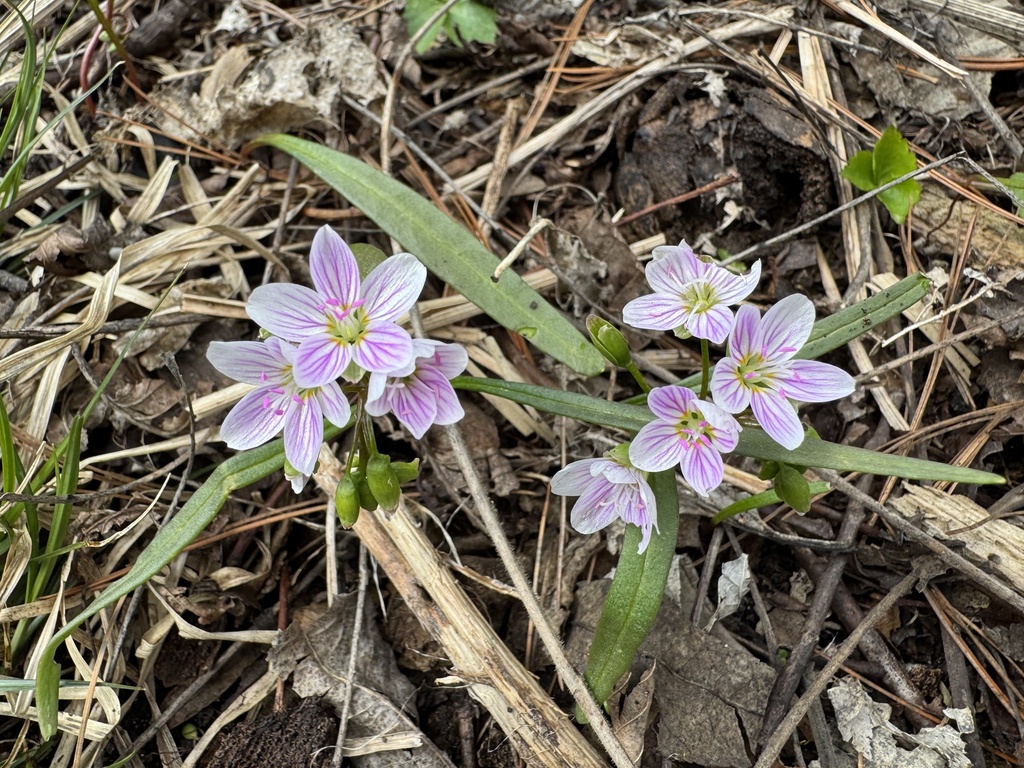
Virginia Springbeauty
Claytonia virginica
Claytonia virginica, the Virginia springbeauty, eastern spring beauty, grass-flower narrowleaf springbeauty or fairy spud, is an herbaceous perennial plant in the family Montiaceae. Its native range is eastern North America. Its scientific name honors Colonial Virginian botanist John Clayton (1694–1773).
From the article Claytonia virginica on Wikipedia (CC BY-SA), quoted section by section
Description
Springbeauty is a perennial plant, overwintering through a tuberous root. It is a trailing plant growing to 5–40 cm (2–16 in) tall. The leaves are slender lanceolate, 3–14 cm (1+1⁄4–5+1⁄2 in) long and 0.5–2 cm (0.20–0.79 in) broad, with a 6–20 cm (2+1⁄4–7+3⁄4 in) long petiole. The flowers are 0.7–1.4 cm (0.28–0.55 in) in diameter with five pale pink or white (rarely yellow) petals, and reflect UV light. It has a raceme inflorescence, in which its flowers branch off of the shoot. The individual flowers bloom for three days, although the five stamens on each flower are only active for a single day. Flowering occurs between March and May depending on part of its range and weather. The seeds are between 0.2 and 0.3 cm (0.08 and 0.12 in) in diameter and a shiny black. The seeds are released from the capsule fruit when it breaks open. Elaiosomes are present on the seeds and allow for ant dispersal. Claytonia virginica is a cytologically complex taxon, including diploids with n=6, 7, 8 and 9, and tetraploids, hexaploids, octaploids and dodecaploids. The largest number of chromosomes (2n=ca. 191) was observed in the New York area.
Range & habitat
Springbeauty is found in the Eastern temperate deciduous forest of North America. It is noted for its abundance throughout many parts of its range, especially in forests. The plant can be found throughout many different habitat types including lawns, city parks, forests, roadsides, wetlands, bluffs, and ravines.
Wikipedia: “Habitat and range”
At the table
This plant has been used medicinally by the Iroquois, who would give a cold infusion or decoction of the powdered roots to children suffering from convulsions. They would also eat the raw roots believing that they permanently prevented conception. They would also eat the roots as food, as would the Algonquin people, who cooked them like potatoes. The bulbs are rich in starch. When they are cooked, the taste has been described to be similar to chestnuts, while when raw, it has been said to taste like radishes. The roots are rich in vitamin A and C. Spring beauty corms along with the entire above ground portion of the plant are safe for human consumption. The leaves can be cooked in salted water or steamed, although are not choice eating.
Wikipedia: “Uses”
Where it lives
Recorded sightings
—
geo-referenced records in GBIF, from museums, herbaria and field observers.
Drag the globe to turn it. Dots are where records exist, not a range map; darker means more records.
In the stacks
Searching the stacks…
Every page naming Claytonia virginica in the Biodiversity Heritage Library →
This page is assembled live from iNaturalist, GBIF, Wikipedia, the Source Library and the Internet Archive. It is not yet part of the hand-edited codex. iNaturalist taxon 117434.