- Plants
- ›Vascular Plants
- ›flowering plants
- ›Dicots
- ›beeches, oaks, walnuts, and allies
- ›beech family
- ›Quercus
- ›Quercus
- ›Lobatae
- ›Phellos
- ›Quercus ilicifolia
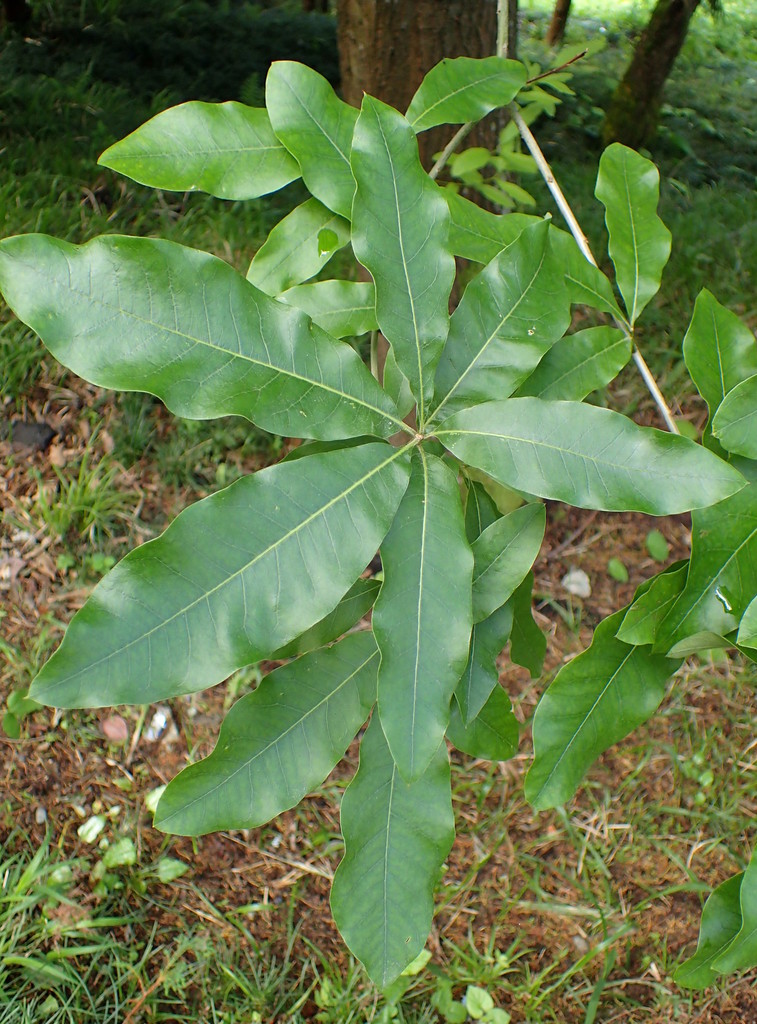
shingle oak
Quercus imbricaria
Quercus imbricaria, the shingle oak, is a deciduous tree in the red oak group of oaks. It is native primarily to the Midwestern and Upper South regions of North America, from southern New York west to northern Illinois and eastern Kansas, and south to central Alabama and Arkansas. It is most commonly found growing in uplands with good drainage, less often along lowland streams, at 100–700 m altitude.
From the article Quercus imbricaria on Wikipedia (CC BY-SA), quoted section by section
Description
Quercus imbricaria is usually 15–18 meters (49–59 ft) high, maximum height 100 ft, with a broad pyramidal head when young, becoming in old age, broad-topped and open. Trunk up to 1 m (39 in) in diameter (rarely 1.4 m or 56 in). It reaches its largest size in southern Illinois and Indiana, although the national champion is 104' by 68' in Cincinnati, Ohio.
Bark: Light brown, scaly; on young stems light brown, smooth. Branchlets slender, dark green and shining at first, later become light brown, finally dark brown. Wood: Pale reddish brown, sapwood lighter; heavy, hard coarse-grained, checks badly in drying; used for shingles and sometimes in construction. Sp. gr., 0.7529; weight of cu. ft., 46.92 lbs. Winter buds: Light brown, ovate, acute, one-eight inch long. Leaves: Alternate, oblong or obovate, four to six inches long, one to two inches wide, wedge-shaped or rounded at base, acute or rounded at apex, sometimes entire or with undulated margins, sometimes more or less three-lobed. They come out of the bud involute, bright red, covered with rusty down above and white tomentum below. When full grown are dark green, smooth and shining above, pale green or pale brown, downy below; midribs stout yellow, grooved above, primary veins slender. In autumn they become dark red above, pale beneath, midribs darken, then the leaf. Petioles stout, hairy, flattened, grooved. …
Range & habitat
It is native primarily to the Midwestern and Upper South regions of North America, from southern New York west to northern Illinois and eastern Kansas, and south to central Alabama and Arkansas. It is abundant in the lower Ohio Valley and middle Mississippi Valley, and rare in the east. It is most commonly found growing in uplands with good drainage, less often along lowland streams, at altitudes of 100–700 m (330–2,300 ft).
Wikipedia: “Distribution and habitat”
At the table
In the past, the wood was important for making shingles, from which the common name derives.
Wikipedia: “Uses”
Where it lives
Recorded sightings
—
geo-referenced records in GBIF, from museums, herbaria and field observers.
Drag the globe to turn it. Dots are where records exist, not a range map; darker means more records.
In the stacks
Searching the stacks…
Every page naming Quercus imbricaria in the Biodiversity Heritage Library →
This page is assembled live from iNaturalist, GBIF, Wikipedia, the Source Library and the Internet Archive. It is not yet part of the hand-edited codex. iNaturalist taxon 117428.