- Plants
- ›Vascular Plants
- ›flowering plants
- ›Dicots
- ›carrots, ivies, and allies
- ›carrot family
- ›Apioideae
- ›Erigenieae
- ›Erigenia
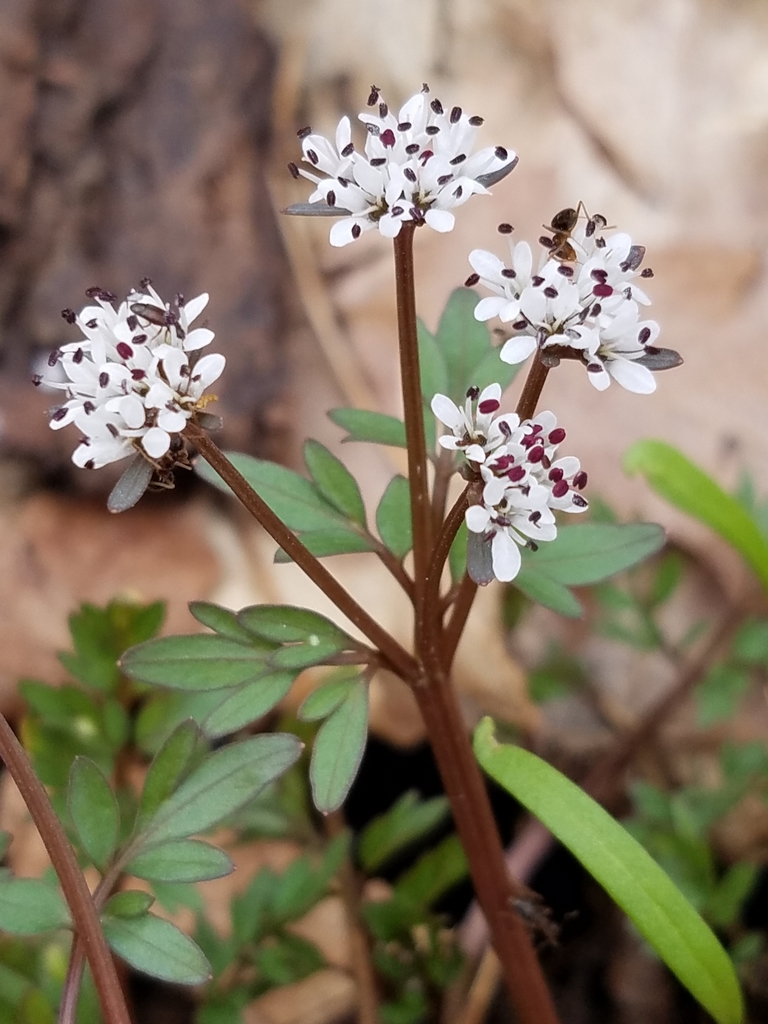
harbinger of spring
Erigenia bulbosa
Erigenia bulbosa, also known as harbinger of spring or pepper and salt, is a perennial plant in the carrot family (Apiaceae). E. bulbosa is the only species in the genus Erigenia (Nutt.). This plant is known as harbinger of spring because it is one of the earliest blooming native wildflowers of rich forests in the mid-latitude United States. It is found as far north as central New York and southern Wisconsin, west to the western Ozarks,...
From the article Erigenia on Wikipedia (CC BY-SA), quoted section by section
Description
It is a small spring ephemeral reaching only 5–15 cm tall when in flower, and slightly larger afterwards. Each spherical bulb gives rise to a single purplish stem, which terminates in an umbel. The flowers have white petals and large dark-reddish anthers. The teardrop shaped petals are 3-4 millimeters long, widely spaced and do not touch each other. As is characteristic of the carrot family, the leaves of this plant are sheathed at the base and pinnately divided into many small sections.
Range & habitat
Harbinger of spring is an occasional plant in rich hardwood forests of eastern North America. It is found as far north as central New York and southern Wisconsin, west to the western Ozarks, and south to central Alabama. It is also found in extreme southern Ontario.
Wikipedia: “Distribution and habitat”
What it does
Its typical associates include spring beauty (Claytonia virginica) and cut-leaf tooth wort (Cardamine laciniata). All of these early spring blooming plants are pollinated by solitary bees, and to a lesser extent, flies and honey bees. E. bulbosa has a small daily accumulation of nectar per flower (7–38 μg sugar/flower), but the presence of numerous, closely arranged, simultaneously blooming flowers in the umbel may increase the overall nectar incentive for the pollinators. The nectar produced by E. bulbosa only contains the sugar fructose. Erigenia bulbosa does not form vesicular-arbuscular mycorrhizal associations with fungi, in contrast to most plants. These plants are protected in New York and Wisconsin as state endangered plants.
Wikipedia: “Ecology”
At the table
The bulb is edible both cooked and raw. The Cherokee were known to chew this plant as medicine for toothaches; it is unknown what parts of plant they chewed. This plant is sometimes used in native wildflower gardens throughout its range.
Wikipedia: “Uses”
Where it lives
Recorded sightings
—
geo-referenced records in GBIF, from museums, herbaria and field observers.
Drag the globe to turn it. Dots are where records exist, not a range map; darker means more records.
In the stacks
Searching the stacks…
Every page naming Erigenia bulbosa in the Biodiversity Heritage Library →
This page is assembled live from iNaturalist, GBIF, Wikipedia, the Source Library and the Internet Archive. It is not yet part of the hand-edited codex. iNaturalist taxon 117309.