- Animals
- ›Molluscs
- ›Bivalves
- ›Autobranchia
- ›Heteroconchia
- ›Euheterodonta
- ›Imparidentia
- ›Myida
- ›Dreissenoidea
- ›Dreissenidae
- ›Dreisseninae
- ›Dreissena
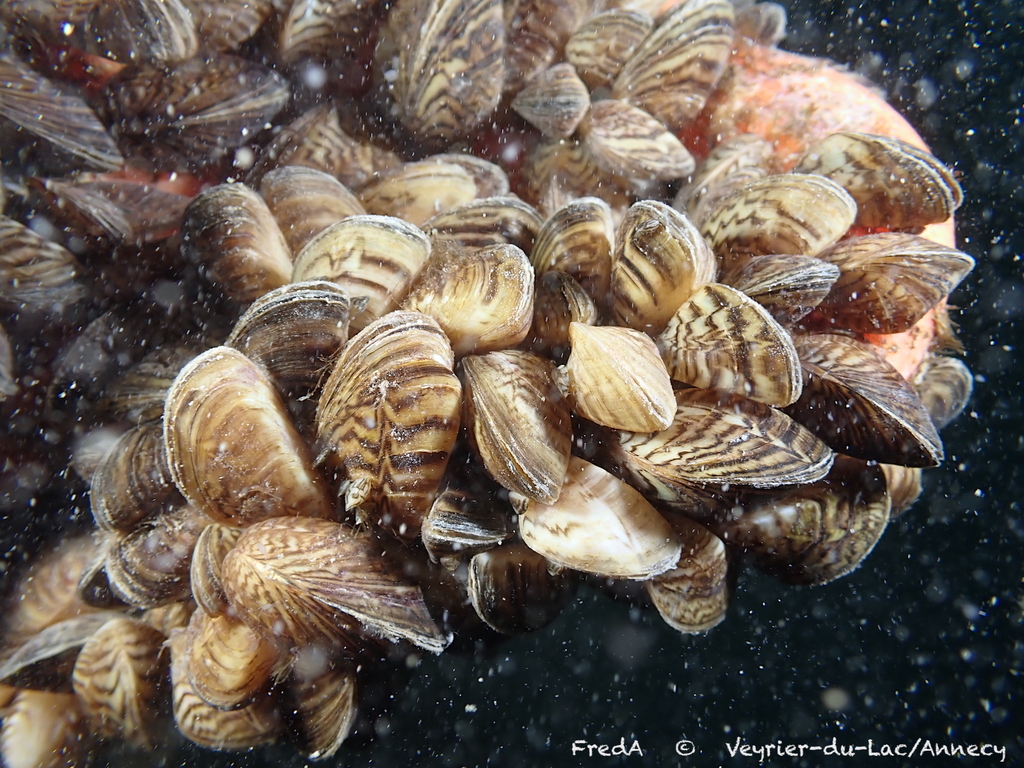
Zebra Mussel
Dreissena polymorpha
The zebra mussel (Dreissena polymorpha) is a small freshwater mussel, an aquatic bivalve mollusc in the family Dreissenidae. The species originates from the lakes of southwestern Russia and southeastern Europe, but has been accidentally introduced to numerous other areas and has become an invasive species in many countries in the Northern Hemisphere. Since the 1980s, the species has invaded the Great Lakes, Hudson River, Lake Travis, Finger Lakes, Lake Bonaparte, and Lake Simcoe. The adverse effects of dreissenid mussels on freshwater systems have led to their classification as among the world's most invasive aquatic species.
The species was first described in 1768 by German zoologist Peter Simon Pallas in the Ural, Volga, and Dnieper Rivers. Zebra mussels get their name from a striped pattern commonly seen on their shells, though it is not universally present. They are usually about the size of a fingernail, but can grow to a maximum length around 50 mm (2 in). Their shells are D-shaped, and attached to the substrate with strong byssal fibres, which come out of their umbo on the dorsal (hinged) side.
From the article Zebra mussel on Wikipedia (CC BY-SA), quoted section by section
What it does
Zebra mussels and the closely related and ecologically similar quagga mussels are filter-feeding organisms; they remove particles from the water column. Zebra mussels process up to 1 litre (0.26 US gal; 34 US fl oz) of water per day, per mussel. Some particles are consumed as food, and faeces are deposited on lakes floor. Nonfood particles are combined with mucus and other matter and deposited on lake floors as pseudofaeces. Since the zebra mussel has become established in Lake Erie, water clarity has increased from 15 cm (6 in) to up to 1 m (3 ft) in some areas. This increased water clarity allows sunlight to penetrate deeper, enabling growth of submerged macrophytes. These plants, when decaying, wash up on shorelines, fouling beaches and causing water-quality problems. Lake-floor food supplies are enriched by zebra mussels, which filter pollutants from the water. This biomass becomes available to bottom-feeding species and to the fish that feed on them. The catch of yellow perch increased five-fold after the invasion of zebra mussels into Lake St. Clair. Zebra mussels attach to most substrates, including sand, silt, and harder substrates, but usually juveniles prefer harder, rockier substrates on which to attach. Other mussel species frequently represent the most stable objects in silty substrates, and zebra mussels attach to and often kill these mussels. …
Wikipedia: “Ecology”
Where it lives
Recorded sightings
—
geo-referenced records in GBIF, from museums, herbaria and field observers.
Drag the globe to turn it. Dots are where records exist, not a range map; darker means more records.
In the stacks
Searching the stacks…
Every page naming Dreissena polymorpha in the Biodiversity Heritage Library →
This page is assembled live from iNaturalist, GBIF, Wikipedia, the Source Library and the Internet Archive. It is not yet part of the hand-edited codex. iNaturalist taxon 116340.