- Plants
- ›Vascular Plants
- ›flowering plants
- ›Dicots
- ›Mints, Plantains, Olives, and Allies
- ›Acanthus Family
- ›Acanthoideae
- ›Justicieae
- ›Dolichostachys
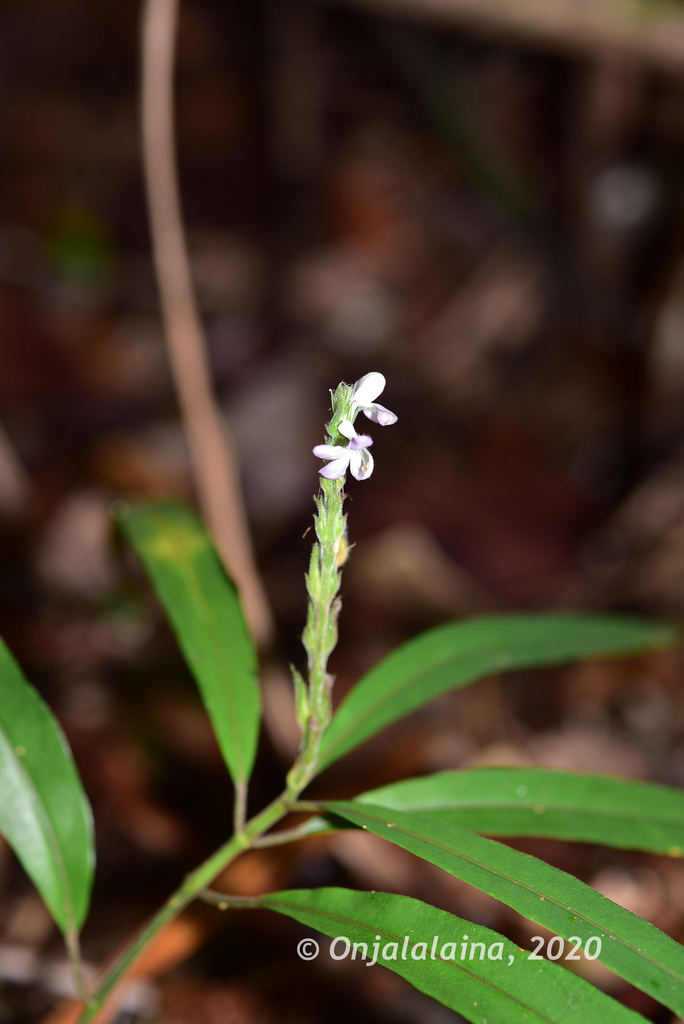
Dolichostachys elongata
Dolichostachys is a monotypic genus of plants in the family Acanthaceae. Its sole species, Dolichostachys elongata, is a subshrub that is endemic to Madagascar. It is considered an endangered species.
From the article Dolichostachys on Wikipedia (CC BY-SA), quoted section by section
Description
Dolichostachys elongata is an erect subshrub growing up to 1 m (3 ft 3 in) tall. The branches are quadrangular and slightly hairy. The leaves are linear to lanceolate and pointed at both the tip and the base, each measuring approximately 7–15 cm (2.8–5.9 in) long and 10–22 mm (0.39–0.87 in) wide. The leaves are hairless, arranged opposite one another, and borne on 10–18 mm (0.39–0.71 in) long petioles. The inflorescence is a bracteolate spike. The bracts are lanceolate, measuring approximately 4 mm (0.16 in) long and 1 mm (0.039 in) wide, while the bracteoles are linear and measure only 1 mm (0.039 in) long. Both the bracts and bracteoles are hairy. The five sepals are of roughly equal size, pointed in shape, and hairy. The corolla is a short, fused tube, with the tube measuring approximately 4.5 mm (0.18 in) long and the corolla as a whole measuring 10 mm (0.39 in) long. The upper lip of the corolla is shaped like a broad oval with a rounded or slightly notched tip, while the lower lip of the corolla is split into three lobes.
Range & habitat
Dolichostachys elongata is known only from the Analanjirofo and Atsimo-Atsinanana regions of Madagascar. In Analanjirofo it can be found near Mananara Nord and Fenerive Est, and in Atsimo-Atsinanana it can be found near Manombo. It grows near rivers in humid forests at elevations from sea level up to 200 m (660 ft) above sea level.
Wikipedia: “Distribution and habitat”
In human culture
The genus Dolichostachys and species Dolichostachys elongata were named and described by Raymond Benoist in 1962 based on two specimens collected by Joseph Marie Henry Alfred Perrier de la Bâthie in 1912. However, as Benoist failed to designate a type specimen, neither the genus nor species names could be considered validly published under Article 40 of the International Code of Nomenclature for algae, fungi, and plants. Benoist's description was verified and a type specimen was designated in a 2022 article published in the journal Taxon, with the author citation attributed to Benoist. D. elongata remains the sole species in the genus Dolichostachys. Morphologically, it resembles members of the genus Populina and its allies in the subtribe Tetrameriinae, but can be differentiated by the length of its flower, the broad upper lip of the flower, and its elongate leaves when mature. It is unplaced within the tribe Justicieae, possibly belonging to either subtribe Isoglossinae or subtribe Tetrameriinae.
Wikipedia: “Taxonomy and history”
Where it lives
Recorded sightings
—
geo-referenced records in GBIF, from museums, herbaria and field observers.
Drag the globe to turn it. Dots are where records exist, not a range map; darker means more records.
In the stacks
Searching the stacks…
Every page naming Dolichostachys elongata in the Biodiversity Heritage Library →
This page is assembled live from iNaturalist, GBIF, Wikipedia, the Source Library and the Internet Archive. It is not yet part of the hand-edited codex. iNaturalist taxon 1156725.