- Plants
- ›Vascular Plants
- ›flowering plants
- ›Dicots
- ›austrobaileya, anises, and allies
- ›anise family
- ›Illicium
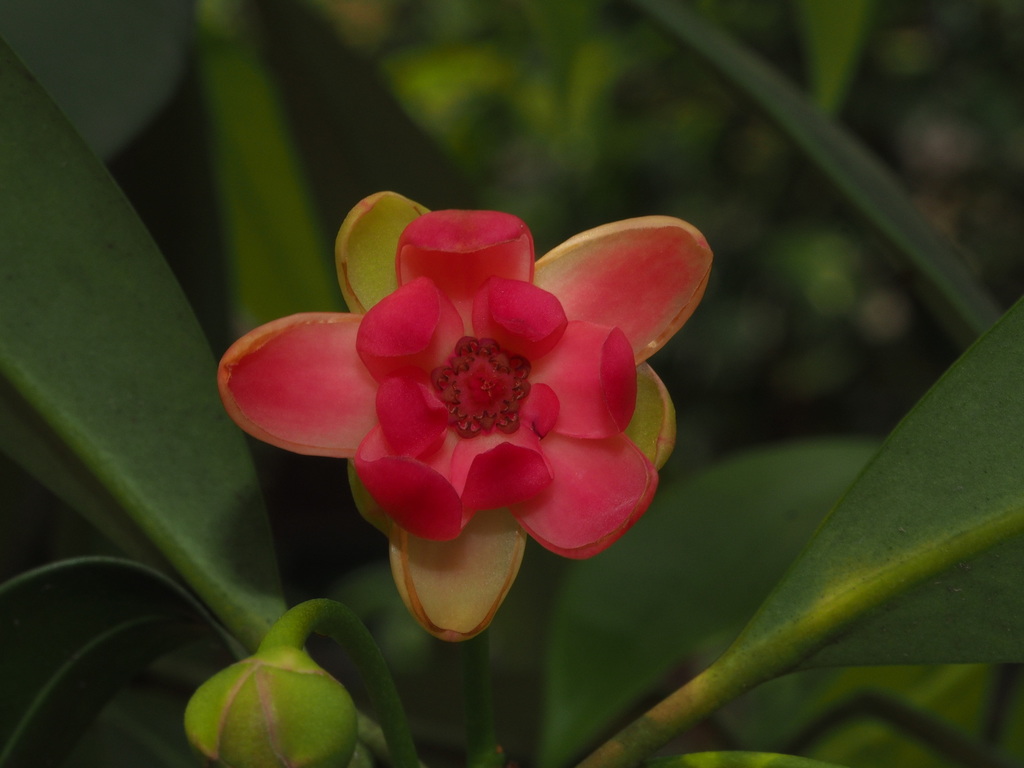
Guandong Star Anise
Illicium lanceolatum
Illicium lanceolatum, commonly known as Guandong star anise, is a species of flowering plant in the family Schisandraceae. It is a shrub or tree with leathery leaves and red flowers. The species was described in 1947, and is native to China.
Illicium lanceolatum is used to produce essential oils, and in medicine. It is listed as of Least Concern by the IUCN.
From the article Illicium lanceolatum on Wikipedia (CC BY-SA), quoted section by section
Description
Illicium lanceolatum is a shrub or tree up to 10 metres (33 ft) high. The leaves are arranged in clusters. The leaf stems are 0.7–1.5 centimetres (0.28–0.59 in) long. The leaves are leathery in texture, lanceolate, oblanceolate, or obovate-elliptical in shape, 5–15 centimetres (2.0–5.9 in) long, and 1.5–4.5 centimetres (0.59–1.77 in) wide. The flower stems are 1.5–5 centimetres (0.59–1.97 in) long. The flowers have ten to fifteen red to dark red tepals. The largest tepals are elliptical to oblong-obovate, fleshy, 8–13 millimetres (0.31–0.51 in) long, and 6–8 millimetres (0.24–0.31 in). The flowers have six to eleven stamens, and ten to fourteen carpels. The plant flowers from April to June. The fruit stems are 6–8 centimetres (2.4–3.1 in) long. The plant fruits from August to October.
Range & habitat
Illicium lanceolatum is native to the temperate biome of south-central and south-east China. It is present in the provinces of Anhui, Fujian, Guizhou, Hubei, Hunan, Jiangsu, Jiangxi, and Zhejiang. The species grows in mixed forests and thickets, at elevations of 300–1,500 metres (980–4,920 ft). The species' estimated extent of occurrence is 1,006,730.39 square kilometres (388,700.78 sq mi).
Wikipedia: “Distribution”
At the table
The fruits and leaves are used to make essential oils. The roots and root bark are used in medicine, although they are toxic.
Wikipedia: “Uses”
Where it lives
Recorded sightings
—
geo-referenced records in GBIF, from museums, herbaria and field observers.
Drag the globe to turn it. Dots are where records exist, not a range map; darker means more records.
In the stacks
Searching the stacks…
Every page naming Illicium lanceolatum in the Biodiversity Heritage Library →
This page is assembled live from iNaturalist, GBIF, Wikipedia, the Source Library and the Internet Archive. It is not yet part of the hand-edited codex. iNaturalist taxon 1151776.