- Animals
- ›Chordates
- ›Vertebrates
- ›Cartilaginous Fishes
- ›Sharks and Rays
- ›Rays
- ›Stingrays
- ›Round Rays
- ›Trygonoptera
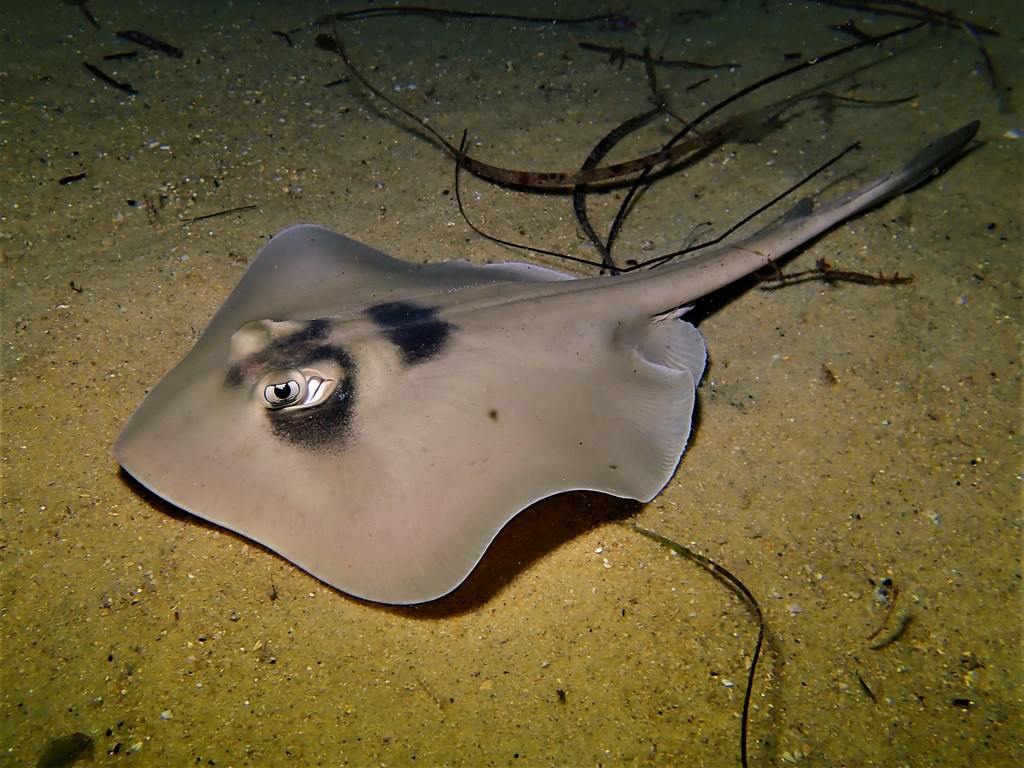
Masked Stingaree
Trygonoptera personata
The masked stingaree (Trygonoptera personata) is a common species of stingray in the family Urolophidae, endemic to southwestern Australia. It prefers moderately deep areas of sand or seagrass some distance from shore, though it can be found in very shallow water or to a depth of 115 m (377 ft). The masked stingaree can be identified by the two large, dark blotches on the upper surface of its rounded pectoral fin disc, one of which encompasses its eyes like a mask. The outer rims of its nostrils are expanded into prominent lobes, while between the nostrils is a skirt-like curtain of skin with a deeply fringed trailing margin. Its tail bears a small dorsal fin just before the stinging spine, and end in a leaf-like caudal fin. This species grows up to 31 cm (12 in) across.
The diet of the masked stingaree consists primarily of polychaete worms and crustaceans, with a general shift from the latter to the former as the ray ages. It is aplacental viviparous, with females typically bearing one pup annually and nourishing it with histotroph ("uterine milk"). The 10–12-month long gestation period consists of a five-month period of suspended development for the egg, followed by rapid growth of the embryo and birthing in late April or early May. The International Union for Conservation of Nature (IUCN) has listed the masked stingaree under Least Concern. Fishing pressure on this species is largely limited to a small number of scallop and prawn trawlers.
From the article Masked stingaree on Wikipedia (CC BY-SA), quoted section by section
Description
The pectoral fin disc of the masked stingaree is approximately as long as wide, and has a rounded shape. The anterior margins of the disc are nearly straight and converge at an obtuse angle on the fleshy, non-protruding snout. The eyes are modestly sized and immediately followed by comma-shaped spiracles with angular posterior rims. The outer margin of each nostril is enlarged into a broad, flattened lobe. Between the nostrils is a skirt-shaped curtain of skin with a fringed trailing margin, that conceals the small mouth. The lower jaw bears a patch of subtle papillae (nipple-shaped structures); there are also 3–4 papillae on the floor of the month. The small teeth have roughly oval bases. The five pairs of gill slits are short. The pelvic fins are small with rounded margins. The tail measures 67–86% as long as the disc; it has an oval cross-section and is slightly flattened at the base. There is a single serrated stinging spine on the upper surface of the tail, which is immediately preceded by a rather large dorsal fin. The tail ends in an elongated, leaf-shaped caudal fin, and lacks lateral fin folds. The skin is devoid of dermal denticles. …
Range & habitat
Found off Western Australia from Shark Bay to Geographe Bay, the masked stingaree is one of the most abundant representatives of its family within its range, particularly in the south. This bottom-dwelling ray has been reported from the shore to a depth of 115 m (377 ft) on the continental shelf, and seems to be most common in offshore waters 20–35 m (66–115 ft) deep. It favors sandy flats and seagrass beds. There is no evidence of segregation by age or sex, or of seasonal migrations.
Wikipedia: “Distribution and habitat”
What it does
Polychaete worms and crustaceans are the predominant sources of food for the masked stingaree; on occasion sipunculid worms, molluscs, and echinoderms are also taken. This species preys on both sedentary polychaetes, which generally inhabit deeply buried tubes, and on errant polychaetes, which are generally more mobile and shallowly buried. The expanded lobes and sensory papillae adjacent to its mouth likely aid in locating and excavating such burrowing prey. Young rays feed mainly on crustaceans, including mysids, amphipods, cumaceans, tanaids, and shrimp. With age polychaetes are added to the diet; sedentary polychaetes are significant to rays 13–29 cm (5.1–11.4 in) across, while errant polychaetes become progressively more important such as that the largest rays eat little else. Like other stingrays, the masked stingaree is aplacental viviparous. Females have a single functional uterus (the left) and produce a single pup (rarely two) per year. Ovulation and mating occur from mid-June to mid-July; fertilized eggs are enclosed by a delicate brown capsule and maintained in a state of diapause (dormancy) within the uterus until November. …
Wikipedia: “Biology and ecology”
Where it lives
Recorded sightings
—
geo-referenced records in GBIF, from museums, herbaria and field observers.
Drag the globe to turn it. Dots are where records exist, not a range map; darker means more records.
In the stacks
Searching the stacks…
Every page naming Trygonoptera personata in the Biodiversity Heritage Library →
This page is assembled live from iNaturalist, GBIF, Wikipedia, the Source Library and the Internet Archive. It is not yet part of the hand-edited codex. iNaturalist taxon 114625.