- Animals
- ›Chordates
- ›Vertebrates
- ›Cartilaginous Fishes
- ›Sharks and Rays
- ›Sharks
- ›Galean Sharks
- ›Ground Sharks
- ›Catsharks
- ›Scyliorhinus
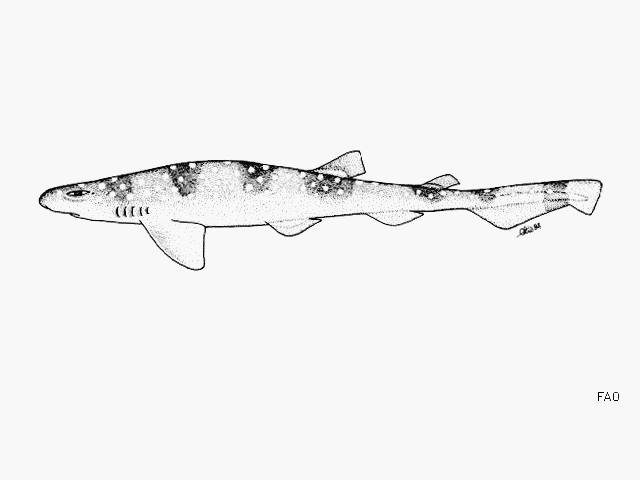
dwarf catshark
Scyliorhinus torrei
The dwarf catshark (Scyliorhinus torrei) is a catshark, belonging to the family Scyliorhinidae. It is found off the coast of southern Florida, the Bahamas, and Cuba and is also known as the whitespotted catshark and Cuban catshark.
From the article Dwarf catshark on Wikipedia (CC BY-SA), quoted section by section
Description
The dwarf catshark is a small, slender but deep-bodied catshark with a maximum length of about 32 cm (13 in). The front nasal flaps are small and do not extend as far as the mouth; there are grooves on the lower lip and there are no nasoral grooves. The first dorsal fin is considerably larger than the second fin and is positioned above or slightly behind the pelvic fin insertion. The distance between the two dorsal fins is greater than the length of the base of the anal fin. The basic colour of the back and sides is pale brown and on this are an evenly distributed scattering of large white spots and seven or eight indistinct dark saddles. This species does not have any black spots.
What it does
This deepwater catshark is known from the subtropical western Atlantic Ocean, it being found off the coasts of southern Florida, the Bahamas and Cuba at depths of between 200 and 600 m (700 and 2,000 ft), but most commonly between 366 and 550 m (1,200 and 1,800 ft); it inhabits the continental shelf and insular slopes and has been little studied. It is oviparous, laying a pair of eggs at a time. As the embryos develop inside their egg-cases, they feed on their egg yolks.
Wikipedia: “Ecology”
Where it lives
Recorded sightings
—
geo-referenced records in GBIF, from museums, herbaria and field observers.
Drag the globe to turn it. Dots are where records exist, not a range map; darker means more records.
In the stacks
Searching the stacks…
Every page naming Scyliorhinus torrei in the Biodiversity Heritage Library →
This page is assembled live from iNaturalist, GBIF, Wikipedia, the Source Library and the Internet Archive. It is not yet part of the hand-edited codex. iNaturalist taxon 112384.