- Animals
- ›Chordates
- ›Vertebrates
- ›Cartilaginous Fishes
- ›Sharks and Rays
- ›Rays
- ›Stingrays
- ›Cownose Rays
- ›Rhinoptera
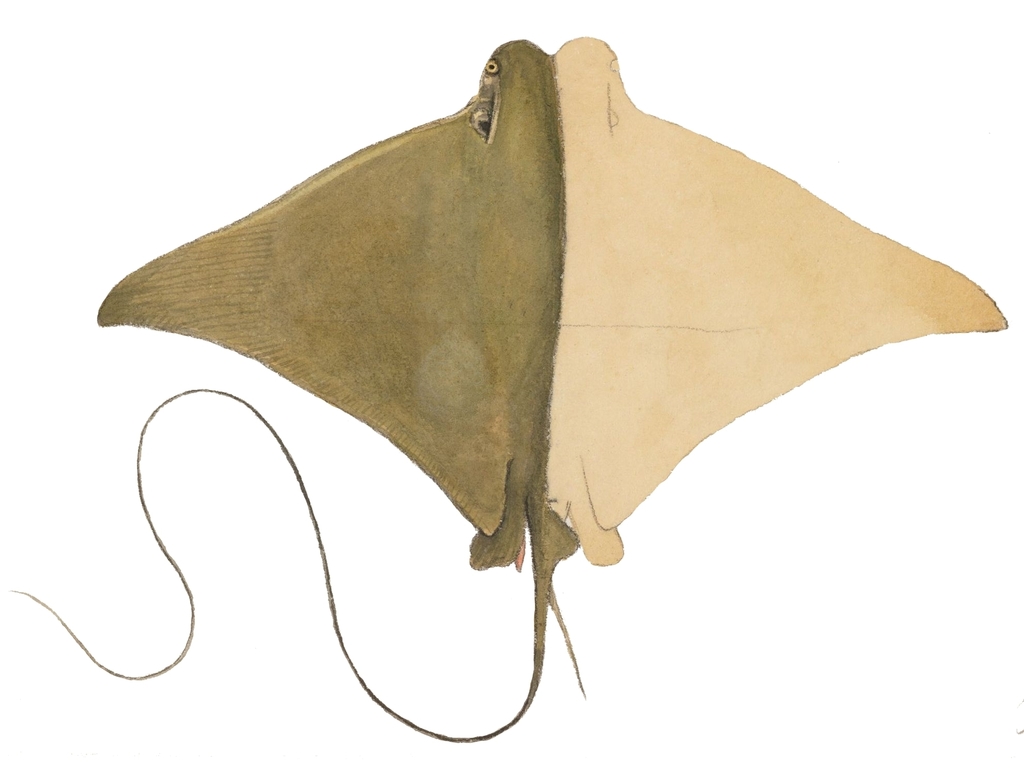
Brazilian Cownose Ray
Rhinoptera brasiliensis
The Brazilian cownose ray (Rhinoptera brasiliensis), also commonly called the Ticon cownose ray, is a species of fish in the family Rhinopteridae. Its range extends along the coast from the southern tip of Brazil to western Florida. Its natural habitats are shallow seas, estuarine waters, and intertidal flats.
From the article Brazilian cownose ray on Wikipedia (CC BY-SA), quoted section by section
Description
Males tend to range in size from 78 to 91 cm disc width (DW) with a brown back and white or light yellow belly. Females are larger, ranging from 77 to 102 cm DW with similar coloring. The Ticon cownose ray very closely resembles its cousin the cownose ray (Rhinoptera bonasus) in both size and coloring. So close is the similarity that the only way to differentiate the two is by the number of teeth. R. brasiliensis have a broader mouth allowing for three central rows of broad teeth as opposed to R. bonasus one central row.
Wikipedia: “Morphology”
What it does
The Brazilian cownose ray is ovoviviparous with the embryo developing in an egg kept within the female. The female only carries one embryo at a time. This low fecundity leads to a low species resiliency with a minimum population doubling time of 4.5 to 14 years.
== References ==
Wikipedia: “Reproduction”
Where it lives
Recorded sightings
—
geo-referenced records in GBIF, from museums, herbaria and field observers.
Drag the globe to turn it. Dots are where records exist, not a range map; darker means more records.
In the stacks
Searching the stacks…
Every page naming Rhinoptera brasiliensis in the Biodiversity Heritage Library →
This page is assembled live from iNaturalist, GBIF, Wikipedia, the Source Library and the Internet Archive. It is not yet part of the hand-edited codex. iNaturalist taxon 111723.