- Animals
- ›Molluscs
- ›Bivalves
- ›Autobranchia
- ›Heteroconchia
- ›Freshwater Mussels and Brooch Clams
- ›Freshwater Mussels
- ›Unionoidea
- ›River Mussels
- ›Ambleminae
- ›Quadrulini
- ›Quadrula
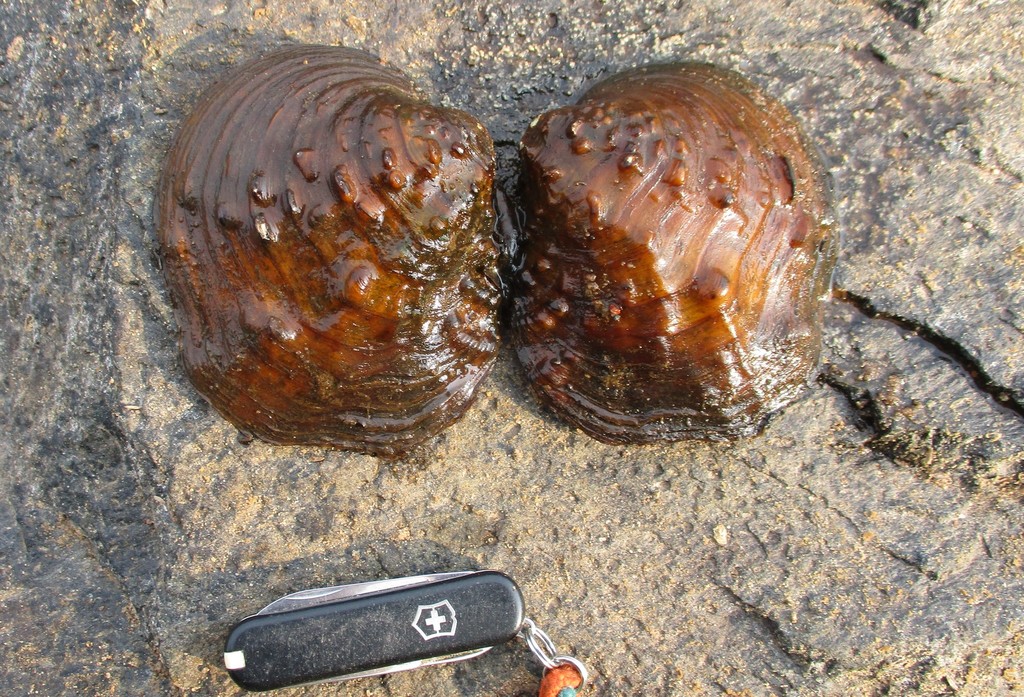
Winged Mapleleaf
Quadrula fragosa
The winged mapleleaf, also known as false mapleleaf, or hickory nut shell, and with the scientific name Quadrula fragosa, is a species of freshwater mussel. It is an aquatic bivalve mollusk in the family Unionidae, the river mussels. It is endemic to the United States.
Quadrula fragosa is only located in a few parts of Wisconsin, Minnesota, Arkansas, and Missouri — in the Midwestern United States. It is a federal critically endangered river mussel species.
From the article Winged mapleleaf on Wikipedia (CC BY-SA), quoted section by section
Description
The anterior end of the Quadrula fragosa shell is slightly rounded and the posterior end of the shell is more of a square shape. The shell can range in color from a yellowish-green to light or dark brown. The inside of the shell is white, and there is sometimes iridescent coloring at one end of the shell. The diameter of a mature mussel of this species is usually about 4 inches (10.2 cm). The shells of these mussels are very thick, and unlike many other mussels, there are bumps on the shell surface running down from the hinge of the shell to the outside edges. It is the patterns of these bumps that help to distinguish the winged mapleleaf from many other mussels that look very similar in appearance.
Range & habitat
The winged mapleleaf is found in medium to large streams and rivers. it can sometimes be found in the mud, but it is more commonly either found in gravel or sandy bottoms. The mussel does need to be in moving water in order to survive, the depth of this running water also needs to be somewhere between 0.4 and 2.0 meters. The water must be free of pollutants and clean.
Wikipedia: “Habitat”
What it does
The mussel filters out tiny food particles, either phytoplankton or zooplankton. The young winged mapleleafs attach themselves to the gills of a host fish for feeding and growing purposes until they reach the stage in their life cycle that they can themselves siphon in the water from the river of the stream that they are in.
Wikipedia: “Feeding”
Where it lives
Recorded sightings
—
geo-referenced records in GBIF, from museums, herbaria and field observers.
Drag the globe to turn it. Dots are where records exist, not a range map; darker means more records.
In the stacks
Searching the stacks…
Every page naming Quadrula fragosa in the Biodiversity Heritage Library →
This page is assembled live from iNaturalist, GBIF, Wikipedia, the Source Library and the Internet Archive. It is not yet part of the hand-edited codex. iNaturalist taxon 111459.