- Animals
- ›Chordates
- ›Vertebrates
- ›Cartilaginous Fishes
- ›Sharks and Rays
- ›Rays
- ›Shovelnose Rays
- ›Sawfishes
- ›Pristis
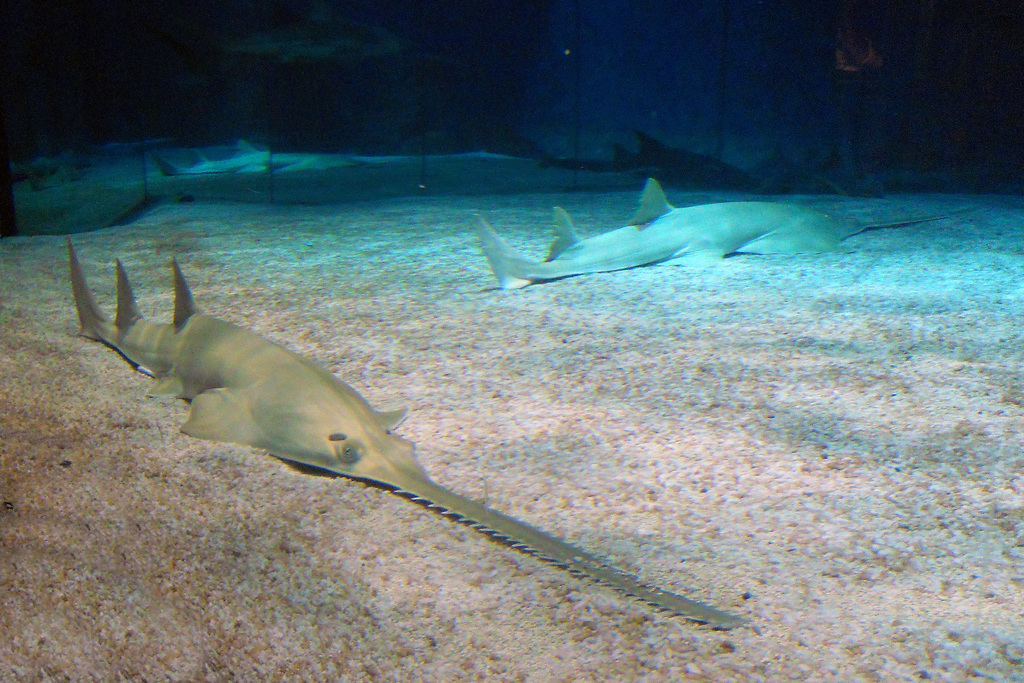
Green Sawfish
Pristis zijsron
The longcomb sawfish, narrowsnout sawfish or green sawfish (Pristis zijsron) is a species of sawfish in the family Pristidae, found in tropical and subtropical waters of the Indo-West Pacific. It has declined drastically and is now considered a critically endangered species.
From the article Longcomb sawfish on Wikipedia (CC BY-SA), quoted section by section
Description
The longcomb sawfish is possibly the largest species of sawfish, reaching a total length of up to 7.3 m (24 ft), but rarely more than 6 m (20 ft) today. Its upperparts are greenish-brown to olive, while the underparts are whitish. A combination of characters are necessary to distinguish it from the other sawfish species: the longcomb sawfish has teeth to near the base of the rostrum or "saw" (unlike the knifetooth sawfish, Anoxypristis cuspidata), 23–37 teeth on each side of the rostrum (18–24 in the dwarf sawfish, P. clavata, 20–32 in smalltooth sawfish, P. pectinata, and 14–24 in largetooth sawfish, P. pristis), the teeth towards the tip of the rostrum are clearly closer to each other than those at its base (unlike the dwarf, smalltooth and largetooth sawfish where either equally spaced or only marginally closer to each other towards the tip of the rostrum), a relatively narrow rostrum, width equalling 9–17% of its length (typically wider in dwarf and largetooth sawfish), a rostrum that is 23–33% of the total length of the fish (20–25% in dwarf sawfish), relatively short pectoral fins (unlike the knifetooth and largetooth sawfish), a leading edge of the dorsal fin that is located clearly behind the leading edge of the pelvic fins (in front of in largetooth sawfish and roughly above in smalltooth sawfish) and it has a very small or no lower tail lobe (present in knifetooth and …
Range & habitat
The longcomb sawfish is native to tropical and subtropical waters in the western and central Indo-Pacific. Historically its distribution covered almost 5,900,000 km2 (2,300,000 mi2) and it ranged from South Africa, north to the Red Sea and Persian Gulf, east to the South China Sea, through Southeast Asia to Australia. In Australia, it ranged from Shark Bay, along the northern part of the country, and south to Jervis Bay on the eastern coast. Today it has disappeared from much of its historical range. It can live in colder waters than its relatives, as also evidenced by the range in Australia where it occurs further south than the other species of sawfish. The longcomb sawfish is mainly found in coastal marine, mangrove and estuarine habitats, even in very shallow waters, but can also occur far offshore to a depth of more than 70 m (230 ft). There are records from rivers far inland, but it is not frequent in freshwater. It is mainly found in places with a bottom consisting of sand, mud or silt.
Wikipedia: “Distribution and habitat”
What it does
The longcomb sawfish feeds on fish, crustaceans and molluscs. It thrashes its rostrum from side-to-side to dislodge prey from the seabed and to stun groups of fish. All sawfish are harmless to humans, except when captured where they can cause serious injuries when defending themselves with their "saw". Little is known of its life cycle, but it is ovoviviparous and the young are 60–108 cm (24–43 in) long at birth. It is often said that there are about 12 young in each litter, but the basis for this number is unclear (in other sawfish species litter size ranges from 1 to 20). The females give birth in inshore areas, and the young stay near the coast and in estuaries in the first part of their lives. Sexual maturity is reached at an age of about 9 years, and a length of 3.4–3.8 m (11–12 ft). The maximum age is unknown, but it might be in excess of 50 years, and an individual caught as a juvenile lived for 35 years at an aquarium.
Wikipedia: “Behavior and life cycle”
Where it lives
Recorded sightings
—
geo-referenced records in GBIF, from museums, herbaria and field observers.
Drag the globe to turn it. Dots are where records exist, not a range map; darker means more records.
In the stacks
Searching the stacks…
Every page naming Pristis zijsron in the Biodiversity Heritage Library →
This page is assembled live from iNaturalist, GBIF, Wikipedia, the Source Library and the Internet Archive. It is not yet part of the hand-edited codex. iNaturalist taxon 110382.