- Animals
- ›Chordates
- ›Vertebrates
- ›Cartilaginous Fishes
- ›Sharks and Rays
- ›Sharks
- ›Squalean Sharks
- ›Saw Sharks
- ›Saw Sharks
- ›Pristiophorus
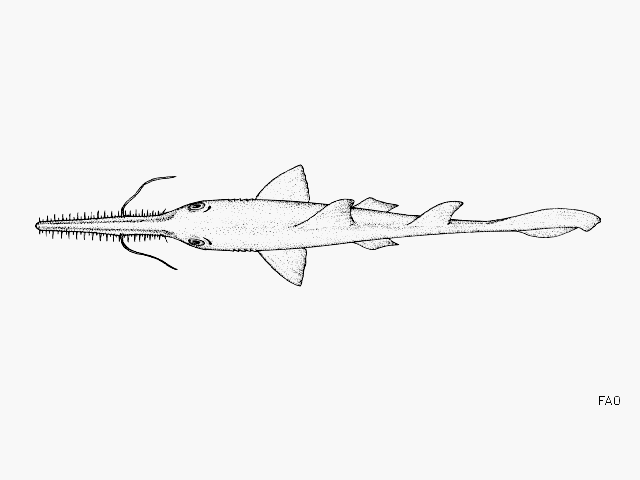
Bahamas Sawshark
Pristiophorus schroederi
The Bahamas sawshark, Pristiophorus schroederi, is a sawshark of the family Pristiophoridae, found in the western Central Atlantic Ocean from the Bahamas and Cuba at depths of between 400 and 1,000 m. These sharks are at least 80 cm long.
The Bahamas sawshark is found on continental and insular slopes. Its reproduction is ovoviviparous.
From the article Bahamas sawshark on Wikipedia (CC BY-SA), quoted section by section
Description
Sharks in the sawshark family (Pristiophoridae) are similar to the sawfish (family Pristidae) in their saw-like snout, but are smaller and have the basic structural plan of sharks rather than rays. Distinguishing features include a slight compression of their body and strong flattening of their head, and they tend to reach maturity at around one meter.
Head. Pristiophorus schroederi has a flattened head, which is typical of this family. It has five gill slits, almost all equal in length. The fifth gill slit crosses the insertion of the pectoral fin and extends about equal distance above and below it. It has a thin saw-like snout, less than one third of the total length of body. The snout has a row of unserrated spines along the sides and two rows of shorter thornlike spines on the underside near the sides all the way from the tip to the nasal openings. Nostrils are oval and surrounded by a narrow raised rim. The spines are very slightly curved and alternate long (5 to 7 mm) and short (2 to 3 mm), 47 or 48 spines on either side of the snout. There is a pair of barbels located on either side of the snout. The mouth itself is slightly arched. The upper jaw teeth are in 36 rows and the bottom jaw teeth are shaped similarly but in 32 rows. P. nudipinnis is within the same range as P. schroederi. …
Wikipedia: “Anatomy”
What it does
Despite the menacing appearance of this sawshark, it tends to feed primarily on fish and crustaceans like other species of its kind. They feed primarily on the seafloor. Although most shark species tend to spend most of their time solitary, sawsharks are known to form schools.
Wikipedia: “Behavior”
Where it lives
Recorded sightings
—
geo-referenced records in GBIF, from museums, herbaria and field observers.
Drag the globe to turn it. Dots are where records exist, not a range map; darker means more records.
In the stacks
Searching the stacks…
Every page naming Pristiophorus schroederi in the Biodiversity Heritage Library →
This page is assembled live from iNaturalist, GBIF, Wikipedia, the Source Library and the Internet Archive. It is not yet part of the hand-edited codex. iNaturalist taxon 110376.