- Animals
- ›Chordates
- ›Vertebrates
- ›Cartilaginous Fishes
- ›Sharks and Rays
- ›Sharks
- ›Squalean Sharks
- ›Saw Sharks
- ›Saw Sharks
- ›Pristiophorus
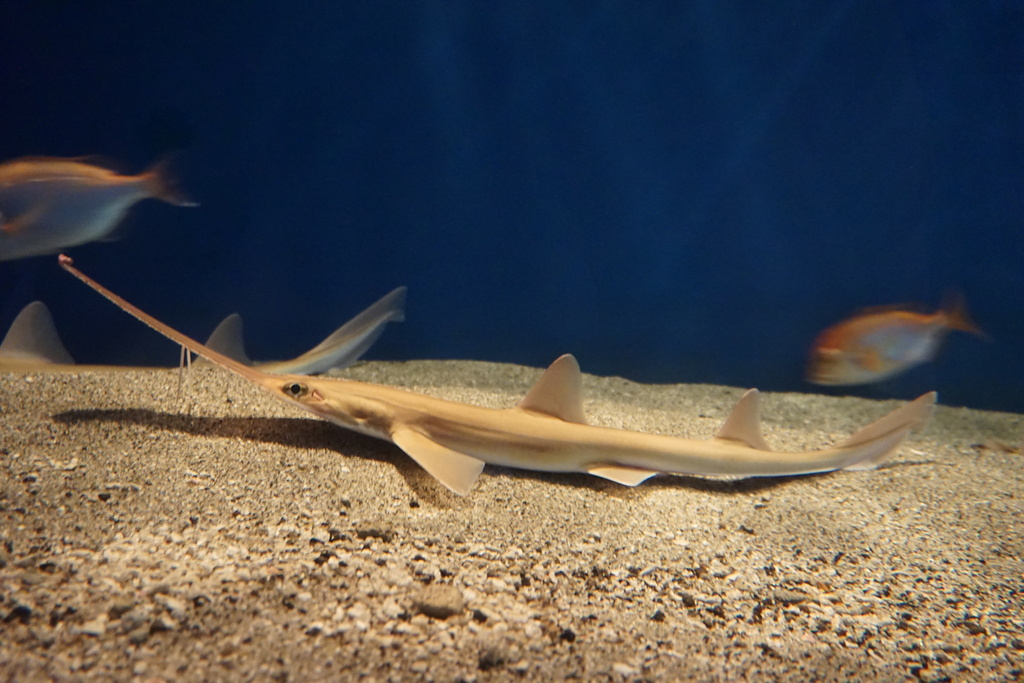
Japanese Sawshark
Pristiophorus japonicus
The Japanese sawshark (Pristiophorus japonicus) is a species of sawshark in the family Pristiophoridae. This shark has a long, narrow rostrum. Its first dorsal fin originates behind the tips of the pectoral fins, and its caudal fin is angled almost straight in line with the body. The Japanese sawshark reaches an maximum length of up to 1.36 m (4 ft 6 in).
From the article Japanese sawshark on Wikipedia (CC BY-SA), quoted section by section
Range & habitat
Found in the northwest Pacific Ocean around Japan, Korea, Taiwan, and northern China between latitudes 48°N and 22°N. It is found over the sandy or muddy bottoms of the continental shelf at depths of 50 to 800 m (160 to 2,620 ft). This species may vertically migrate in the water column because of changes in temperature.
Wikipedia: “Range and habitat”
What it does
The Japanese sawshark has a varied diet of small benthic organisms. Like seemingly all sawsharks, this species is ovoviviparous. After an unknown gestation period, the female shark gives live birth to around 12 pups. These pups average around 30 cm (12 in) long. At sexual maturity the male is 80 to 100 cm (31 to 39 in) long, and the female is around 100 cm (39 in) long.
Wikipedia: “Behavior”
Where it lives
Recorded sightings
—
geo-referenced records in GBIF, from museums, herbaria and field observers.
Drag the globe to turn it. Dots are where records exist, not a range map; darker means more records.
In the stacks
Searching the stacks…
Every page naming Pristiophorus japonicus in the Biodiversity Heritage Library →
This page is assembled live from iNaturalist, GBIF, Wikipedia, the Source Library and the Internet Archive. It is not yet part of the hand-edited codex. iNaturalist taxon 110374.