- Plants
- ›Vascular Plants
- ›flowering plants
- ›Dicots
- ›nightshades, bindweeds, gooseweeds, and allies
- ›bindweed family
- ›Bindweeds, Morning-glories and Allies
- ›Ipomoeeae
- ›Ipomoea
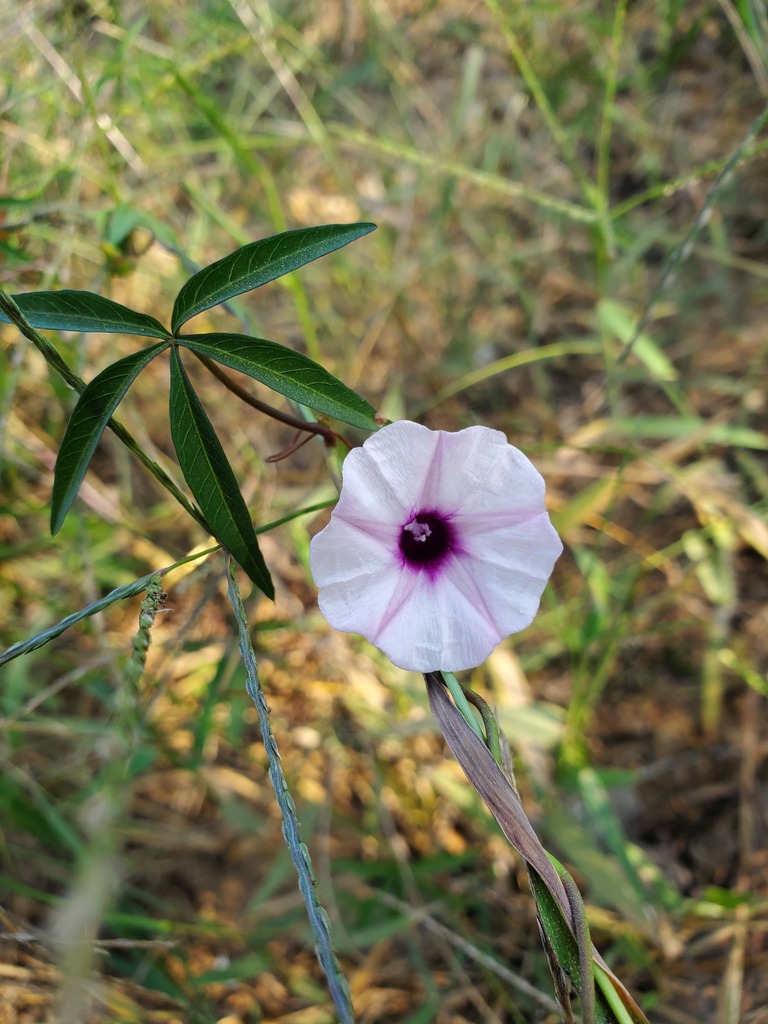
Wright's Morning-glory
Ipomoea heptaphylla
Ipomoea heptaphylla, sometimes known as Wright's morning glory in the United States, is a species of morning glory. It is incorrectly classified as I. wrightii in American publications, but is incorrectly known as I. tenuipes in Africa and India. It is an annual or short-lived perennial vine which climbs using twining stems, and has pink or purple flowers. The leaf shape is somewhat variable, with individuals possessing compound leaves palmately divided into five leaflets, and lanceolate-leaved individuals occurring in neighbouring populations. The name heptaphylla actually means 'seven-leaved'. This plant has a very extensive distribution, from Texas and adjacent states in the southeastern USA to Misiones in northern Argentina, the Greater Antilles of the Caribbean, India, Sri Lanka and East and Southern Africa. Despite its wide distribution it is uncommon throughout its range. The rediscovery of the presence of the species in India after an absence of over half a century was published in 2014. The species appears to favour dry subtropical to tropical habitats.
From the article Ipomoea heptaphylla on Wikipedia (CC BY-SA), quoted section by section
Description
It is an annual or short-lived perennial vine. Besides being able to climb using thin stems which wind around the stems of other plants, the leaf petioles and flower peduncles of this species are also able to twist around supporting objects. There are some rough points on the stem and some hairs within the corolla, but otherwise the plant is completely glabruos. The flowers are coloured pink or purple. The leaf shape is somewhat variable, with individuals usually possessing compound leaves palmately divided into five leaflets, but with lanceolate-leaved individuals occurring in neighbouring populations. The name heptaphylla actually means 'seven-leaved'. When palmate the leaflets are all approximately the same size, with the entire leaf being roughly round in dimensions. It is quite similar to Ipomoea cairica, which occurs throughout much of its range, having similar leaves, flowers and twining petioles, but this is a less robust plant with smaller flowers and much longer peduncles. Furthermore, in I. cairica the flower petals are rounded at their ends as opposed to slightly pointed, and the leaves are somewhat longer than they are broad.
Range & habitat
Aside from the first references to this species from Brazil, India and Cuba, other early collections of this species are from Jamaica, Paraguay, Tanzania, Sri Lanka, northernmost Mexico, Texas and Arkansas. Likely the first specimens in India, and indeed the world, were collected near Chennai, then known as Madras, in Marmelon, now Mambalam-Saidapet, in the 'Nopalry', the Opuntia gardens, of the Scottish physician and keen gardener James Anderson, who was (quite unsuccessfully) attempting to develop cochineal farming in India at this location. Herbarium specimens taken from these gardens made their way to Germany, where they were used as the type to base the taxon on in 1803. Another early collection from the geographical area was in Sri Lanka, from which seeds were sent to a lady gardener in England in the 1840s, which were then grown into plants featured in Curtis's Botanical Magazine (under the name Ipomoea pulchella, and dubbed with the vernacular name 'handsome bindweed' for this work). In 2014 it was recollected in India in Aurangabad district, Maharashtra, after not having been identified in the country for 53 years. In Africa it is known to grow in Angola, Mozambique, Namibia, South Africa (the former Transvaal Province), Sudan (information from before succession), Tanzania (continental), Zambia (Luangwa), and Zimbabwe. …
Wikipedia: “Distribution”
At the table
Seed of this species has sometimes been offered for sale in commercial horticultural catalogues. It was first cultivated in Britain in 1827.
== References ==
Wikipedia: “Uses”
Where it lives
Recorded sightings
—
geo-referenced records in GBIF, from museums, herbaria and field observers.
Drag the globe to turn it. Dots are where records exist, not a range map; darker means more records.
In the stacks
Searching the stacks…
Every page naming Ipomoea heptaphylla in the Biodiversity Heritage Library →
This page is assembled live from iNaturalist, GBIF, Wikipedia, the Source Library and the Internet Archive. It is not yet part of the hand-edited codex. iNaturalist taxon 1097993.