- Plants
- ›Vascular Plants
- ›flowering plants
- ›Dicots
- ›Guinea-flowers and allies
- ›Guinea-flower family
- ›Hibbertia
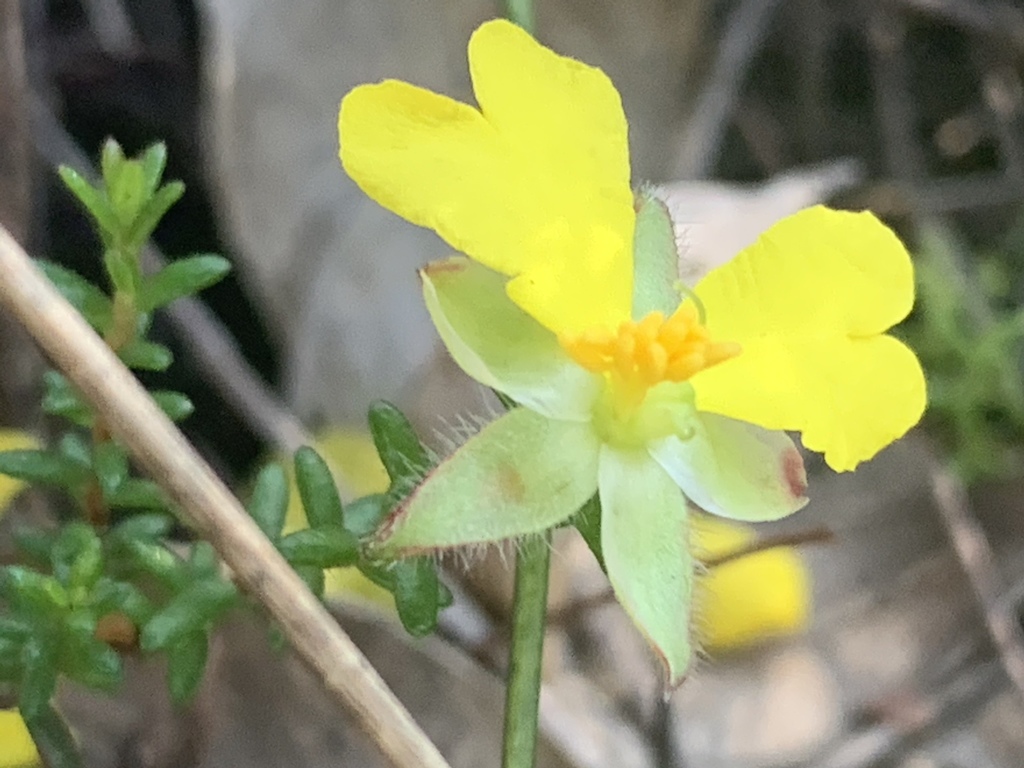
Hibbertia puberula
Hibbertia puberula is a species of flowering plant in the family Dilleniaceae and is endemic to New South Wales. It is a small shrub with softly-hairy foliage, narrow egg-shaped to almost linear leaves, and yellow flowers usually arranged on singly short side shoots with ten to fourteen stamens on one side of two carpels.
From the article Hibbertia puberula on Wikipedia (CC BY-SA), quoted section by section
Description
Hibbertia puberula is a small shrub with a few wiry branches up to 30 cm (12 in) long and with softly-hairy foliage. The leaves are narrow egg-shaped to almost linear, mostly 3.0–5.5 mm (0.12–0.22 in) long, 0.8–1.4 mm (0.031–0.055 in) wide on a petiole 0.2–0.5 mm (0.0079–0.0197 in) long and with the edges rolled under. The flowers are usually arranged singly on the ends of short side-shoot with leaf-like bracts mostly 3.0–3.5 mm (0.12–0.14 in) long at the base. The five sepals are joined at the base, the outer sepal lobes egg-shaped and more or less beaked with the edges rolled under near the tip, 6–10 mm (0.24–0.39 in) long, the inner sepal lobes mostly 5–7 mm (0.20–0.28 in) long. The five petals are yellow, egg-shaped with the narrower end towards the base, 6–8 mm (0.24–0.31 in) long and there are ten to fourteen stamens fused together at the base on one side of the two carpels, each carpel with four to six ovules. Flowering mainly occurs from October to November.
Range & habitat
This hibbertia grows in sandy soil over sandstone in the Sydney basin. Subspecies extensa mostly grows on rock shelves near the upper Georges River and on the Central Coast, subspecies glabrescens is only known from near Bankstown Airport and subspecies puberula grows in a range of habitats near Sydney and in Morton National Park.
Wikipedia: “Distribution and habitat”
Where it lives
Recorded sightings
—
geo-referenced records in GBIF, from museums, herbaria and field observers.
Drag the globe to turn it. Dots are where records exist, not a range map; darker means more records.
In the stacks
Searching the stacks…
Every page naming Hibbertia puberula in the Biodiversity Heritage Library →
This page is assembled live from iNaturalist, GBIF, Wikipedia, the Source Library and the Internet Archive. It is not yet part of the hand-edited codex. iNaturalist taxon 1084882.