- Animals
- ›Chordates
- ›Vertebrates
- ›Cartilaginous Fishes
- ›Sharks and Rays
- ›Sharks
- ›Squalean Sharks
- ›Squaliform Sharks
- ›Rough Sharks
- ›Oxynotus
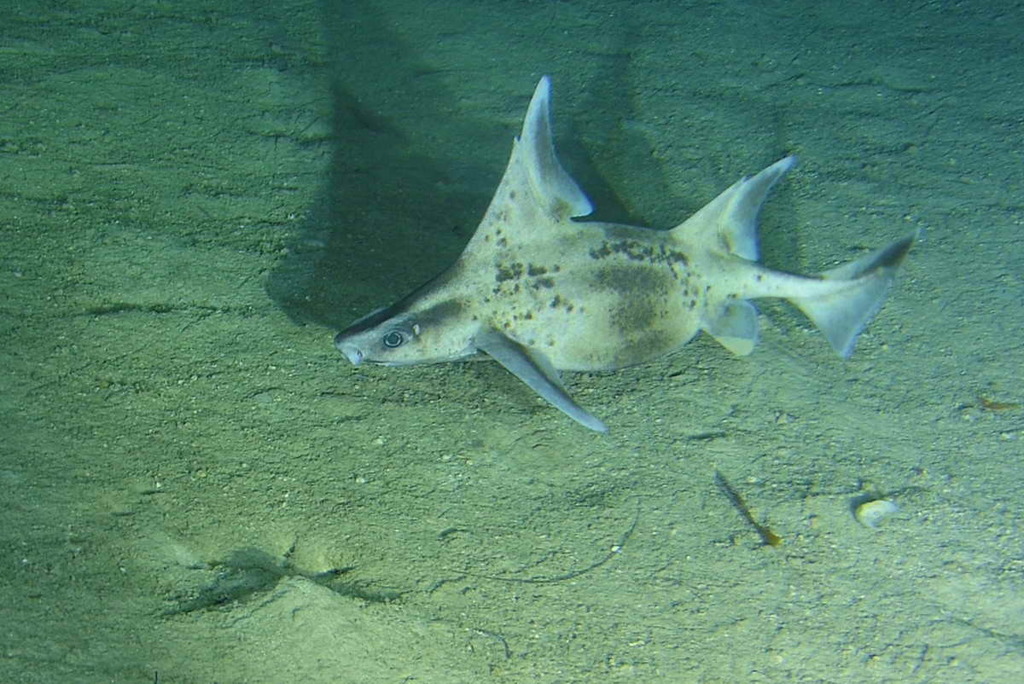
Caribbean Roughshark
Oxynotus caribbaeus
The Caribbean roughshark (Oxynotus caribbaeus) is a rough shark of the family Oxynotidae, found on the upper continental slopes of the Caribbean Sea, at depths between 400 and 450 m (1,310 and 1,480 ft). It reaches a length around 50 cm (20 in).
Oxynotus caribbaeus is thought to be a slow-moving predator of small benthic organisms. Not much is known about the lifecycle of this species, but it is being observed in its natural environment lately. This species is an uncommon bycatch of bottom trawls.
From the article Caribbean roughshark on Wikipedia (CC BY-SA), quoted section by section
Description
Oxynotus caribbaeus is a small shark found in the upper continental slope of Venezuela; it is easily distinguishable from other Oxynotus species. Adult males reach a maximum size of 50 cm (1.6 ft) in length and the females are thought to grow even longer, although none has been examined. The Caribbean roughshark has a short, blunt snout and head. This chubby-looking shark looks nothing like the typical shark. It has two dorsal fins that help differentiate this shark from other Oxynotus species. Its first dorsal fin is inclined forward, is very long and thick, and triangular in shape. The second dorsal fin is similar to the first, although it is not as long. However, as some other Oxynotus species, the Caribbean roughshark does not have an anal fin. It has the typical shark coarse dermal denticles, but these are atypically large for the size of the shark. It contains small, circular spiracles at the dorsal base of its head. The supraorbital ridges are not expanded and do not form a knob in front of the spiracles. It has lanceolate upper teeth, containing 12 rows and lower bladelike teeth containing 12 rows. It has distinct color features that make it easily identifiable. On the head, body, and tail, it has light, greyish skin, patterned with dark bands and blotches, although it contains noticeably lighter color patterns on its pectoral fins and pelvic fins.
Range & habitat
Oxynotus caribbeaus is found in the western Atlantic Ocean, also near the bottom of the Gulf of Mexico and the Caribbean Sea. However, sightings of the Caribbean roughshark have happened in the waters off of the Bahamas, Honduras, and Venezuela. It occupies water at a range of 400 and 450 m (1,310 and 1,480 ft). At that range, the water temperature is at about 10 °C. This means it has a bathydemersal habitat or is a demersal fish.
Wikipedia: “Geographical habitat and ecology”
What it does
Little is known about this shark, but due to its unusual dentition, the spear-shaped upper teeth and blade-like lower teeth, it feeds on invertebrates and fishes found near the bottom of their habitat.
Wikipedia: “Diet”
Where it lives
Recorded sightings
—
geo-referenced records in GBIF, from museums, herbaria and field observers.
Drag the globe to turn it. Dots are where records exist, not a range map; darker means more records.
In the stacks
Searching the stacks…
Every page naming Oxynotus caribbaeus in the Biodiversity Heritage Library →
This page is assembled live from iNaturalist, GBIF, Wikipedia, the Source Library and the Internet Archive. It is not yet part of the hand-edited codex. iNaturalist taxon 108111.