- Animals
- ›Chordates
- ›Vertebrates
- ›Cartilaginous Fishes
- ›Sharks and Rays
- ›Rays
- ›Stingrays
- ›Eagle Rays
- ›Myliobatis
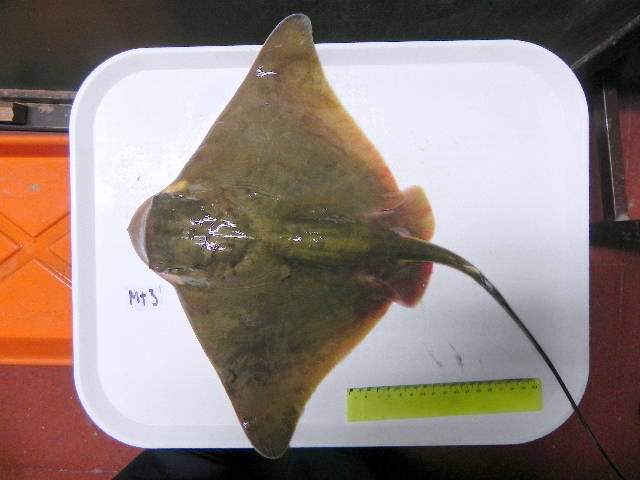
Southern Eagle Ray
Myliobatis goodei
The southern eagle ray (Myliobatis goodei), sometimes known as the southern eagle fish or the rockfish, is a ray species in the family Myliobatidae. It lives in waters just off of the Atlantic coast, from the tip of Florida down to Argentina, inhabiting estuaries or bays to give birth during spring and summer and migrating to the open sea in autumn and winter. It has an average width of 99 centimeters, and a length of 60 centimeters. It is often confused with the bullnose ray, a related species in the genus Myliobatis, due to the two species' similarities in appearance.
From the article Southern eagle ray on Wikipedia (CC BY-SA), quoted section by section
Description
The southern eagle ray's average length is 80 cm (31.5 in), but some specimens have reached up to 125 cm (49 in). The species is somewhat wider than it is long, with its disc being an average of 99 cm (39 in) wide. It does not have spines on its disc. The southern eagle ray usually has a dark brown colored upper side, while most of its underside is a light shade of brown or white, with the outer edges often being darker.
Comparison with the bullnose ray. The southern eagle ray's appearance is similar to that of the bullnose ray, causing the two to often be confused. The following table shows the similarities and differences between the two related species:
Range & habitat
The southern eagle ray lives on various parts of the Atlantic coast. Sightings have been reported from the coast of Southern Mexico all the way down to Argentina, as well as on the coast of Florida. The specific countries that the Southern eagle ray is native to are Argentina, Belize, Brazil, Colombia, Costa Rica, French Guiana, Guyana, Honduras, Mexico, Nicaragua, Panama, Suriname, United States, Uruguay, and Venezuela. A sighting was also reported in the island of Maldives in August 2012, and then three more were reported in Australia. The southern eagle ray lives in shallow waters, mostly under 100 meters, but it can live in depths of up to 200 meters. This is a significant contrast from the bullnose ray, which most commonly lives in depths of no more than 10 meters. It is benthopelagic, feeding in and inhabiting the areas just above the ocean floor, typically in brackish water. It prefers waters with a soft seabed, composed of elements such as mud, sand, or sea grass.
Wikipedia: “Distribution and habitat”
What it does
The southern eagle ray is a carnivore, mostly feeding on small invertebrates, such as shrimp, crabs, and gastropods. The southern eagle ray migrates seasonally. Adults inhabit the open sea during the autumn and winter, and return to their home location, which is usually an estuary or a bay, in the spring and summer, to give birth. The young that are born in summer usually wait until the end of the next summer before they migrate into the open waters, while those who are born in spring do this after the first summer passes. They then return to their home location again in the spring and summer to give birth themselves. Little else is known about the ecology and reproduction of the southern eagle ray.
Wikipedia: “Behavior”
Where it lives
Recorded sightings
—
geo-referenced records in GBIF, from museums, herbaria and field observers.
Drag the globe to turn it. Dots are where records exist, not a range map; darker means more records.
In the stacks
Searching the stacks…
Every page naming Myliobatis goodei in the Biodiversity Heritage Library →
This page is assembled live from iNaturalist, GBIF, Wikipedia, the Source Library and the Internet Archive. It is not yet part of the hand-edited codex. iNaturalist taxon 106323.