- Animals
- ›Molluscs
- ›Bivalves
- ›Autobranchia
- ›Heteroconchia
- ›Freshwater Mussels and Brooch Clams
- ›Freshwater Mussels
- ›Unionoidea
- ›River Mussels
- ›Unioninae
- ›Anodontini
- ›Lasmigona
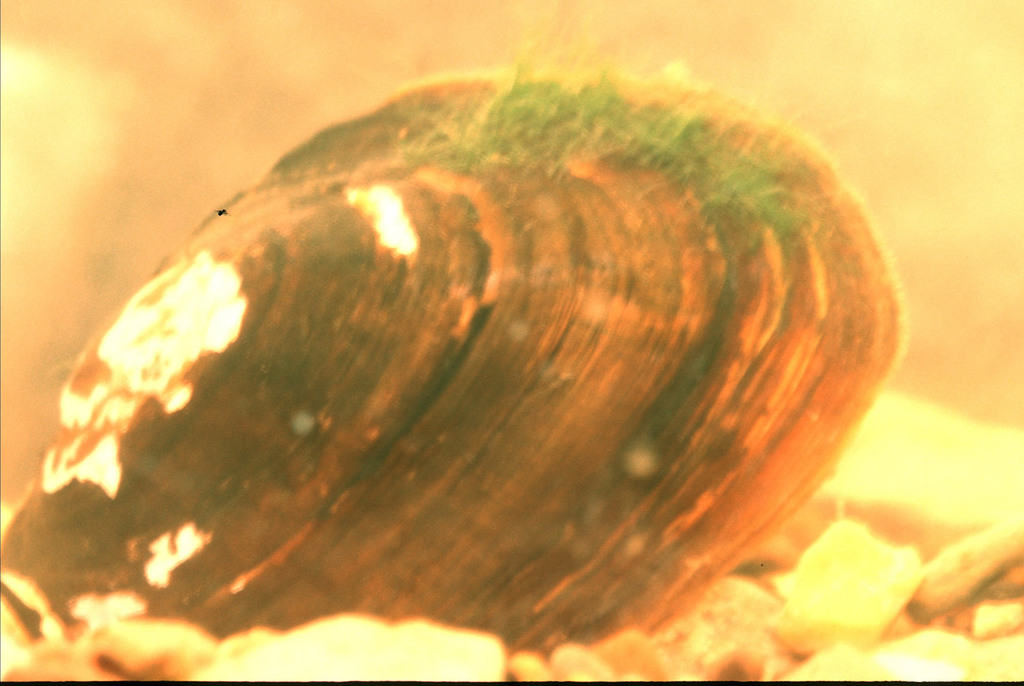
Carolina Heelsplitter
Lasmigona decorata
The Carolina heelsplitter (Lasmigona decorata) is a species of freshwater mussel, an aquatic bivalve mollusk in the family Unionidae.
It is named the "Carolina heelsplitter" because the sharp edge of the valves protrudes from the substrate and could cut the foot of someone walking on the river or stream bed. This species is endemic to the United States and is found in only North Carolina and South Carolina.
From the article Carolina heelsplitter on Wikipedia (CC BY-SA), quoted section by section
Description
The first recorded encounter with the Carolina heelsplitter was in 1852 by Isaac Lea. He described this new creature as Unio decoratus. The largest recorded specimen was about 5 in (130 mm) long. This freshwater mussel has a greenish-brown to dark brown outer shell; the inner shell usually has nacre that is pearly white or bluish-white, although it can be pale orange in older specimens. The younger individuals tend to have faint black or greenish-brown rays on the outer surface of the shell. This medium-sized mussel has well-developed, but thin, lateral teeth that are somewhat delicate. The Carolina heelsplitter also has two blade-like pseudocardinal teeth in the left valve, and one in the right valve. With an "ovate, trapezoid-shaped, unsculptured shell", the size of the largest Carolina heelsplitter is about 4.6 inches (12 cm) in length and 1.56 inches (4.0 cm) in width, with a thickness of 2.7 inches (6.9 cm).
Range & habitat
The Carolina heelsplitter lives in shallow streams and rivers, and occasionally, ponds. They can usually be found in mud or mixed sediments, usually along stable stream banks, but have also been found in the middle of a waterway. The water must not carry much sediment. Historically, the Carolina heelsplitter was known to be found in the Catawba River and Pee Dee River systems in North Carolina, and the Pee Dee and Savannah River systems of South Carolina. These mussels historically lived possibly in the Saluda River systems in South Carolina. Currently, 10 known populations (prior to the 2007–2008 drought) occur in North and South Carolina. The areas include Goose Creek and Flat Creek in the Pee Dee River system, Waxhaw Creek, Sixmile Creek, Gills Creek, Fishing Creek, and Bull Run Creek in the Catawba River system, and Red Bank Creek, Turkey Creek, and Cuffytown Creek in the Saluda River system. The numbers of individuals in every population is very small:
One to 17 individuals were found in eight of the known populations, with only one to five individuals being found in four of these eight populations. In only one population, 26 individuals were found The largest population included only 42 individuals. The numbers that the surveyors found also indicate that the species is in decline, and also that none of the populations has improved over time. …
Wikipedia: “Location and distribution”
What it does
The reproductive cycle begins when a male Carolina heelsplitter releases his sperm into the stream. Soon afterward, the sperm is taken in by the females, in a process called siphoning. The female's eggs, which are carried in the female's gills, are then fertilized. The Carolina heelsplitter is a bradytichtic species, brooding fertilized eggs over the winter after spawning. When the glochidia (larvae) are fully developed the next year, the female mussel releases them into the water. The larvae must attach themselves quickly to a body part of their host fish, which is not harmed in the process. Host species for this mussel include members of the Cyprinidae. Attached to the fish, the heelsplitters receive oxygen and other needs from the host for several weeks. When they have grown into fully developed juvenile mussels, they release themselves from the fish and settle into the stream or river. A fish host is very important to all mussels, not only because it provides the young with food and oxygen, but also because it serves as a mode of transportation. The transportation of the mussels is key when attempting to create new populations in streams and river banks. Thus, this creature can seed the fresh waters and have more larvae.
Wikipedia: “Reproduction”
Toxicity
This species was determined to be endangered on June 30, 1993. The reasons stated were: Present or threatened destruction, modification, or curtailment of its habitat or range, over-utilization for commercial, recreational, scientific, or educational purposes, disease or predation, the inadequacy of existing regulatory mechanisms, and other natural or manmade factors affecting its continued existence. A review of the species and how it has been recovering has since been conducted, dated July 28, 2006. The original recovery plan for the species was written by John A. Fridell and recognized in January 1997. The major points were using government regulations to protect the species, creating educational opportunities, continuing to search for new populations, establishing six viable populations, and alleviating major threats to the species, with the final objective being to get the species delisted. When the recovery plan was written, only four populations of Lasmigona decorata were known. The original report stated that the populations appeared to have extremely restricted distribution and that much of the habitat in the species historic range (Catawba, Pee Dee, Saluda, and Savannah River systems) is now unsuitable for the reintroduction of the species. …
Wikipedia: “Endangered Species Act and recovery plan”
Where it lives
Recorded sightings
—
geo-referenced records in GBIF, from museums, herbaria and field observers.
Drag the globe to turn it. Dots are where records exist, not a range map; darker means more records.
In the stacks
Searching the stacks…
Every page naming Lasmigona decorata in the Biodiversity Heritage Library →
This page is assembled live from iNaturalist, GBIF, Wikipedia, the Source Library and the Internet Archive. It is not yet part of the hand-edited codex. iNaturalist taxon 104092.