- Animals
- ›Molluscs
- ›Bivalves
- ›Autobranchia
- ›Heteroconchia
- ›Freshwater Mussels and Brooch Clams
- ›Freshwater Mussels
- ›Unionoidea
- ›River Mussels
- ›Ambleminae
- ›Lampsilini
- ›Lampsilis
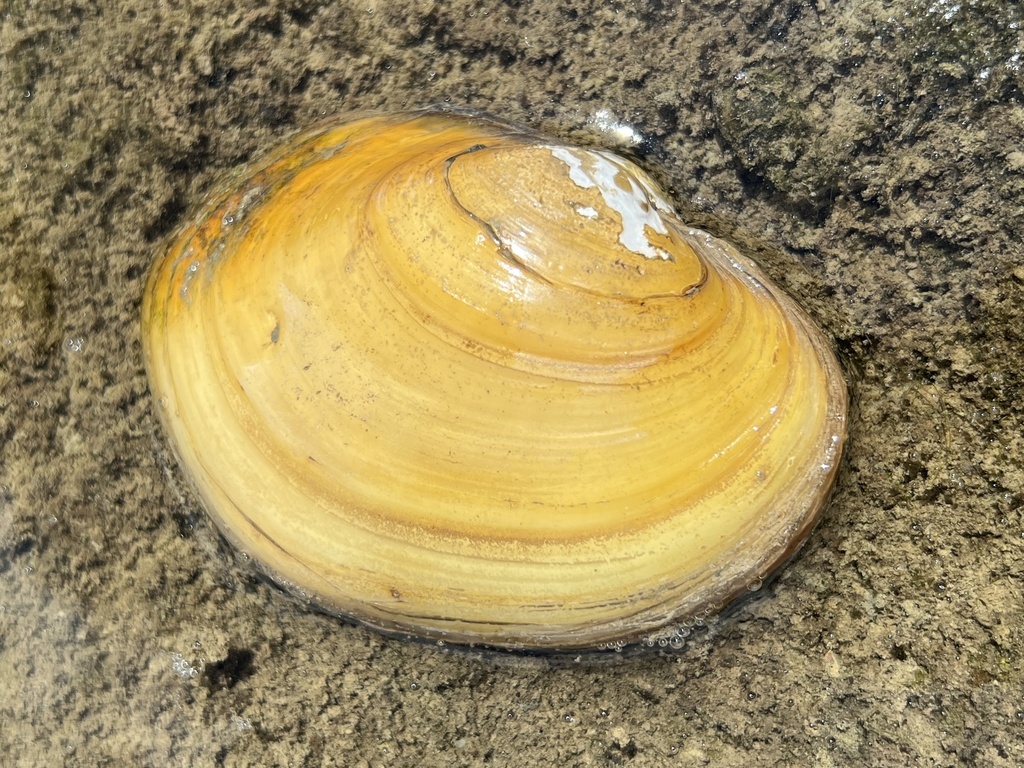
Yellow Lampmussel
Lampsilis cariosa
Lampsilis cariosa, the Yellow Lampmussel, is a species of freshwater mussel, an aquatic bivalve mollusk in the family Unionidae, the river mussels. The Yellow Lampmussel can be found in rivers and lakes in the eastern United States and Canadian maritime provinces (the "Atlantic Slope"). Bivalves are essential organisms in both aquatic and marine ecosystems, acting as natural water filters. A single freshwater bivalve can filter 0.5 to 1.25 gallons of water and hour.
From the article Lampsilis cariosa on Wikipedia (CC BY-SA), quoted section by section
Description
Adults can grow to 75-155 mm (approx. 3-4 inches). They display sexual dimorphism; adult females have a rounder posterior margin while adult males are more elongated (comin. The shells are glossy, yellow to reddish-brown, and have greenish colored growth rings. L. cariosa can be mistaken for other Unionidae like Atlanticoncha ochracea and Lampsilis cardium. Furthermore, L. cariosa and L. cardium are thought to be hydrizing in regions of co-occurrence such as the Potomac drainage.
Range & habitat
This species is currently believed to occupy 124 Hydrologic Unit Code 8 watersheds in Canada and the United States. It is commonly found in large rivers, but can also be found in lakes and ponds in its northern range like Maine and Nova Scotia.
Wikipedia: “Distribution and habitat”
What it does
L. cariosa and other Lampsilis sp. utilize a parasitic reproductive strategy. Lampsilis sp. display a mantle-flap that resembles a small bait fish that attracts larger predatory fish. These fish bite down on the lure (thereby the mussel gills), which then releases the glochidia and they embed themselves into the fish's gills. They remain on the fish, feeding on their blood, until they detach after 14-55 days as juvenile mussels.
Wikipedia: “Reproduction”
Where it lives
Recorded sightings
—
geo-referenced records in GBIF, from museums, herbaria and field observers.
Drag the globe to turn it. Dots are where records exist, not a range map; darker means more records.
In the stacks
Searching the stacks…
Every page naming Lampsilis cariosa in the Biodiversity Heritage Library →
This page is assembled live from iNaturalist, GBIF, Wikipedia, the Source Library and the Internet Archive. It is not yet part of the hand-edited codex. iNaturalist taxon 104028.