- Plants
- ›Vascular Plants
- ›flowering plants
- ›Dicots
- ›proteas, lotuses, planes, and allies
- ›Protea family
- ›Singlet Proteas
- ›Nutseed Proteoid Clade
- ›Adenanthinae
- ›Adenanthos
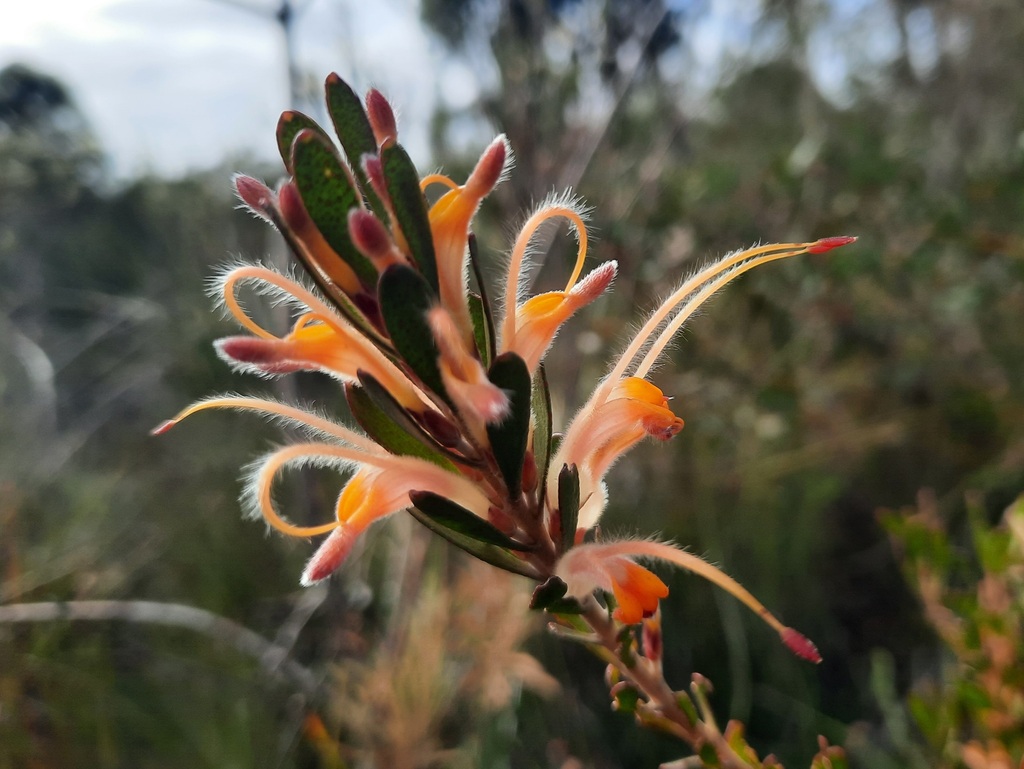
Adenanthos × pamelus
Adenanthos × pamela is a naturally occurring hybrid of A. detmoldii and A. obovatus in Western Australia.
A bushy shrub intermediate between its parents in habit, leaf shape and flower colour, it is known only from road verges in the Scott River area, where its parent species co-occur. Despite its hybrid origin, it is fertile.
From the article Adenanthos × pamela on Wikipedia (CC BY-SA), quoted section by section
Description
Morphologically, A. × pamela is intermediate between its two parent species. It grows as a bushy shrub about 1.5 m (5 ft) in height, roughly twice the height of the compact A. obovata, but shorter than the tall, lanky A. detmoldii. Leaf shape is also intermediate between the short obovate leaves of A. obovata, and the longer lanceolate leaves of A. detmoldii; and flowers are orange or light red, again intermediate between the yellow to orange of A. detmoldii and the scarlet of A obovata. Like A. obovata, A. × pamela possesses a lignotuber.
Range & habitat
Adenanthos × pamela is restricted to the Scott River areas, where the parent species co-occur, and has only been found growing with both parents. It is known only from about twenty scattered individuals growing on road verges, particularly Governor Broome Road, east of Scott River National Park.
Wikipedia: “Distribution and habitat”
How it is grown
Nelson describes Adenanthos × pamela as "an attractive shrub, with considerable potential as a garden plant." Kings Park and Botanic Garden have successfully cultivated the species from cuttings collected from native plants.
Wikipedia: “Cultivation”
Where it lives
Recorded sightings
—
geo-referenced records in GBIF, from museums, herbaria and field observers.
Drag the globe to turn it. Dots are where records exist, not a range map; darker means more records.
In the stacks
Searching the stacks…
Every page naming Adenanthos × pamelus in the Biodiversity Heritage Library →
This page is assembled live from iNaturalist, GBIF, Wikipedia, the Source Library and the Internet Archive. It is not yet part of the hand-edited codex. iNaturalist taxon 1033726.