- Plants
- ›Vascular Plants
- ›flowering plants
- ›Dicots
- ›proteas, lotuses, planes, and allies
- ›Protea family
- ›Primitive Proteas
- ›Persoonieae
- ›Persoonia
Persoonia katerae
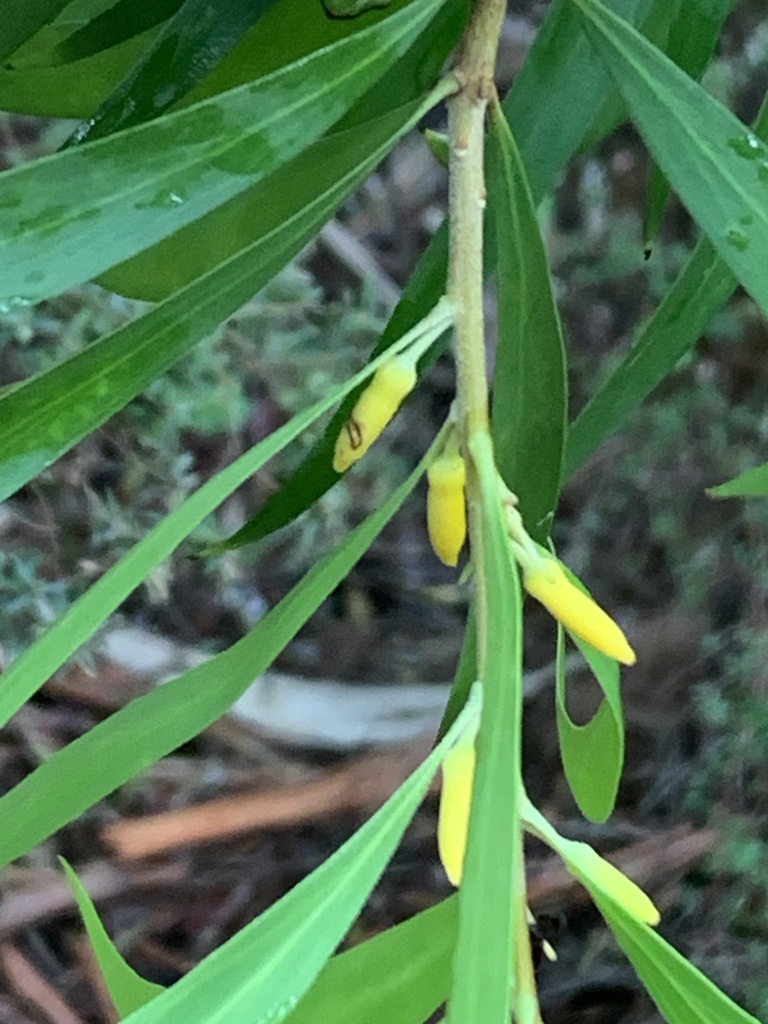
Persoonia katerae is a species of plant in the family Proteaceae that is endemic to a small area on the coast of New South Wales, Australia. It is an erect shrub to small tree with smooth bark on the branches, narrow elliptic to lance-shaped leaves with the narrower end towards the base, and yellow flowers in groups of six to twenty-two on a rachis 30–160 mm (1.2–6.3 in) long.
From the article Persoonia katerae on Wikipedia (CC BY-SA), quoted section by section
Description
Persoonia katerae is an erect shrub to small tree that typically grows to a height of about 2.5–9 m (8 ft 2 in – 29 ft 6 in) and has finely fissured bark near the base, smooth bark above. Its young branchlets are covered with greyish hairs. The leaves are narrow elliptical to lance-shaped with the narrower end towards the base, 60–170 mm (2.4–6.7 in) long and 8–22 mm (0.31–0.87 in) wide, sometimes with a few hairs mainly on the edges. The flowers are arranged in groups of six to twenty-two along a rachis 30–160 mm (1.2–6.3 in) long that grows into a leafy shoot after flowering. Each flower is on a pedicel about 35 mm (1.4 in) long and the tepals are yellow, 9–12 mm (0.35–0.47 in) long and hairy on the outside. Flowering occurs from January to February and the fruit is a green drupe, sometimes suffused with purple.
Range & habitat
This geebung grows in heath and forest on coastal sand between the Hastings River and Myall Lakes in coastal New South Wales.
== References ==
Wikipedia: “Distribution and habitat”
Where it lives
Recorded sightings
—
geo-referenced records in GBIF, from museums, herbaria and field observers.
Drag the globe to turn it. Dots are where records exist, not a range map; darker means more records.
In the stacks
Searching the stacks…
Every page naming Persoonia katerae in the Biodiversity Heritage Library →
This page is assembled live from iNaturalist, GBIF, Wikipedia, the Source Library and the Internet Archive. It is not yet part of the hand-edited codex. iNaturalist taxon 1032835.