- Animals
- ›Chordates
- ›Vertebrates
- ›Cartilaginous Fishes
- ›Sharks and Rays
- ›Rays
- ›Shovelnose Rays
- ›Giant Guitarfishes
- ›Glaucostegus
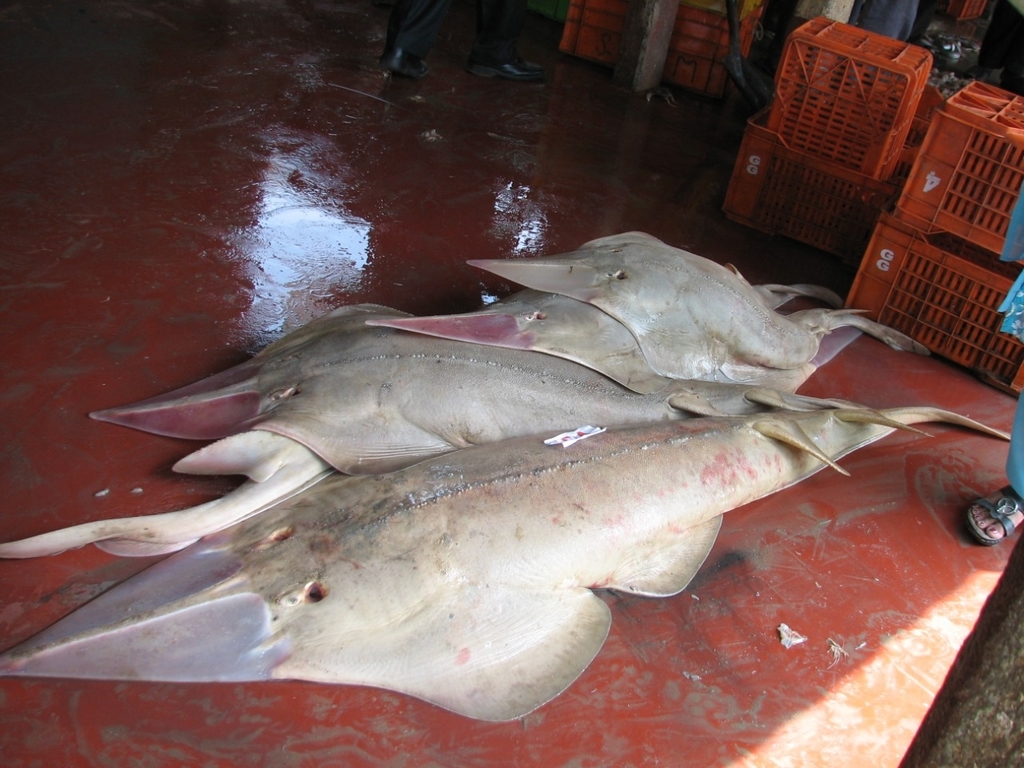
Granulated Guitarfish
Glaucostegus granulatus
The sharpnose guitarfish also known as the granulated guitarfish (Glaucostegus granulatus) is a species of ray in the Glaucostegidae family. They belong to the subclass Elasmobranchii which are cartilaginous fish that include sharks, rays, and skates as shown in their morphology. They have a flattened ray-like body and shark-like elongated snout. This species was first described by Georges Cuvier in 1829, and despite their appearance, they don't pose any threat to humans. As of April 2022, the IUCN has classified the sharpnose guitarfish as critically endangered.
From the article Sharpnose guitarfish on Wikipedia (CC BY-SA), quoted section by section
Description
The Glaucostegidae family are classified as rays that have a flattened body that is adapted for a benthic lifestyle. Glaucostegus granulatus is a large ray species that can reach a total length of 2.3 metres (7 ft 7 in). Its body is flattened and wedge-shaped, with a long, narrow truck and a pointed snout with oblique nostrils. The dorsal surface of the body is yellowish to brownish or greyish and has rough skin in small denticles. The dorsal fins are closely together, with a spacing of 1.3 to 1.6 times the length of the base of the dorsal fin, and the tail length is roughly 1 to 1.4 times the disc length. The wedge disc has a long and narrow pointed tip snout with broad oblique nostrils and with narrow anterior opening. Mature males can be as long as 98 cm (39 in), although larger individuals that are up to 2.7 metres (8 ft 10 in) have been recorded. The skin has fine denticles, with a midline, small patches near the eye, on the shoulder, and sometimes snout that are generally more visible with younger guitarfish. The long snout and rough skin texture that has more of a granular dorsally can help to correctly identify sharpnose guitarfish from similar species in their family.
Range & habitat
The sharpnose guitarfish is endemic to the Indo-Pacific region. The populations are found near Australia, India, Indonesia, Kuwait, Myanmar, Pakistan, Papua New Guinea, the Philippines, Sri Lanka, Thailand, Vietnam, and possibly China and Oman. Its natural habitats are open seas, coral reefs, and estuarine waters. It ranges from intertidal to offshore continental shelves down to 119 m (390 ft). The sharpnose guitarfish feeds on large shellfish and other invertebrates. Due to the distribution across the Indo-Pacific, the sharpnose guitarfish have experienced environmental pressures based on their habitat degrading and overfishing.
Wikipedia: “Distribution”
What it does
Sharpnose guitarfish are cartilaginous benthic organisms that consume crustaceans, mollusks, and benthic organisms that inhabit the sediment. They are well-suited for hunting on the seafloor even though visibility might be low, and prey might be under the sediment. There is little information surrounding sharpnose guitarfish feeding habits but like other rays, sharpnose guitarfish have electroreceptive organs known as the ampullae of Lorenzini on their snout. These organs can detect weak electric fields that are generated from the muscle movements of prey. Also, elasmobranchs possess a lateral line that can detect hydrodynamic movements to spot prey or evade potential predators. The flattened body and the long snout enable them to maneuver near the seafloor which maximizes their access to benthic creatures.
Wikipedia: “Feeding”
Where it lives
Recorded sightings
—
geo-referenced records in GBIF, from museums, herbaria and field observers.
Drag the globe to turn it. Dots are where records exist, not a range map; darker means more records.
In the stacks
Searching the stacks…
Every page naming Glaucostegus granulatus in the Biodiversity Heritage Library →
This page is assembled live from iNaturalist, GBIF, Wikipedia, the Source Library and the Internet Archive. It is not yet part of the hand-edited codex. iNaturalist taxon 101483.