- Animals
- ›Chordates
- ›Vertebrates
- ›Cartilaginous Fishes
- ›Sharks and Rays
- ›Sharks
- ›Galean Sharks
- ›Ground Sharks
- ›Houndsharks
- ›Galeorhine Houndsharks
- ›Furgaleus
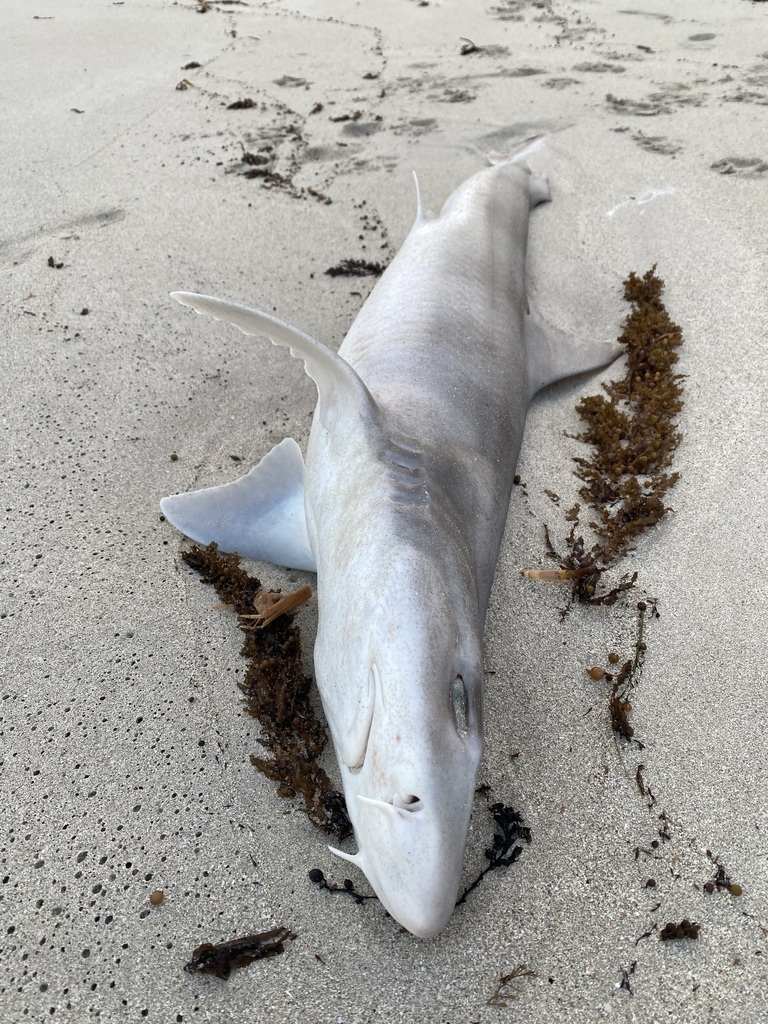
Whiskery Shark
Furgaleus macki
The whiskery shark (Furgaleus macki) is a species of houndshark in the family Triakidae, and the only member of its genus. This common shark inhabits the Australian continental shelf from Western Australia to the Bass Strait, to a depth of 220 m (720 ft). It is demersal in habits and prefers rocky and vegetated habitats. Stout-bodied and almost "humpbacked" in form, the whiskery shark can be distinguished from all other members of its family by the presence of long nasal barbels. Its two moderately large dorsal fins are roughly equal in size. It is brownish gray above and lighter below, with a pattern of darker saddles and blotches in younger sharks. This species reaches 1.6 m (5.2 ft) in length.
The diet of the whiskery shark consists almost entirely of octopuses. It is viviparous; females bear litters of four to 28 pups every other year from August to October, after a gestation period of 7–9 months. This harmless shark is used for its meat, being one of the species marketed as "flake" in Australia. It is mainly caught by a Western Australian commercial gillnet fishery. Its numbers declined significantly from overfishing in the 1970s and early 1980s, leading to the introduction of new management measures in the mid-1980s. Since then, strict fishery management has kept the whiskery shark population stable or increasing, resulting in its listing as of least concern by the International Union for Conservation of Nature.
From the article Whiskery shark on Wikipedia (CC BY-SA), quoted section by section
Description
The whiskery shark has a moderately stout build, with an almost "humpbacked" appearance. The short snout is rounded or wedge-shaped when viewed from above. This species is the only houndshark in which the flaps of skin preceding the nostrils are elongated into thin barbels. The horizontally oval eyes are placed high on the head and are equipped with rudimentary nictitating membranes (protective third eyelids). Beneath the eye is a prominent ridge, and behind it is a tiny spiracle. The mouth forms a short, wide arch, and bears somewhat long furrows at the corners. Tooth rows number 24–32 in the upper and 36–42 in the lower jaw. Each upper tooth has an angled, knife-like main cusp with smaller cusplets on the trailing side, while each lower tooth has a single upright cusp. Five pairs of gill slits are seen. The first dorsal fin is rather large and positioned closer to the pectoral than the pelvic fins, though its origin lies posterior to the pectoral fin rear tips. The second dorsal fin roughly equals the first in size and is positioned slightly ahead of the anal fin, which is much smaller than either dorsal fin. The caudal fin has a short lower lobe and a deep ventral notch near the tip of the upper lobe. …
Range & habitat
Endemic to Australia, the whiskery shark inhabits temperate continental shelf waters from the North West Cape in Western Australia to Wynyard in Tasmania. It is most common in the southwestern portion of its range between Kalbarri and Albany, and is rare off Victoria and Tasmania. Its range seems to encompass a single population. This species is found close to the bottom at depths to 220 m (720 ft). It favors rocky areas and kelp beds.
Wikipedia: “Distribution and habitat”
What it does
The whiskery shark is an active and highly specialized predator, feeding almost exclusively on octopuses. Other cephalopods, bony fishes, small rock lobsters, spoon worms, and seagrass have also been found amongst its stomach contents. A known parasite of this species is the tapeworm Calliobothrium pritchardae. Like other houndsharks, the whiskery shark is viviparous; the developing embryos are sustained by yolk and probably also maternally produced histotroph. Males can mate every year, while females have a biennial reproductive cycle. Mating takes place in August and September; females store sperm until late January to early April of the following year, when the ova are ready to be ovulated into the uterus. After a 7– to 9-month-long gestation period, litters of four to 28 (average 19) pups are born between August and October. The litter size increases with the size of the female. The newborns measure 22–27 cm (8.7–10.6 in) long. Juvenile whiskery sharks are rarely caught by commercial fishers, suggesting that nursery areas may be found in deeper water or other unfished habitats. Pups double to triple in size in the first 15–17 months of life, and continue to grow rapidly until they are 3–4 years old. Sexual maturity is attained at a length of 1.1–1.3 m (3.6–4.3 ft) for both sexes, corresponding to around five years of age for males and seven years of age for females. …
Wikipedia: “Biology and ecology”
Where it lives
Recorded sightings
—
geo-referenced records in GBIF, from museums, herbaria and field observers.
Drag the globe to turn it. Dots are where records exist, not a range map; darker means more records.
In the stacks
Searching the stacks…
Every page naming Furgaleus macki in the Biodiversity Heritage Library →
This page is assembled live from iNaturalist, GBIF, Wikipedia, the Source Library and the Internet Archive. It is not yet part of the hand-edited codex. iNaturalist taxon 101098.