- Animals
- ›Chordates
- ›Vertebrates
- ›Cartilaginous Fishes
- ›Sharks and Rays
- ›Sharks
- ›Squalean Sharks
- ›Squaliform Sharks
- ›Lantern Sharks
- ›Etmopterus
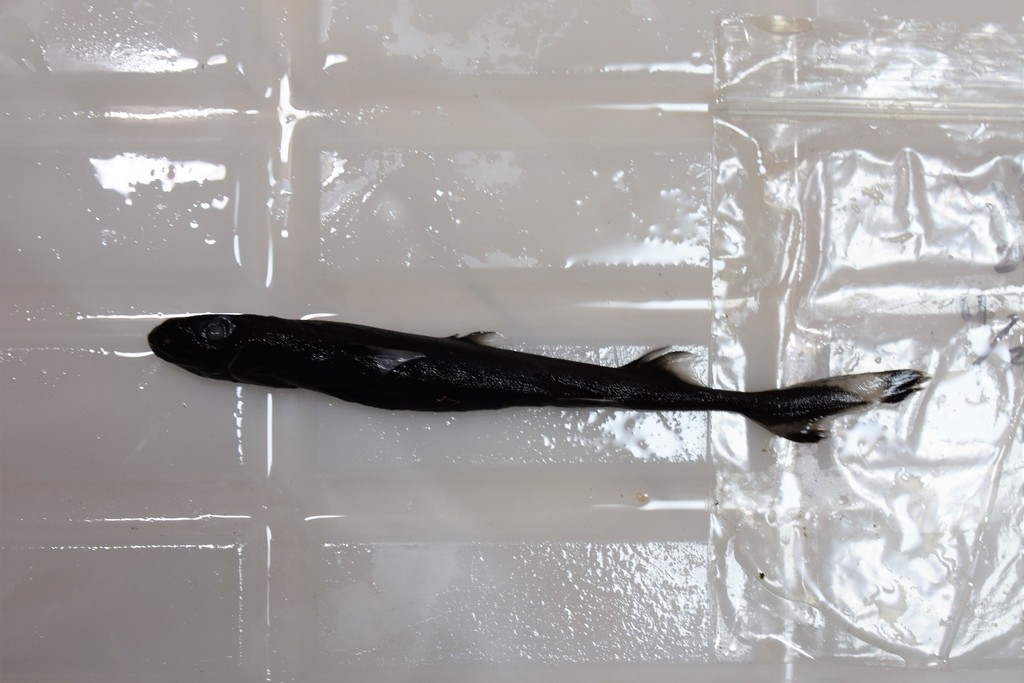
Blackbelly Lanternshark
Etmopterus lucifer
The blackbelly lanternshark or lucifer shark (Etmopterus lucifer) is a shark of the family Etmopteridae found around the world in tropical and temperate seas at depths between 150 and 1,250 meters – the mesopelagic zone. Compared to other mesopelagic fish predators and invertebrates, the blackbelly lanternshark is thought to reside in shallower, more southern waters. E. lucifer can reach up to 47 centimeters in length and consumes mesopelagic cephalopods, fish, and crustaceans. Blackbelly lanternsharks are bioluminescent, using hormone controlled mechanisms to emit light through ventral photogenic organs called photophores and are presumed to be ovoviviparous. The blackbelly lanternshark has been classified as "Not Threatened" within the New Zealand Threat Classification System.
From the article Blackbelly lanternshark on Wikipedia (CC BY-SA), quoted section by section
Description
Etmopterus lucifer has a slender body with brown coloration on the top and black coloration on the bottom. E. lucifer is shown to have a higher amount of pores – associated with sensory ampullae of Lorenzini – on its ventral side than dorsal side, meaning the species likely closes in on prey from above. Black markings are also featured around the pelvic, or ventral, fins and at the base of the caudal, or tail, fin. The blackbelly lanternshark has two dorsal fins, the second of which is larger, and a caudal, or tail, fin, which is relatively long. The interdorsal space is short. E. lucifer has relatively long gills, as well as five branchial arches. Along the side of the body, from its snout to its tail fin, are rows of hook-shaped denticles. The lower jaw contains between 29 and 39 teeth that have one cusp, while the upper jaw contains between 21 and 26 teeth that have up to three cusps. Teeth are around 2 mm in length. The maximum length of E. lucifer is about 47 cm. Males range from 29 to 42 cm, while females are 34 cm or more in length. Etmopterus lucifer has a wide and protruding rostrum, with large nasal capsules and rostral fenestrae. As a deep-sea species, E. lucifer has a large eye diameter, which can result in higher sensitivity to penetrating light and bioluminescence. A translucent region in the upper eye orbit of E. …
Wikipedia: “Anatomy and morphology”
Range & habitat
Etmopterus lucifer is prevalent in New Zealand's deep waters, most commonly found on the south Chatham Rise, with the greatest occurrence recorded at around 500 meters in depth. E. lucifer is categorized as a mesopelagic fish, preferring shallower and more southern habitats. Between 1992 and 2010, a significant increase in E. lucifer biomass was observed along the east coast of the North Island. In New Zealand's deep-sea trawl fisheries, Etmopterus lucifer, alongside the Etmopterus granulosus, constitutes the predominant by-catch species.
Wikipedia: “Distribution and habitat”
What it does
Blackbelly lanternsharks are presumed to be ovoviviparous. The diet of Etmopterus lucifer is generally characterized as consisting of squids and myctophids (lanternfishes) with slight regional differences. Populations found near Australia have been found to consume a variety of teleost, with the most common being myctophids, while also being known to feed on crustaceans and squids. Populations in Japan have been found to consume euphausiids as part of their regular diet instead of crustaceans, though they still retain squids, albeit mesopelagic squids, and myctophids as part of their feeding regime. In Southern Africa, E. lucifer has maintained myctophids in their diet, however, studies have found that they prefer to also hunt pelagic cephalopods in contrast to their regional counterparts that typically prefer squids in specific. Etmopterus lucifer is thought to attract its prey through the use of the photophores primarily found concentrated on its body that contribute to its cryptic coloration that provides both camouflage from predators and prey alike. Etmopterus lucifer prey detection can be attributed to its theorized electro-sensory sensitivity. …
Wikipedia: “Biology and ecology”
Where it lives
Recorded sightings
—
geo-referenced records in GBIF, from museums, herbaria and field observers.
Drag the globe to turn it. Dots are where records exist, not a range map; darker means more records.
In the stacks
Searching the stacks…
Every page naming Etmopterus lucifer in the Biodiversity Heritage Library →
This page is assembled live from iNaturalist, GBIF, Wikipedia, the Source Library and the Internet Archive. It is not yet part of the hand-edited codex. iNaturalist taxon 100586.