 NL·0787
Herbarium of the Nature Library
- Name
- Vombatus ursinus
- Family
- Vombatidae
- Native to
- Southeastern Australia (New South Wales, Victoria, southeastern South Australia and Queensland border), Tasmania and Flinders Island
- Habitat
- Temperate forest, Woodland, Heath, Alpine grassland
Common wombat
Vombatus ursinus
Also calledBare-nosed wombat · Wambad (Dharug, origin of 'wombat') · Wombat común (Spanish)
A sturdy, burrowing marsupial of southeastern Australia and Tasmania, famous for its cube-shaped droppings. Its backward-facing pouch keeps soil out while digging, and its burrows give shelter to many other animals, notably during bushfires.
The common wombat, also known as the bare-nosed wombat, is a marsupial, one of three extant species of wombats and the sole extant member of the genus Vombatus. It has three subspecies: Vombatus ursinus hirsutus, found on the Australian mainland; Vombatus ursinus tasmaniensis, found in Tasmania; and Vombatus ursinus ursinus, found on Flinders Island and Maria Island in the Bass Strait. Wikipedia
What it can do
- iProduces cube-shaped scats, shaped by varying elasticity of the intestinal wall
- iiBackward-facing pouch prevents soil entering when digging
- iiiDigs burrow systems up to about 20 m long
- ivTough cartilage plate on the rump blocks burrow entrances against predators
In the field
Field marks
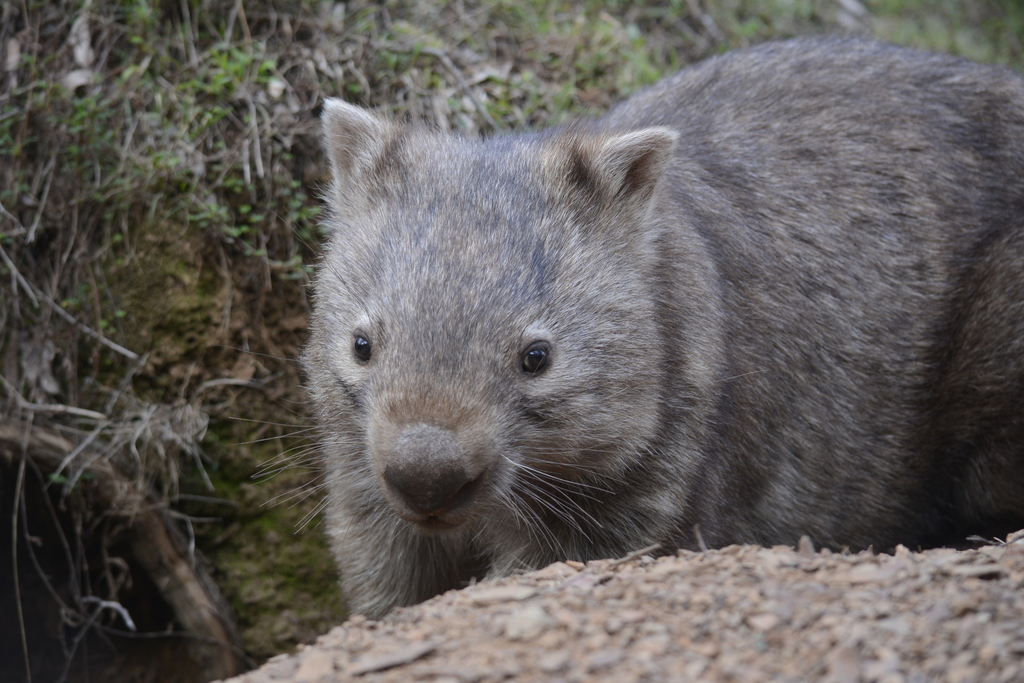
- aSilhouette: low, barrel-shaped, almost tailless animal with a broad head
- bCoarse fur, grey-brown to sandy or black
- cLarge, hairless, granular nose; short rounded ears
- dSigns: cube-shaped scats placed on rocks, logs and track edges; large burrow entrances with spoil heaps
- Not to be confused with
- Southern hairy-nosed wombat has a furry nose, longer pointed ears and silkier fur, and lives in drier South Australia. Echidnas are spiny.
- Where to see it
- Maria Island and Cradle Mountain (Tasmania); Wilsons Promontory (Victoria); Bendeela Recreation Area, Kangaroo Valley (New South Wales); Kosciuszko National Park
- When
- Resident; often active by day in cool winter weather
Listen
Looking for field recordings…
Life & habits
- Diet
- Grasses, sedges, roots and tubers
- Habitat
- Forest, woodland, heath and grassland with suitable digging soil
- Size
- About 1 m long; 20–35 kg
- Lifespan
- About 15 years in the wild
Mostly nocturnal; grazes slowly, but can sprint at about 40 km/h. Leaves scats on rocks and logs as territorial markers.
Where it lives
Recorded sightings
—
geo-referenced records in GBIF, from museums, herbaria and field observers.
Native range
Southeastern Australia (New South Wales, Victoria, southeastern South Australia and Queensland border), Tasmania and Flinders Island
Drag the globe to turn it. Dots are where records exist, not a range map; darker means more records.
In the stacks
Searching the stacks…
Every page naming Vombatus ursinus in the Biodiversity Heritage Library →
Marginalia
The word 'wombat' comes from the Dharug language of the Sydney area. The Pre-Raphaelite poet Dante Gabriel Rossetti kept a pet wombat in London in 1869.
Curiosity
A wombat can produce around 80–100 cube-shaped scats a night.
Kinship



Photographs: iNaturalist contributors under the licences shown. Records: GBIF.org. Historical plates: Source Library (CC BY-SA 4.0; originals public domain). Summary text: Nature Library editors and Wikipedia (CC BY-SA). Medicinal and edibility notes are historical and educational, not advice. iNaturalist taxon 43009.