 NL·0695
Herbarium of the Nature Library
- Name
- Sepia officinalis
- Family
- Sepiidae
- Native to
- Eastern Atlantic from the North Sea and Baltic approaches south to north-west Africa; Mediterranean Sea
- Habitat
- Coastal seagrass, Sandy and muddy sea floor, Rocky reef
Common cuttlefish
Sepia officinalis
Also calledSeiche (French) · Sepia / Choco (Spanish) · Seppia (Italian) · Sübye (Turkish) · Habbar (Arabic)
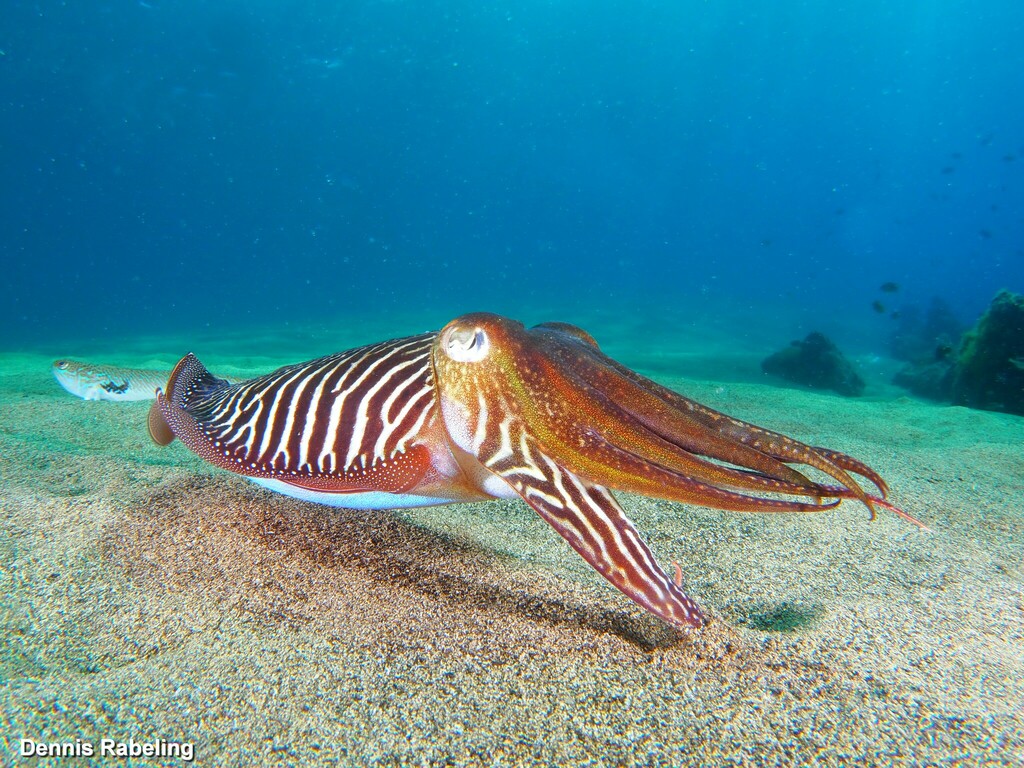
A master of disguise that can change colour, pattern and even skin texture in under a second, despite being colour-blind. Its ink gave artists the pigment sepia, and its internal shell, the cuttlebone, washes up on European beaches.
The common cuttlefish or European common cuttlefish is one of the largest and best-known cuttlefish species. They are a migratory species that spend the summer and spring inshore for spawning and then move to depths of 100–200 metres (330–660 ft) during autumn and winter. They grow to 49 centimetres (19 in) in mantle length and 4 kilograms (8.8 lb) in weight. Animals from subtropical seas are smaller and rarely exceed 30 centimetres (12 in) in mantle length. Wikipedia
What it can do
- iMillions of chromatophores give rapid, patterned colour change
- iiRaises skin papillae to mimic rocks and seaweed
- iiiSees polarised light and uses it in signalling
- ivAdjusts buoyancy by pumping fluid in and out of its chambered cuttlebone
- vEjects clouds of melanin ink
In the field
Field marks
- aBroad, oval, flattened body with a narrow fin running around the entire edge
- bW-shaped pupils
- cEight short arms plus two long feeding tentacles
- dBreeding males show bold black-and-white 'zebra' stripes
- Not to be confused with
- Elegant cuttlefish (Sepia elegans) and pink cuttlefish (S. orbignyana) are smaller and pinkish, with a sharp spine at the rear of the cuttlebone. Squid have fins only at the tail end, and octopuses have no fins.
- Where to see it
- Seagrass and sandy bays in the Mediterranean and along the English Channel and Biscay coasts; cuttlebones on beaches in summer.
- When
- Inshore spawning Apr–Jul
Life & habits
- Diet
- Shrimps, crabs and small fish, caught with two shooting tentacles
- Habitat
- Shallow coastal waters, seagrass and sandy bottoms, down to about 200 m
- Size
- Mantle up to about 45 cm; weight up to about 4 kg
- Lifespan
- About 1–2 years
In spring, adults move inshore to spawn; small males have been reported to mimic females to slip past large rival males and mate, a tactic better known in the giant Australian cuttlefish.
Where it lives
Recorded sightings
—
geo-referenced records in GBIF, from museums, herbaria and field observers.
Native range
Eastern Atlantic from the North Sea and Baltic approaches south to north-west Africa; Mediterranean Sea
Drag the globe to turn it. Dots are where records exist, not a range map; darker means more records.
In the old herbals & bestiaries
Woodcuts and engravings matched from the Source Library’s scanned books by name. Plates marked “relative” show a close kin rather than this exact species. Click a plate to read the page it came from, with translation.

History of Animals, Book II: On Oviparous Quadrupeds
Conrad Gessner · 1586 · p.554

Commentaries on the Six Books of Dioscorides
Pietro Andrea Mattioli · 1560 · p.315

Commentaries on the Six Books of Dioscorides
Pietro Andrea Mattioli · 1560 · p.314

François Le Vaillant — Histoire naturelle des promerops et des guêpiers (1807)
François Le Vaillant · 1807 · p.673

François Bouchard — Recueil de cent-trente-trois oiseaux des plus belles especes (1775)
François Bouchard · 1775 · p.47
In the stacks
Searching the stacks…
Every page naming Sepia officinalis in the Biodiversity Heritage Library →
Marginalia
Aristotle described its ink, mating and egg-laying in his History of Animals. Brown 'sepia' ink made from it was used for writing and drawing, and the name of the genus became a word for the colour.
Curiosity
Its cuttlebone is sold as a calcium supplement for caged birds.
Kinship




Fact-checked: 1 correction made to this sheet. Photographs: iNaturalist contributors under the licences shown. Records: GBIF.org. Historical plates: Source Library (CC BY-SA 4.0; originals public domain). Summary text: Nature Library editors and Wikipedia (CC BY-SA). Medicinal and edibility notes are historical and educational, not advice. iNaturalist taxon 151429.