 NL·0210
Herbarium of the Nature Library
- Name
- Macrocystis pyrifera
- Family
- Laminariaceae
- Native to
- Cool coastal waters of the eastern Pacific (Alaska to Baja California; Peru and Chile), the southern Atlantic and sub-Antarctic coasts, southern Australia and New Zealand
- Habitat
- Kelp forest, Rocky subtidal reef
Giant kelp
Macrocystis pyrifera
Also calledHuiro (Chilean Spanish, from Mapudungun) · Sargazo gigante (Spanish) · Bladder kelp (English) · Rimurimu (Māori, for seaweeds) · 巨藻 jùzǎo (Chinese)
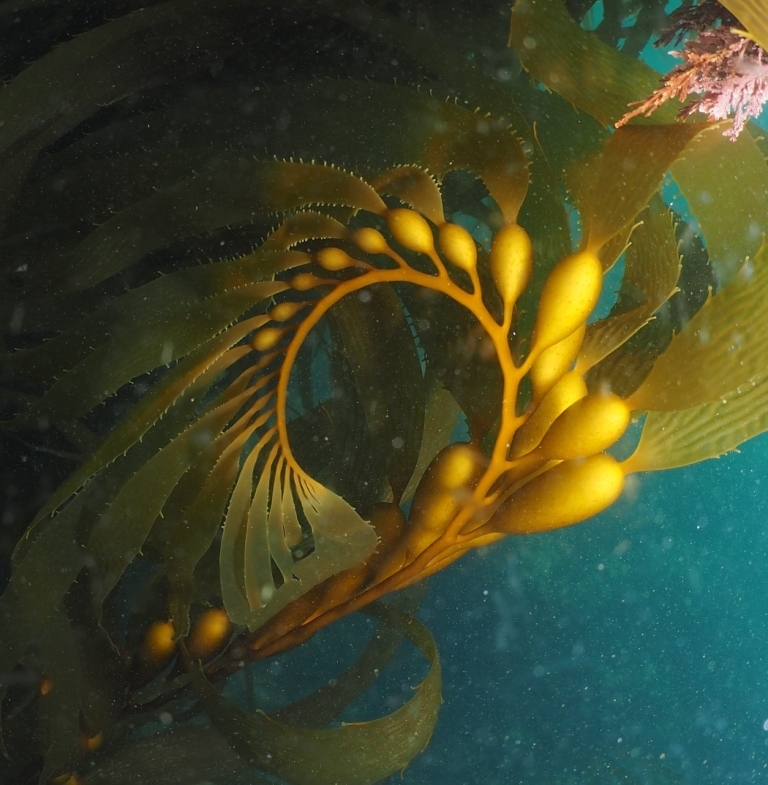
One of the fastest-growing organisms on Earth, adding up to about half a metre a day and reaching lengths of 45 m or more. Giant kelp is a brown alga, not a plant, and forms underwater forests that shelter fish, sea otters and countless invertebrates.
Macrocystis is a monospecific genus of kelp with all species now synonymous with Macrocystis pyrifera. It is commonly known as giant kelp or bladder kelp. This genus contains the largest of all the Phaeophyceae or brown algae. Macrocystis has pneumatocysts at the base of its blades. Sporophytes, the macroscopic forms, are perennial and the individual may live for up to three years; stipes/fronds within a whole individual undergo senescence, where each frond may persist for approximately 100 days. The genus is found widely in subtropical, temperate, and sub-Antarctic oceans of the Southern Hemisphere and in the northeast Pacific. Macrocystis is often a major component of temperate kelp forests. Wikipedia
What it can do
- iGrows up to about 50 cm a day in good conditions
- iiFloats its fronds to the surface with gas-filled bladders (pneumatocysts) at each blade
- iiiGrips rock with a root-like holdfast that is not used for feeding
- ivBuilds forest habitats that support hundreds of species, kept in balance by sea otters that eat kelp-grazing urchins
At the table
Eatenfronds and blades (dried, as kelp)
Edible, but very high in iodine; frequent large servings can upset thyroid function. Can concentrate heavy metals such as arsenic from polluted water.
Seed
Seed
Spores ~5–10 µm
Reproduces by microscopic zoospores released from special blades (sporophylls) near the base
- Dispersal
- Water currents, mostly over short distances
- Germination
- Spores grow into tiny male and female gametophytes whose offspring become new kelp
Where it lives
Recorded sightings
—
geo-referenced records in GBIF, from museums, herbaria and field observers.
Native range
Cool coastal waters of the eastern Pacific (Alaska to Baja California; Peru and Chile), the southern Atlantic and sub-Antarctic coasts, southern Australia and New Zealand
Drag the globe to turn it. Dots are where records exist, not a range map; darker means more records.
In the stacks
Searching the stacks…
Every page naming Macrocystis pyrifera in the Biodiversity Heritage Library →
Marginalia
The 'kelp highway' hypothesis proposes that early people followed productive kelp-forest coasts around the Pacific Rim into the Americas. Darwin, on the Beagle, compared southern kelp forests to land forests and said their loss would destroy many animals.
Curiosity
For much of the 20th century, giant kelp harvested off California was a major source of alginate, the thickener in ice cream, toothpaste and wound dressings.
Kinship
Fact-checked: 1 correction made to this sheet. Photographs: iNaturalist contributors under the licences shown. Records: GBIF.org. Historical plates: Source Library (CC BY-SA 4.0; originals public domain). Summary text: Nature Library editors and Wikipedia (CC BY-SA). Medicinal and edibility notes are historical and educational, not advice. iNaturalist taxon 124748.