 NL·0331
Herbarium of the Nature Library
- Name
- Macaca fuscata
- Family
- Cercopithecidae
- Native to
- Honshu, Shikoku, Kyushu and nearby small islands, Japan
- Habitat
- Temperate forest, Subalpine forest, Montane
Japanese macaque (snow monkey)
Macaca fuscata
Also calledNihonzaru / Saru (Japanese) · Rìběn mílóu 日本猕猴 (Chinese) · Macaco japonés (Spanish)
The northernmost non-human primate, a red-faced monkey that survives snowy winters in the mountains of Japan. Some troops have learned habits, like bathing in hot springs, that spread from monkey to monkey, an early example of animal culture.
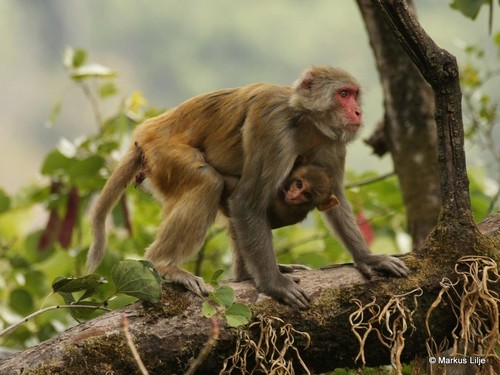
The Japanese macaque, also known as the snow monkey, is a terrestrial Old World monkey species that is native to Japan. Colloquially, this macaque is referred to as the "snow monkey", because some live in areas where snow covers the ground for months each year. No other non-human primate lives farther north, nor in a colder climate. It has brownish grey fur, a pinkish-red face, and a short tail. Two subspecies are known. Wikipedia
What it can do
- iSurvives winters at −15 °C with thick fur and by huddling
- iiTroops at Jigokudani soak in volcanic hot springs in winter, which lowers their stress hormones
- iiiOn Kōshima, a young female named Imo started washing sweet potatoes in the sea in 1953, and the habit spread through the troop
- ivSome troops roll snowballs for play
In the field
Field marks
- aThick grey-brown fur
- bRed face and rump
- cShort tail
- dBathes in hot springs
- Voice
- Coos and barks
- Not to be confused with
- The only monkey in Japan.
- Where to see it
- Jigokudani Monkey Park (Nagano)
- When
- Hot-spring bathing best Dec–Mar
Listen
Looking for field recordings…
Life & habits
- Diet
- Omnivore: fruit, seeds, leaves, bark, insects; bark and buds in winter
- Habitat
- Subtropical to subalpine forests
- Size
- Males ~10–14 kg; females ~8–10 kg; short tail
- Lifespan
- Females ~25–30 years; males shorter
Troops are organised around ranked lines of related females. Males leave their birth troop and join others.
Where it lives
Recorded sightings
—
geo-referenced records in GBIF, from museums, herbaria and field observers.
Native range
Honshu, Shikoku, Kyushu and nearby small islands, Japan
Drag the globe to turn it. Dots are where records exist, not a range map; darker means more records.
In the old herbals & bestiaries
No plate in the Source Library names this exact species, so these show its closest relatives as the old naturalists drew them: same genus, or the same kind of animal. Click a plate to read the page it came from, with translation.


In the stacks
Searching the stacks…
Every page naming Macaca fuscata in the Biodiversity Heritage Library →
Marginalia
The 'see no evil, hear no evil, speak no evil' monkeys carved at the Tōshō-gū shrine in Nikkō (17th century) are Japanese macaques. Monkeys are messengers of the Sannō deity at Hiyoshi Taisha shrine.
Curiosity
The hot-spring bathing began in 1963, when a young female at Jigokudani followed soybeans into a pool and others copied her.
Kinship




Photographs: iNaturalist contributors under the licences shown. Records: GBIF.org. Historical plates: Source Library (CC BY-SA 4.0; originals public domain). Summary text: Nature Library editors and Wikipedia (CC BY-SA). Medicinal and edibility notes are historical and educational, not advice. iNaturalist taxon 43458.