 NL·0661
Herbarium of the Nature Library
- Name
- Lithobates catesbeianus
- Family
- Ranidae
- Native to
- Eastern and central North America, from southern Canada to the Gulf of Mexico; introduced in western North America, South America, Europe and East Asia
- Habitat
- Ponds, Lakes, Slow rivers, Marshes
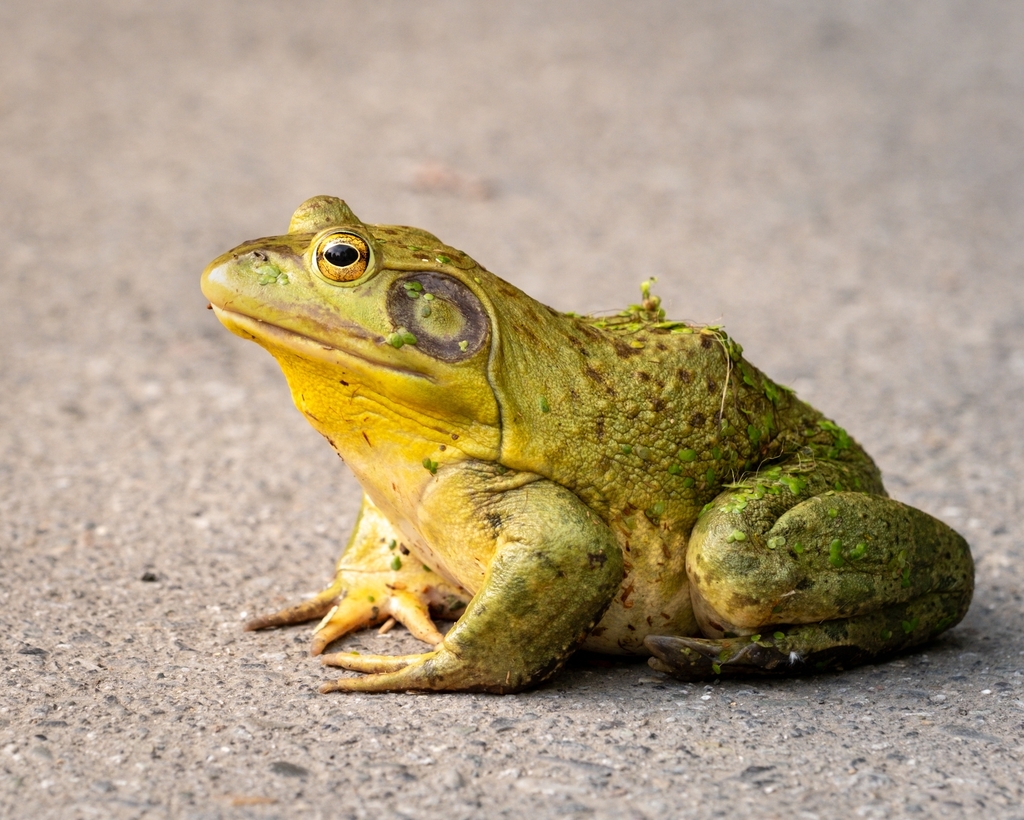
American bullfrog
Lithobates catesbeianus
Also calledBullfrog · Rana toro (Spanish) · Ouaouaron (Québec French) · Rã-touro (Portuguese) · Ushigaeru ウシガエル (Japanese)
North America's largest true frog, whose deep, booming call carries across summer ponds. It will eat almost anything it can fit in its mouth. Introduced around the world for frog legs, it has become an invasive species that eats native frogs and spreads disease.
The American bullfrog, often simply known as the bullfrog in Canada and the United States, is a species of large frog in the family Ranidae. The species is native to eastern North America. It typically inhabits large permanent water bodies such as swamps, ponds, and lakes. The bullfrog can also be found in manmade habitats such as pools, koi ponds, canals, ditches, reservoirs and culverts. The bullfrog gets its common name from the sound the male makes during the breeding season, which sounds similar to a bull bellowing. It is a generalist carnivore, consuming a wide variety of prey. In turn, it is eaten by predators such as alligators, snakes, and birds. Wikipedia
What it can do
- iEats insects, crayfish, fish, other frogs, snakes, birds and small mammals
- iiTadpoles may take one to three years to turn into frogs
- iiiCan jump more than ten times its own body length
- ivCan carry chytrid fungus without becoming ill, spreading it to other amphibians
In the field
Field marks
- aLarge green to olive frog, often with darker mottling
- bLarge round eardrum (tympanum), bigger than the eye in males
- cA ridge curving around the eardrum but no ridges down the back
- dMales have a yellow throat
- Voice
- A deep, resonant 'jug-o-rum' or bellowing 'rumm', like a foghorn or bull; heard on summer nights
- Not to be confused with
- The green frog (L. clamitans) has a pair of ridges (dorsolateral folds) running down its back and calls a twangy 'gunk', like a loose banjo string. The pig frog (L. grylio) of the Southeast has a grunting call and a more pointed snout.
- Where to see it
- Ponds, lakes and marshes across the eastern US and southern Canada
- When
- Calls May–August; hibernates underwater in winter
Listen
Looking for field recordings…
Life & habits
- Diet
- Almost anything it can swallow
- Habitat
- Permanent ponds, lakes and slow rivers with vegetation
- Size
- Body ~9–15 cm; up to ~20 cm and ~0.5 kg
- Lifespan
- ~8–10 years
Males defend calling territories in summer and wrestle rivals.
Where it lives
Recorded sightings
—
geo-referenced records in GBIF, from museums, herbaria and field observers.
Native range
Eastern and central North America, from southern Canada to the Gulf of Mexico; introduced in western North America, South America, Europe and East Asia
Drag the globe to turn it. Dots are where records exist, not a range map; darker means more records.
In the stacks
Searching the stacks…
Every page naming Lithobates catesbeianus in the Biodiversity Heritage Library →
Marginalia
Mark Twain's 1865 story 'The Celebrated Jumping Frog of Calaveras County' inspired the jumping frog contest held at the Calaveras County Fair since 1928, where bullfrogs are the usual competitors.
Curiosity
Bullfrogs released in Japan in 1918 for food spread across the islands, and they are now listed in Japan as an invasive alien species.
Kinship

Photographs: iNaturalist contributors under the licences shown. Records: GBIF.org. Historical plates: Source Library (CC BY-SA 4.0; originals public domain). Summary text: Nature Library editors and Wikipedia (CC BY-SA). Medicinal and edibility notes are historical and educational, not advice. iNaturalist taxon 65979.