- Animals
- ›Chordates
- ›Vertebrates
- ›Mammals
- ›Therians
- ›Placental Mammals
- ›Primates, Rodents, and Allies
- ›Primates
- ›Lemurs, Lorises, and Allies
- ›Lemurs
- ›Lemurs
- ›Typical Lemurs
- ›Eulemur
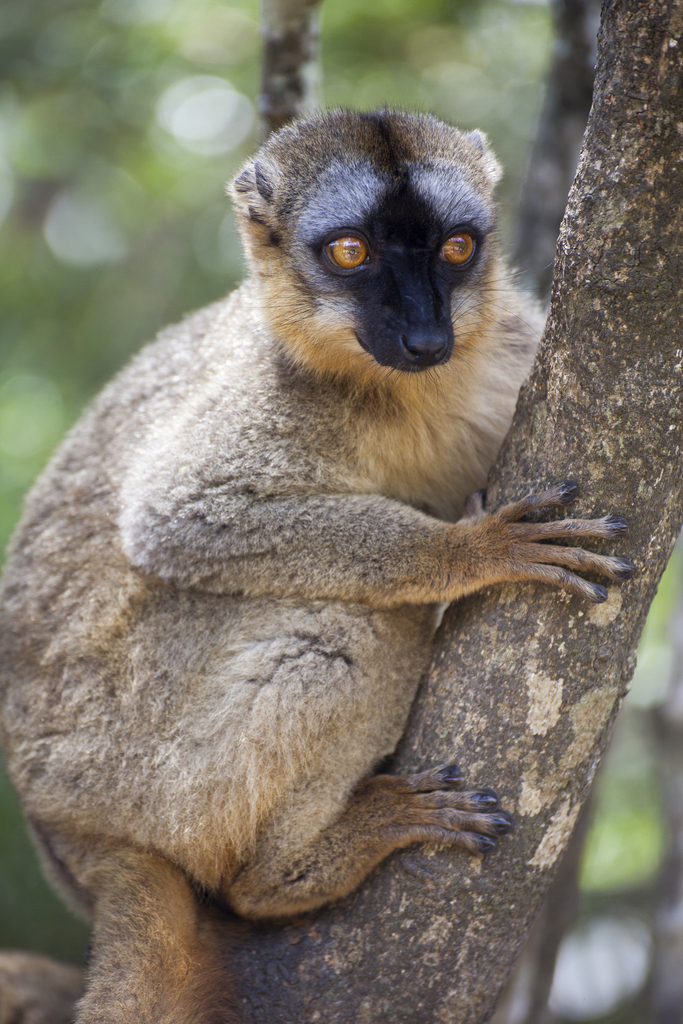
Common Brown Lemur
Eulemur fulvus
The common brown lemur (Eulemur fulvus) is a species of lemur in the family Lemuridae. It is found in Madagascar and has been introduced to Mayotte.
From the article Common brown lemur on Wikipedia (CC BY-SA), quoted section by section
Range & habitat
The common brown lemur lives in western Madagascar north of the Betsiboka River and eastern Madagascar between the Mangoro River and Tsaratanana, as well as in inland Madagascar connecting the eastern and western ranges. They also live on the island of Mayotte, although this population has been introduced there by man.
== References ==
Wikipedia: “Distribution”
What it does
Consistent with its large range, the common brown lemur occupies a variety of forest types, including lowland rainforests, montane rainforests, moist evergreen forests and dry deciduous forests. They spend about 95% of their time in upper layers of the forest and less than 2% of their time on the ground. They normally live in groups of 5 to 12, but group size can be larger, especially on Mayotte. Groups occupy home ranges of 1 to 9 hectares in the west, but more than 20 hectares in the east. Groups include members of both sexes, including juveniles, and there are no discernible dominance hierarchies. They are primarily active during the day, but can exhibit cathemeral activity and continue into the night, especially during full moons and during the dry season. In the western part of its range, the common brown lemur overlaps that of the mongoose lemur, and the two species sometimes travel together. In the areas of overlap, the two species also adapt their activity patterns to avoid conflict. For example, the mongoose lemur can become primarily nocturnal during the dry season in the areas of overlap. At Berenty (south Madagascar) there is a population of introduced E. fulvus rufus x collaris. These lemurs show linear hierarchy, adult female dominance, and the presence of conciliatory behavior after aggressions. …
Wikipedia: “Behavior”
Listen
Looking for field recordings…
Where it lives
Recorded sightings
—
geo-referenced records in GBIF, from museums, herbaria and field observers.
Drag the globe to turn it. Dots are where records exist, not a range map; darker means more records.
In the stacks
Searching the stacks…
Every page naming Eulemur fulvus in the Biodiversity Heritage Library →
This page is assembled live from iNaturalist, GBIF, Wikipedia, the Source Library and the Internet Archive. It is not yet part of the hand-edited codex. iNaturalist taxon 43613.