- Animals
- ›Chordates
- ›Vertebrates
- ›Mammals
- ›Therians
- ›Placental Mammals
- ›Primates, Rodents, and Allies
- ›Primates
- ›Monkeys, Apes, and Tarsiers
- ›Monkeys and Apes
- ›Apes and Old World Monkeys
- ›Old World Monkeys
- ›Colobines
- ›Langurs, Surilis, and Lutungs
- ›Rhinopithecus
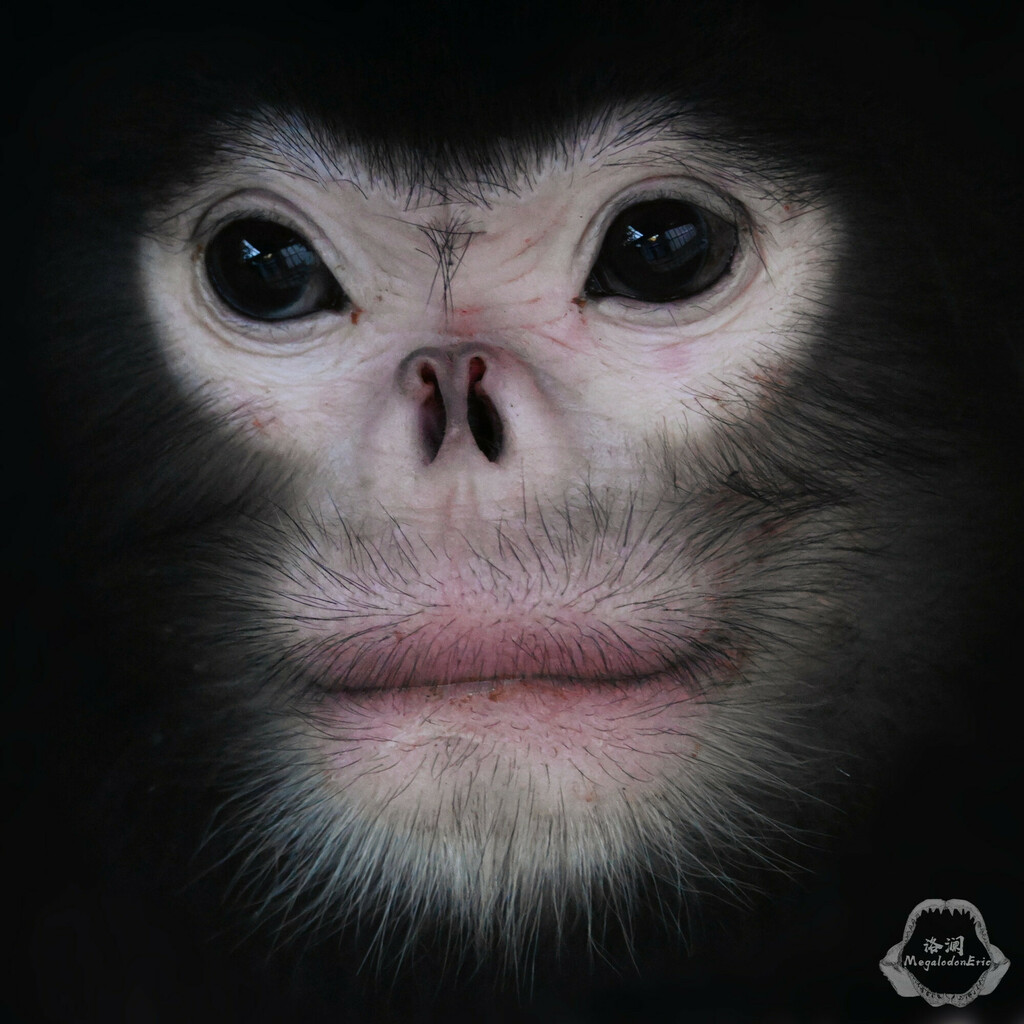
Burmese Snub-nosed Monkey
Rhinopithecus strykeri
The Myanmar snub-nosed monkey or Burmese snub-nosed monkey or black snub-nosed monkey (Rhinopithecus strykeri) is a critically endangered species of colobine monkey described in 2010 in northern Myanmar. It was formally described as a novel species of primate in 2011 based on its fur, beard and tail. Two groups of the species were described in China in 2011 and 2015, respectively.
The species is known in local dialects of Lisu people as mey nwoah and Law Waw people as myuk na tok te, both of which mean "monkey with an upturned face". Rain allegedly causes it to sneeze due to the short upturned nasal flesh around its nostrils. People from the area report that it sits with its head directed downwards, hiding its face between its knees when it rains.
From the article Myanmar snub-nosed monkey on Wikipedia (CC BY-SA), quoted section by section
Range & habitat
The species spend summer months in temperate mixed forests at upper elevations of their range, and descend to lower ground in the winter to escape snow. In contrast to other snub-nosed monkeys which are mostly ground dwellers, the Myanmar snub-nosed monkeys are highly arboreal in habitat behaviour spending much of their times on trees. Males are outnumbered females by 1 to 2.1. When first discovered, the only known specimens existed in three or four groups within a 270 square kilometres (100 sq mi) range at 1,700 to 3,200 metres (5,600–10,500 ft) above sea level in the eastern Himalayas, in the north-eastern section of Kachin State, the northernmost part of Burma (Myanmar). In 2011, a population was discovered in Pianma, Lushui County, Yunnan, China. The species is isolated from other snub-nosed Rhinopithecus by the Mekong and the Salween rivers; the other 4 species, golden, black, gray and Tonkin snub-nosed monkeys, are found in China and Vietnam. The species shares habitat with Shortridge's langur, stump-tailed macaque, Assam macaque, rhesus macaque, and northern pig-tailed macaque. On the morning of 16 October 2011, a forest guard at Gaoligongshan National Nature Reserve in China took photos of a group of snub-nosed monkeys which were later identified as R. strykeri. …
Wikipedia: “Distribution and habitat”
Listen
Looking for field recordings…
Where it lives
Recorded sightings
—
geo-referenced records in GBIF, from museums, herbaria and field observers.
Drag the globe to turn it. Dots are where records exist, not a range map; darker means more records.
In the stacks
Searching the stacks…
Every page naming Rhinopithecus strykeri in the Biodiversity Heritage Library →
This page is assembled live from iNaturalist, GBIF, Wikipedia, the Source Library and the Internet Archive. It is not yet part of the hand-edited codex. iNaturalist taxon 144090.