- Animals
- ›Chordates
- ›Vertebrates
- ›Mammals
- ›Therians
- ›Placental Mammals
- ›Primates, Rodents, and Allies
- ›Primates
- ›Monkeys, Apes, and Tarsiers
- ›Monkeys and Apes
- ›Apes and Old World Monkeys
- ›Old World Monkeys
- ›Colobines
- ›Langurs, Surilis, and Lutungs
- ›Presbytis
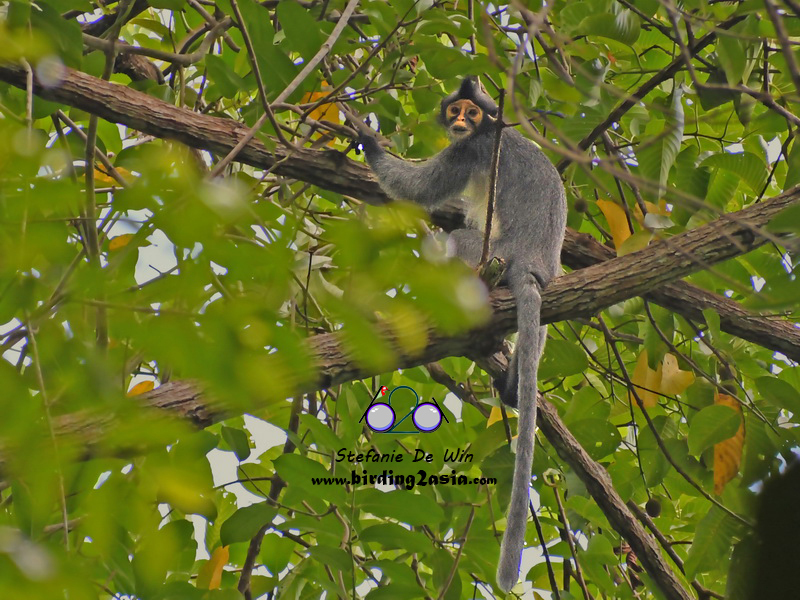
Saban Grizzled Langur
Presbytis sabana
The Sabah grizzled langur (Presbytis sabana), also known as the Saban grizzled langur, is a species of monkey in the family Cercopithecidae. It was formerly considered a subspecies of Hose's langur, Presbytis hosei (as Presbytis hosei sabana). The Sabah grizzled langur is native to the island of Borneo in the province of Sabah in Malaysia, with part of its range in Indonesia. It is listed as endangered by the IUCN due primarily to habitat loss, fragmentation and hunting.
From the article Sabah grizzled langur on Wikipedia (CC BY-SA), quoted section by section
Description
The Sabah grizzled langur is mostly gray, with white underparts and black hands and feet. Sabah grizzled langurs range from 48 centimetres (19 in) to 56 centimetres (22 in) long excluding tail and have a tail length ranging from 64 centimetres (25 in) to 84 centimetres (33 in). Males weigh from 6 kilograms (13 lb) to 7 kilograms (15 lb) while females weight between 5.5 kilograms (12 lb) and 6 kilograms (13 lb).
What it does
The Sabah grizzled langur is arboreal and diurnal. It lives in groups of about seven animals including a single adult male. Males who are not part of a group are solitary. It has a varied diet consisting of leaves, fruit, seeds, flowers, insects and bark, and it also consumes mineral-rich mud. It sometimes associates with the maroon langur.
== References ==
Wikipedia: “Diet & behaviour”
Listen
Looking for field recordings…
Where it lives
Recorded sightings
—
geo-referenced records in GBIF, from museums, herbaria and field observers.
Drag the globe to turn it. Dots are where records exist, not a range map; darker means more records.
In the stacks
Searching the stacks…
Every page naming Presbytis sabana in the Biodiversity Heritage Library →
This page is assembled live from iNaturalist, GBIF, Wikipedia, the Source Library and the Internet Archive. It is not yet part of the hand-edited codex. iNaturalist taxon 1369311.