- Animals
- ›Chordates
- ›Vertebrates
- ›Mammals
- ›Therians
- ›Placental Mammals
- ›Primates, Rodents, and Allies
- ›Primates
- ›Monkeys, Apes, and Tarsiers
- ›Monkeys and Apes
- ›New World Monkeys
- ›Cebid Monkeys
- ›Capuchins
- ›Sapajus
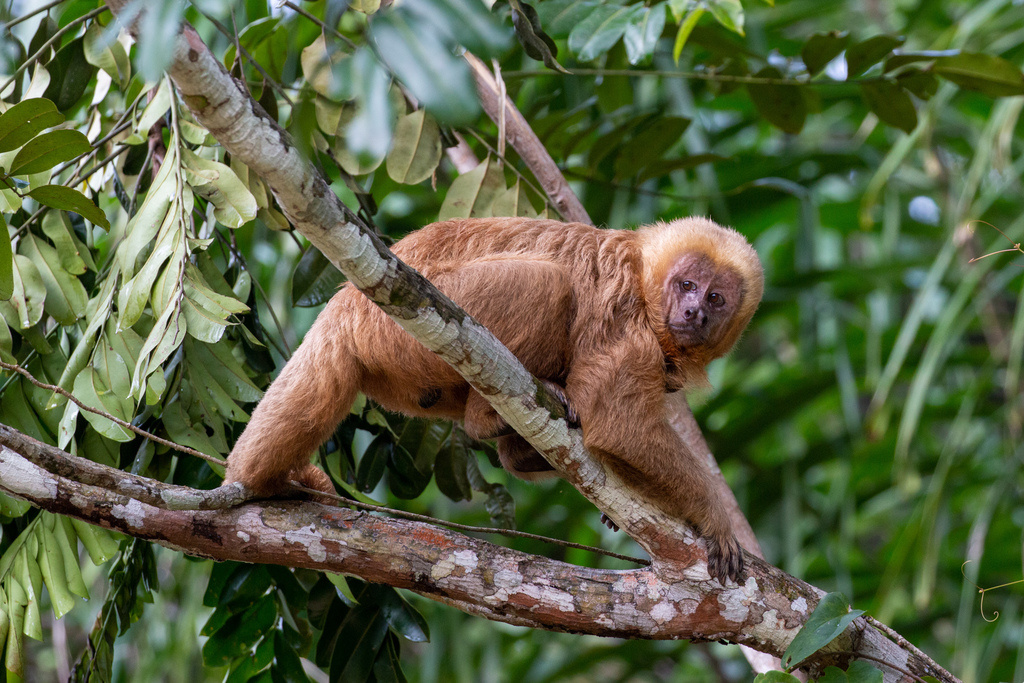
Blonde Capuchin
Sapajus flavius
The blond capuchin (Sapajus flavius) is a species of capuchin monkey endemic to northeastern Brazil. This endangered species was rediscovered in 2006. It can live in exceptionally large groups of over 150 individuals, and like other capuchin species, exhibits a complex and high level of sociality. It is threatened by loss of habitat due to agriculture, primarily sugarcane fields. In many cases this has caused sugarcane to make up a large portion of their diet, which would otherwise consist of mostly fruit and small animals. The blond capuchin is known to inhabit both the Atlantic forest and Caatinga biomes, although the habitation of the Caatinga may be a recent choice caused by human encroachment into its former habitats. Like other primate species, the blond capuchin is also threatened by poaching and capture for the illegal pet trade.
From the article Blond capuchin on Wikipedia (CC BY-SA), quoted section by section
Description
The body hair of the blond capuchin is almost uniformly golden-yellow with the notable exception of a whitish cap on the front half of the head. It has a pink-coloured face with light-brown eyes and a darkly-coloured, hairless throat flap on the ventral side of its neck. The hair on the feet and hands is much lighter compared to the rest of the coat, while the palms and soles of the feet are hairless and black. The hair on the head grows towards the posterior and is not tufted. The blond capuchin is on the smaller end of capuchin monkeys, reaching a maximum head and body length of 40 cm (16 in). Similar to other capuchin species, the length of the tail is nearly equivalent to the length of the head and body. The typical weight of an adult ranges from 2 to 3 kg (4.4 to 6.6 lb).
Range & habitat
The blond capuchin inhabits the northeastern Atlantic Forest extended in the states of Paraíba, Pernambuco, and Alagoas in the northeastern part of Brazil. It was rediscovered in two Atlantic Forest fragments in Paraíba, the Camaratuba Experimental Station and the Engenho Gargaú Private Natural Heritage Reserve. Sample animals were captured and examined. In the Gargaú reserve they seemed healthy and were probably a viable population for the next 100 years. The Camaratuba population had a 50% risk of extinction. It has also been seen in the Pau-Brasil Ecological Station in Paraíba, just south of the Camaratuba station. The blond capuchin is also known to inhabit the Caatinga biome in the state of Rio Grande do Norte located in northeastern Brazil. Although only officially discovered in the mid to late 2000s, local residents claim to have seen them for at least the past 40 years. Locals of the area claim the blond capuchins frequently raid the nearby maize fields, indicating that they may have been forced to move to and adapt to the Caatinga biome due to human activity. Notably, blond capuchins living in the Caatinga spend much more of their time on the ground then populations living in the Atlantic forest.
Wikipedia: “Distribution”
What it does
Like other capuchin species, the blond capuchin is diurnal and does most of its foraging during the early morning, possibly to avoid harsher midday temperatures. It is an omnivore and feeds on a wide variety of food types including fruits and other vegetable parts, small vertebrates, arthropods, and sugarcane. Notably, sugarcane was found in one study to make up 50% of the blond capuchin's diet, although fruit was the preferred food when available. Sugarcane is obtained by raiding the agricultural sugarcane fields that often surround the forest fragments the blond capuchins inhabit. Within these forest fragments, sugarcane is often more readily available than fruit, but requires significant processing time and effort, thus creating conflict between individuals who gather the sugarcane and individuals who would prefer to steal the processed sugarcane from the gatherers. Blond capuchins suck on the sugarcane rather than eating it, indicating that the consumption of sugarcane is providing caloric intake without much of the nutrition found in other plant foods they would normally consume. …
Wikipedia: “Diet”
Listen
Looking for field recordings…
Where it lives
Recorded sightings
—
geo-referenced records in GBIF, from museums, herbaria and field observers.
Drag the globe to turn it. Dots are where records exist, not a range map; darker means more records.
In the stacks
Searching the stacks…
Every page naming Sapajus flavius in the Biodiversity Heritage Library →
This page is assembled live from iNaturalist, GBIF, Wikipedia, the Source Library and the Internet Archive. It is not yet part of the hand-edited codex. iNaturalist taxon 496703.