- Animals
- ›Chordates
- ›Vertebrates
- ›Mammals
- ›Therians
- ›Placental Mammals
- ›Primates, Rodents, and Allies
- ›Primates
- ›Monkeys, Apes, and Tarsiers
- ›Monkeys and Apes
- ›Apes and Old World Monkeys
- ›Old World Monkeys
- ›Cercopithecines
- ›Baboons, Macaques, and Mangabeys
- ›Cercocebus
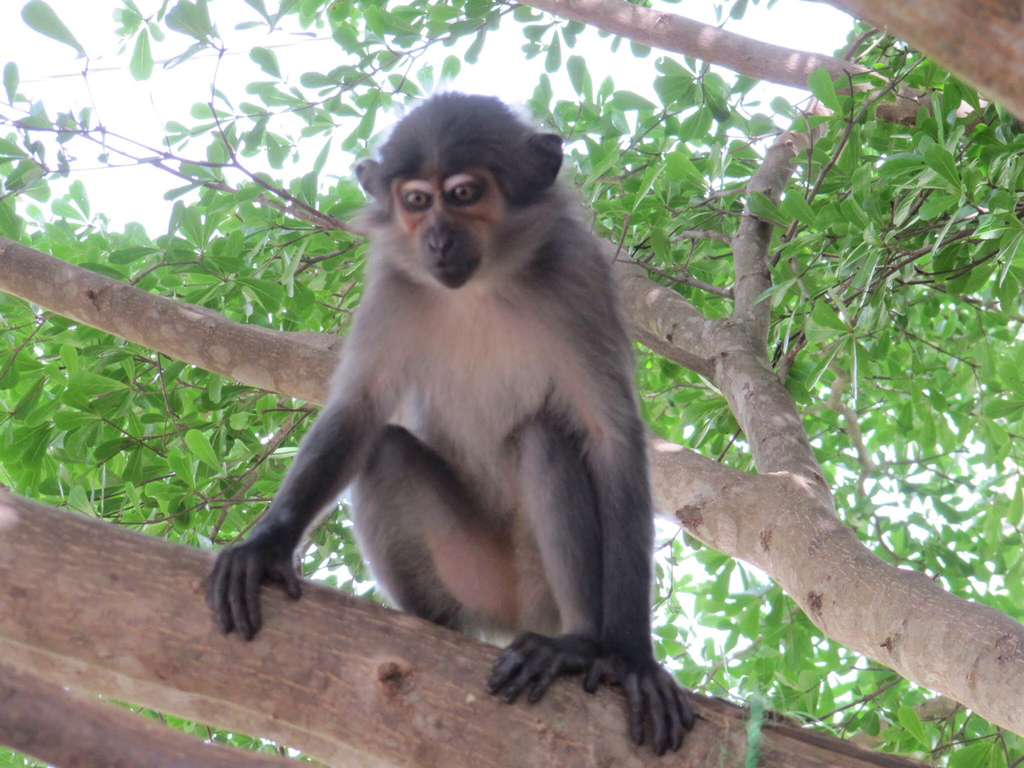
Smoky Mangabey
Cercocebus atys
The sooty mangabey (Cercocebus atys) is an Old World monkey found in forests from Senegal in a margin along the coast down to Ghana. While overall rated as Near Threatened, the eastern race lunulatus, also known as the white-crowned, white-naped, or white-collared mangabey (leading to confusion with the collared mangabey), is considered Endangered by the IUCN. The White-collared mangabey was declared its own species by the IUCN in 2016, but it retains the endangered conservation status.
From the article Sooty mangabey on Wikipedia (CC BY-SA), quoted section by section
Description
Sooty mangabeys are gray-colored primates with a lighter-colored chest and stomach. Their faces are typically grayish pink, with darker fur along the forehead and ears; given their diet of hard seeds and nuts, sooty mangabeys are observed to have strong molars. Sooty mangabeys also show sexual dimorphism; males typically weigh about 10–11 kg (22–24 lb), while females are typically smaller at about 5–6 kg (11–13 lb).
Wikipedia: “Appearance”
Range & habitat
The sooty mangabey is native to tropical West Africa, being found in Guinea, Guinea-Bissau, Liberia, Senegal, Sierra Leone, and Ivory Coast. Sooty mangabeys inhabit both old growth and secondary forests as well as in flooded, dry, swamp, mangrove, and gallery forests. Farmland can also be inhabited or put to use by the sooty
Wikipedia: “Habitat and ecology”
What it does
Sooty mangabeys are terrestrial omnivores, typically spending around 75% of their overall time on the ground (~85% of travel time and ~71% of foraging time). In their foraging behaviors, sooty mangabeys typically consume fruits (~20% of diet), invertebrates (~13% of diet), and nuts and seeds (>55% of diet). In acquiring nuts, sooty mangabeys have been observed scavenging the remains of coula and panda nuts cracked by chimpanzees and red river hogs, potentially using either the sound of cracking nuts or social networks to identify sites of remnants.
Wikipedia: “Diet”
Listen
Looking for field recordings…
Where it lives
Recorded sightings
—
geo-referenced records in GBIF, from museums, herbaria and field observers.
Drag the globe to turn it. Dots are where records exist, not a range map; darker means more records.
In the stacks
Searching the stacks…
Every page naming Cercocebus atys in the Biodiversity Heritage Library →
This page is assembled live from iNaturalist, GBIF, Wikipedia, the Source Library and the Internet Archive. It is not yet part of the hand-edited codex. iNaturalist taxon 566523.