- Animals
- ›Chordates
- ›Vertebrates
- ›Mammals
- ›Therians
- ›Placental Mammals
- ›Primates, Rodents, and Allies
- ›Primates
- ›Monkeys, Apes, and Tarsiers
- ›Monkeys and Apes
- ›Apes and Old World Monkeys
- ›Old World Monkeys
- ›Cercopithecines
- ›Guenons, Vervet Monkeys, and Talapoins
- ›Chlorocebus
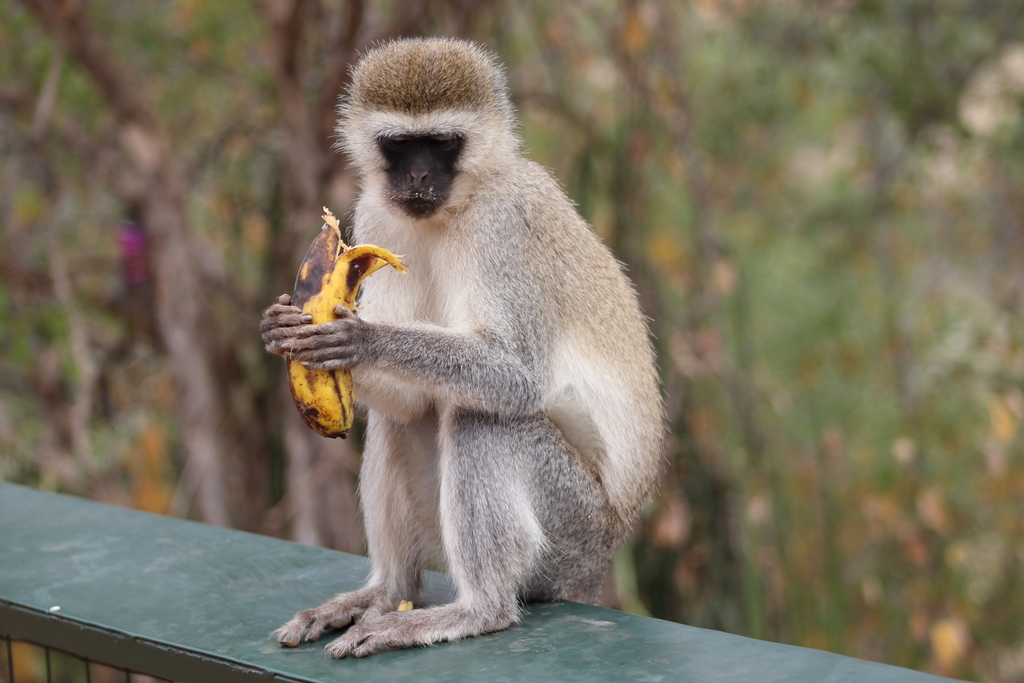
Vervet Monkey
Chlorocebus pygerythrus
The vervet monkey (Chlorocebus pygerythrus), or simply vervet, is an Old World monkey of the family Cercopithecidae native to Africa. The term "vervet" is also used to refer to all the members of the genus Chlorocebus. The five distinct subspecies can be found mostly throughout Southern Africa, as well as some of the eastern countries. These mostly herbivorous monkeys have black faces and grey body hair color, ranging in body length from about 40 cm (16 in) for females, to about 50 cm (20 in) for males.
In addition to behavioral research on natural populations, vervet monkeys serve as a nonhuman primate model for understanding genetic and social behaviors of humans. They have been noted for having human-like characteristics, such as hypertension, anxiety, and social and dependent alcohol use. Vervets live in social groups ranging from 10 to 70 individuals, with males moving to other groups at the time of sexual maturity. Studies done on vervet monkeys involve their communication and alarm calls, specifically in regard to kin and group recognition, and particular predator sightings.
From the article Vervet monkey on Wikipedia (CC BY-SA), quoted section by section
Range & habitat
The vervet monkey ranges throughout much of Southern and East Africa, being found from Ethiopia and extreme southern South Sudan all the way down to South Africa. It is not found west of the East African Rift or the Luangwa River, where it is replaced by the closely related malbrouck (C. cynosuros) species. The vervet monkey inhabits savanna, riverine woodland, coastal forest, and mountains up to 4000 m (13,100 ft). They are adaptable and able to persist in secondary and/or highly fragmented vegetation, including cultivated areas, and sometimes are found living in both rural and urban environments. Annual home range size has been observed to be as high as 176 ha, with an average population density of 54.68 animals/km2.
Wikipedia: “Natural habitat”
What it does
When males reach sexual maturity, they move to a neighboring group. Often, males move with a brother or peer, presumably for protection against aggression by males and females of the resident group. Groups that had previously transferred males show significantly less aggression upon the arrival of another male. In almost every case, males migrate to adjacent groups. This obviously increases benefits in regard to distance traveled, but also reduces the amount of genetic variance, increasing the likelihood of inbreeding. Females remain in their groups throughout life. Separate dominance hierarchies are found for each sex. Male hierarchies are determined by age, tenure in the group, fighting abilities, and allies, while female hierarchies are dependent on maternal social status. A large proportion of interactions occurs between individuals that are similarly ranked and closely related. Between unrelated individuals, female competition exists for grooming members of high-ranking families, presumably to gain more access to resources. These observations suggest individual recognition is possible and enables discrimination of genetic relatedness and social status. Interactions between different groups are variable, ranging from highly aggressive to friendly. …
Wikipedia: “Social behaviour”
Listen
Looking for field recordings…
Where it lives
Recorded sightings
—
geo-referenced records in GBIF, from museums, herbaria and field observers.
Drag the globe to turn it. Dots are where records exist, not a range map; darker means more records.
In the stacks
Searching the stacks…
Every page naming Chlorocebus pygerythrus in the Biodiversity Heritage Library →
This page is assembled live from iNaturalist, GBIF, Wikipedia, the Source Library and the Internet Archive. It is not yet part of the hand-edited codex. iNaturalist taxon 68137.