- Animals
- ›Chordates
- ›Vertebrates
- ›Mammals
- ›Therians
- ›Placental Mammals
- ›Primates, Rodents, and Allies
- ›Primates
- ›Monkeys, Apes, and Tarsiers
- ›Monkeys and Apes
- ›Apes and Old World Monkeys
- ›Old World Monkeys
- ›Colobines
- ›Langurs, Surilis, and Lutungs
- ›Rhinopithecus
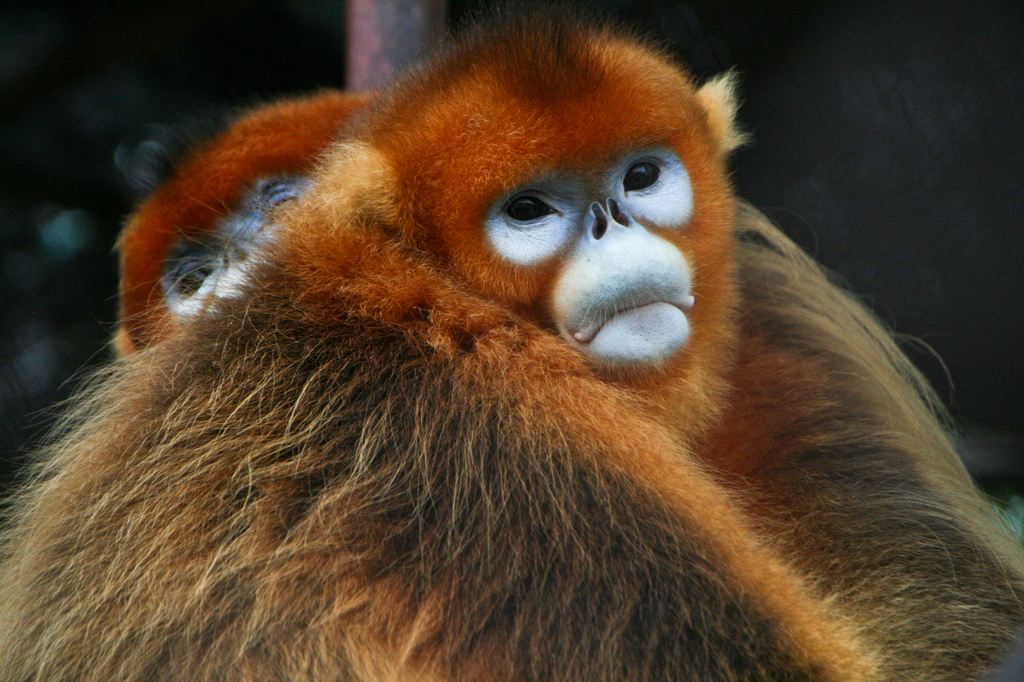
Golden Snub-nosed Monkey
Rhinopithecus roxellana
The golden snub-nosed monkey (Rhinopithecus roxellana) is an Old World monkey in the subfamily Colobinae. It is endemic to a small area in temperate, mountainous forests of central and Southwest China. They inhabit these mountainous forests of Southwestern China at elevations of 1,500–3,400 m (4,900–11,200 ft) above sea level. The Chinese name is Sichuan golden hair monkey (四川金丝猴). It is also widely referred to as the Sichuan snub-nosed monkey. Of the three species of snub-nosed monkeys in China, the golden snub-nosed monkey is the most widely distributed throughout China.
Snow occurs frequently within its range, and it can withstand colder average temperatures better than any other non-human primate. Its diet varies markedly with the seasons, but it is primarily a herbivore with lichens being its main food source. It is diurnal and largely arboreal, spending some 97% of its time in the canopy. There are three subspecies. Population estimates range from 8,000 to 15,000 and it is threatened by habitat loss.
From the article Golden snub-nosed monkey on Wikipedia (CC BY-SA), quoted section by section
Range & habitat
The distribution of the golden snub-nosed monkey is limited to temperate forests on mountains in four provinces in China: Sichuan, Gansu, Shaanxi, and Hubei. This monkey is found at elevations of 1,500-3,400 m. Within this area, vegetation varies with altitude from deciduous, broadleaf forests at low elevations to mixed coniferous, broadleaf forests above 2,200 m and coniferous forests above 2,600 m. Average annual temperature is 6.4 °C (43.5 °F) with a minimum of −8.3 °C (17.1 °F) in January and a maximum of 21.7 °C (71.1 °F) in July. Home range size varies seasonally. The change in home range size and location is dependent upon the availability and distribution of food. The total area covered by seasonal home ranges is surprisingly large for a species. One of the largest home ranges found covered 40 square kilometres (15 sq mi).
Wikipedia: “Habitat and distribution”
What it does
The golden snub-nosed monkey is found in groups ranging in size from 5–10 individuals to bands of about 600. The social organization of this species can be quite complex. The one-male-units (OMUs) are the basic social unit within groups of golden snub-nosed monkeys with many of the OMUs forming a bigger group. These multi-tier societies consist of several OMUs that include one adult male plus a number of adult females and their offspring. Some observers have even come to conclude that these large foraging groups are multi-male and multi-female societies. The male may stay solitary, often remaining away from the rest of the group members as they rest. Adult females tend to socialize more with one another than with other males or juveniles. Group members remain close to one another, interactions between different OMUs often result in confrontations. Females of the golden snub-nosed monkey are usually observed to form several close associations with other females. However, in conflicts against other units in the surrounding site, both males and females support each other, while also protecting their young (usually observed at a distance by putting the young in the center of the pack). Unusually for a harem-forming species, infanticide by males is averted. …
Wikipedia: “Behavior”
Listen
Looking for field recordings…
Where it lives
Recorded sightings
—
geo-referenced records in GBIF, from museums, herbaria and field observers.
Drag the globe to turn it. Dots are where records exist, not a range map; darker means more records.
In the stacks
Searching the stacks…
Every page naming Rhinopithecus roxellana in the Biodiversity Heritage Library →
This page is assembled live from iNaturalist, GBIF, Wikipedia, the Source Library and the Internet Archive. It is not yet part of the hand-edited codex. iNaturalist taxon 75028.