- Plants
- ›Vascular Plants
- ›flowering plants
- ›Dicots
- ›Mints, Plantains, Olives, and Allies
- ›bladderwort family
- ›Pinguicula
- ›Pinguicula
- ›Pinguicula
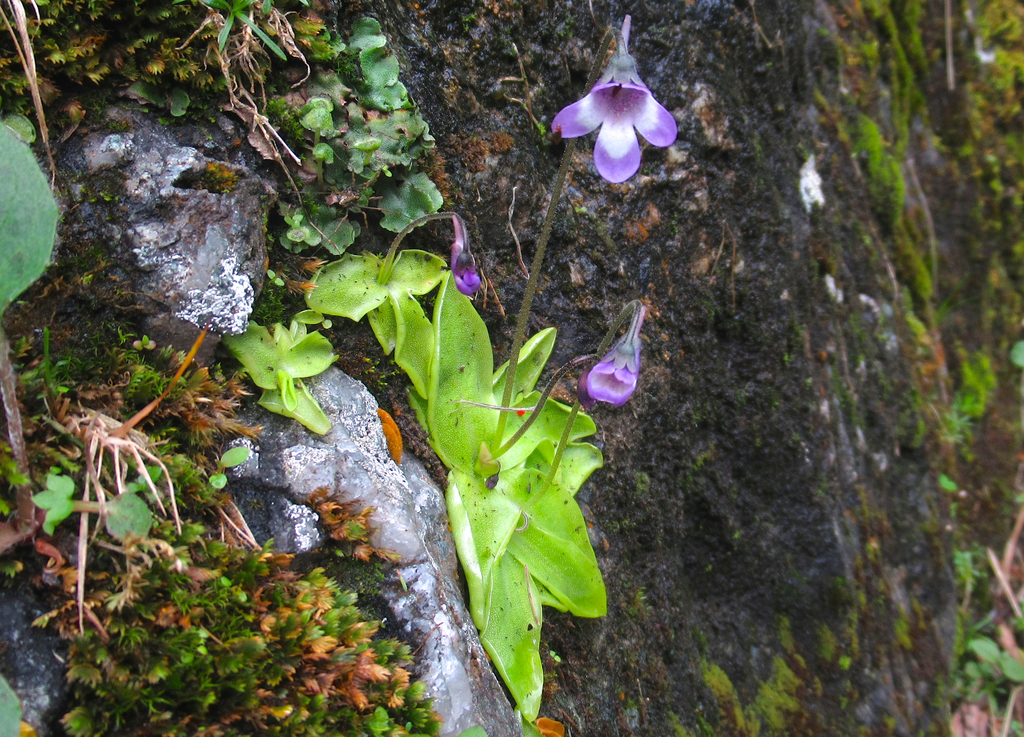
Common Butterwort
Pinguicula vulgaris
Pinguicula vulgaris, the common butterwort, is a perennial carnivorous plant in the bladderwort family Lentibulariaceae. It grows to a height of 3–16 cm, and is topped with a purple, and occasionally white, flower that is 15 mm or longer, and shaped like a funnel. This butterwort grows in damp environments such as bogs and swamps, in low or subalpine elevations. It has a generally circumboreal distribution, being native to almost every country in Europe as well as Russia,...
From the article Pinguicula vulgaris on Wikipedia (CC BY-SA), quoted section by section
Description
It grows to a height of 3–16 centimetres (1.2–6.3 in), and is topped with a purple, and occasionally white, flower that is 15 millimetres (0.59 in) or longer, and shaped like a funnel. This butterwort grows in damp environments such as bogs and swamps, in low or subalpine elevations. Being native to environments with cold winters, they produce a winter-resting bud (hibernaculum). There are three forms originating from Europe: P. vulgaris f. bicolor, which has petals that are white and purple; P. vulgaris f. albida, which has all white petals; and P. vulgaris f. alpicola, which has larger flowers. The taxonomic status of these forms is not universally recognised – see e.g. The Plant List. Common butterwort is an insectivorous plant. Its leaves have glands that excrete a sticky fluid that traps insects; the glands also produce enzymes that digest the insects. This serves as a way for the plant to access a source of nitrogen, as they generally grow in soil that is acidic and low in nutrients, such as bogs. Insect capture is an adaptation to nutrient-poor conditions, and the plant is highly dependent on insects for nitrogen.
Range & habitat
It has a generally circumboreal distribution, being native to almost every country in Europe as well as Russia, Canada, and the United States. It is generally found growing in places such as bogs, fens, alvars, and other areas with limestone bedrock and alkaline waters.
Wikipedia: “Distribution”
Where it lives
Recorded sightings
—
geo-referenced records in GBIF, from museums, herbaria and field observers.
Drag the globe to turn it. Dots are where records exist, not a range map; darker means more records.
In the stacks
Searching the stacks…
Every page naming Pinguicula vulgaris in the Biodiversity Heritage Library →
This page is assembled live from iNaturalist, GBIF, Wikipedia, the Source Library and the Internet Archive. It is not yet part of the hand-edited codex. iNaturalist taxon 121266.