- Plants
- ›Vascular Plants
- ›flowering plants
- ›Dicots
- ›pinks, cactuses, and allies
- ›Amaranth family
- ›Amaranthoideae
- ›Amaranthus
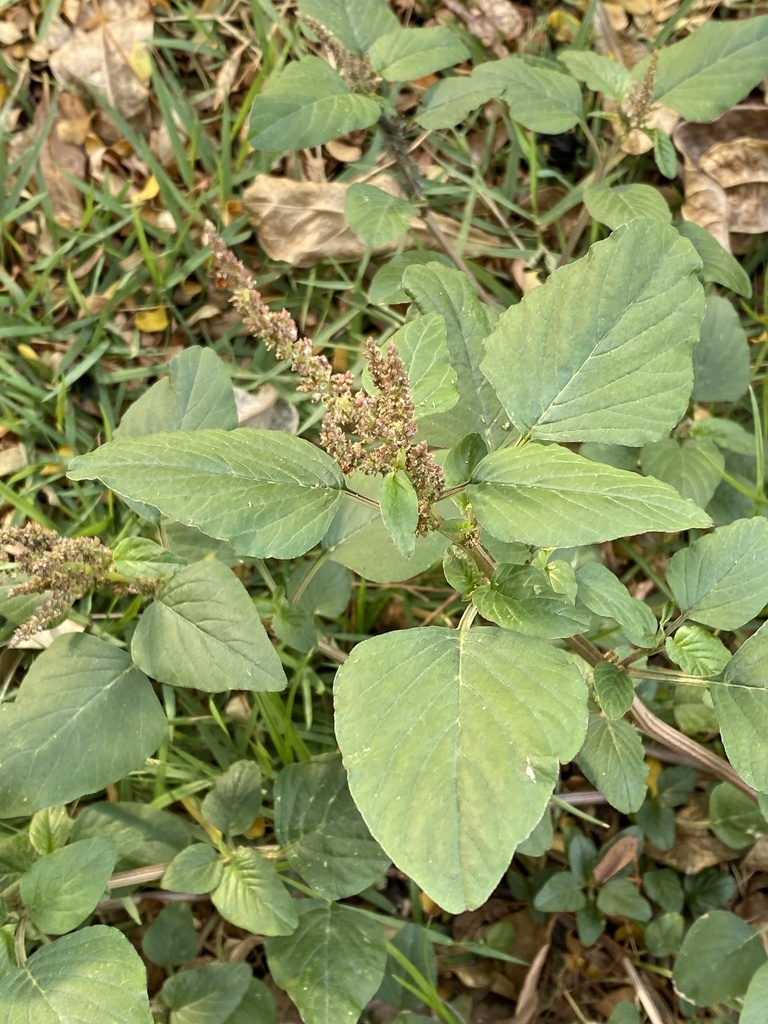
green amaranth
Amaranthus viridis
Amaranthus viridis is a cosmopolitan species in the botanical family Amaranthaceae and is commonly known as slender amaranth or green amaranth. It is native to the tropics of the Americas, specifically South America, Central America, and the Caribbean.
From the article Amaranthus viridis on Wikipedia (CC BY-SA), quoted section by section
Description
Amaranthus viridis is an annual herb with an upright, light green stem that grows to about 60–80 cm in height. Numerous branches emerge from the base, and the leaves are ovate, 3–6 cm long, 2–4 cm wide, with long petioles of about 5 cm. The plant has terminal panicles with few branches, and small green flowers with 3 stamens.
At the table
Amaranthus viridis is eaten as a boiled green or as a [vegetable in many parts of the world. In the Northeastern Indian state of Manipur, it is known as cheng-kruk and in Assam it is known as khutora xak; in Bihar and Jharkhand it is known as Gandhari (or sometimes Gendhari) saag; it is also eaten as a vegetable in South India, especially in Kerala, where it is known as kuppacheera കുപ്പച്ചീര. Sinhala name: Koora thampala (කූර තම්පලා). It is a common vegetable in Bengali cuisine, where it is called notey shak (নোটে শাক, "shak" meaning 'leafy vegetable'). It a very common vegetable used in Odia cuisine as Saaga, namely as Kosila Saaga or Marshi Saag in rural areas. It is also eaten as a vegetable in parts of Africa. The leaves of this plant, known as massaagu in Dhivehi, have been used in the diet of the Maldives for centuries in dishes such as mas huni. The Yoruba in West Africa name for this plant is ewe tete and is used for medicinal and spiritual purposes. In the 19th Century A. viridus, or green amaranth was an item of food in Australia. The botanist Joseph Maiden wrote in 1889: "It is an excellent substitute for spinach, being far superior to much of the leaves of the white beet sold for spinach in Sydney. Next to spinach it seems to be most like boiled nettle leaves, which when young are used in England, and are excellent. …
Wikipedia: “Uses”
Where it lives
Recorded sightings
—
geo-referenced records in GBIF, from museums, herbaria and field observers.
Drag the globe to turn it. Dots are where records exist, not a range map; darker means more records.
In the stacks
Searching the stacks…
Every page naming Amaranthus viridis in the Biodiversity Heritage Library →
This page is assembled live from iNaturalist, GBIF, Wikipedia, the Source Library and the Internet Archive. It is not yet part of the hand-edited codex. iNaturalist taxon 75401.