- Plants
- ›Vascular Plants
- ›flowering plants
- ›Dicots
- ›Roses, Elms, Figs, and Allies
- ›rose family
- ›brambles, roses, strawberries, and allies
- ›strawberries, cinquefoils, and allies
- ›cinquefoil subtribe
- ›Potentilla
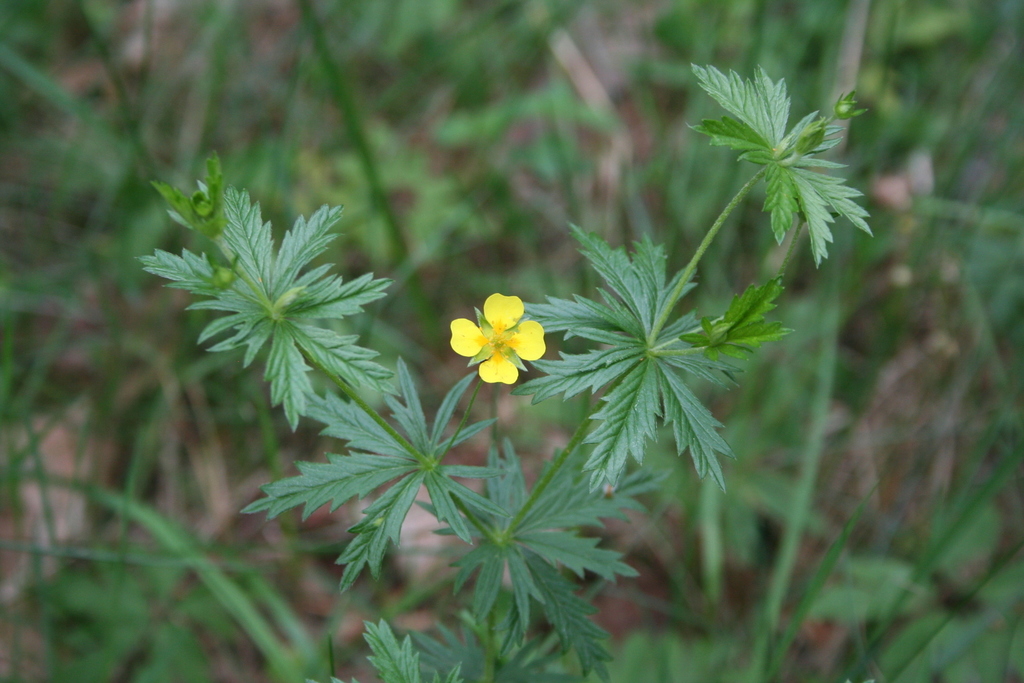
Tormentil
Potentilla erecta
Potentilla erecta (syn. Tormentilla erecta, Potentilla laeta, Potentilla tormentilla, known as the (common) tormentil, septfoil or erect cinquefoil ) is a herbaceous perennial plant belonging to the rose family (Rosaceae).
From the article Potentilla erecta on Wikipedia (CC BY-SA), quoted section by section
Description
Potentilla erecta is a low, clump-forming plant with slender, procumbent to arcuately upright stalks, growing 10–30 centimetres (3.9–11.8 in) tall and with non-rooting runners. It grows wild predominantly in Europe and western Asia[1], mostly on acid soils and in a wide variety of habitats such as mountains, heaths, meadows, sandy soils, and dunes. This plant flowers from May to August or September. There is one yellow, 7–11 millimetres (0.28–0.43 in) wide flower, growing at the tip of a long stalk. There are almost always four notched petals, each between 3 and 6 mm long. Four petals are rather uncommon in the rose family. The petals are somewhat longer than the sepals. There are 20–25 stamens. The radical leaves have a long petiole, whilst the leaves on the flowering stalks are usually sessile or with short petioles. The glossy leaves are alternate, ternate, consisting of three obovate leaflets with serrated margins. The paired stipules are leaflike and palmately lobed. There are 2–8 dry, inedible fruits.
At the table
The rhizomatous root is thick. It has little value for food use because of its bitterness and low caloric value. The roots are a main ingredient of a bitter liqueur from Bavaria and the Black Forest area, called Blutwurz. It is also used in Ukraine along with honey in horilka. The plant is used in herbal medicine as an astringent because of its tannin content, which is unusually high for a herbaceous plant. Structurally-related phlobaphenes, used as a red dye for leather known as tormentil red, can be extracted from the root of the common tormentil along with the triterpene alcohol tormentiol. Aqueous extracts of the rhizomes are reported to have low toxicity in rats and mice. Research into the plant during 2026 indicates that other significant medicinal uses may be indicated.
Wikipedia: “Uses”
Where it lives
Recorded sightings
—
geo-referenced records in GBIF, from museums, herbaria and field observers.
Drag the globe to turn it. Dots are where records exist, not a range map; darker means more records.
In the old herbals & bestiaries

Latin Herbal
1491 · p.1

Living Images of Plants
Otto Brunfels · 1532 · p.95

Latin Herbal
1484 · p.301

Herbarius
1485 · p.302

Herbarius latinus (with Dutch synonyms)
1486 · p.299

Herbarius latinus (with French synonyms)
1486 · p.303

Latin Herbal with German Synonyms
1486 · p.302

Ortus sanitatis
1491 · p.459

Herbal of Virtues
1499 · p.301

Garden of Health
1507 · p.370

Living Images of Plants
Otto Brunfels · 1532 · p.92

The Great Herbary with all the figures of the herbs
1532 · p.307
In the stacks
Searching the stacks…
Every page naming Potentilla erecta in the Biodiversity Heritage Library →
This page is assembled live from iNaturalist, GBIF, Wikipedia, the Source Library and the Internet Archive. It is not yet part of the hand-edited codex. iNaturalist taxon 132622.