- Plants
- ›Vascular Plants
- ›flowering plants
- ›monocots
- ›grasses, sedges, cattails, and allies
- ›grasses
- ›Paniceae, andropogoneae, paspaleae, and allies
- ›bristle, rosette, and barnyard grasses, and allies
- ›Cenchrinae
- ›Setaria
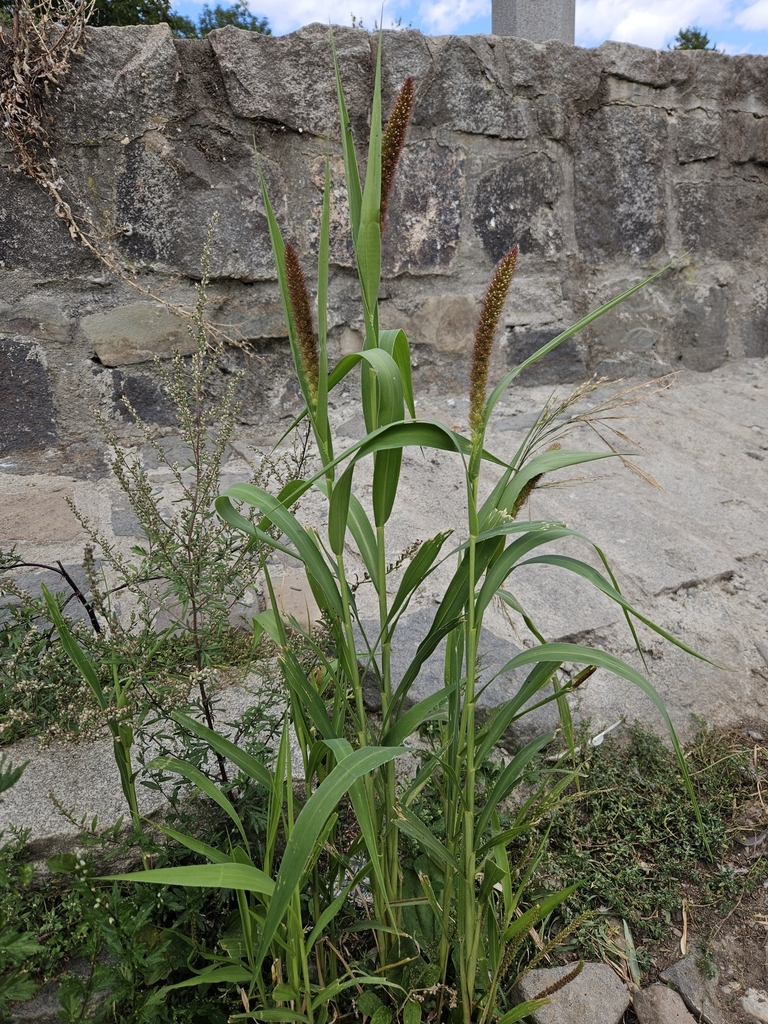
Foxtail Bristle-grass
Setaria italica
Foxtail millet, scientific name Setaria italica (synonym Panicum italicum L.), is an annual grass grown for human food. It is the second-most widely planted species of millet and the most grown millet species in Asia. The oldest evidence of foxtail millet cultivation was found along the ancient course of the Yellow River in Cishan, China, carbon dated to be from around 8,000 years ago.
Other names for the species include dwarf setaria, foxtail bristle-grass, giant setaria, green foxtail, Italian millet, German millet, and Hungarian millet.
From the article Foxtail millet on Wikipedia (CC BY-SA), quoted section by section
Description
Foxtail millet is an annual grass with slim, vertical, leafy stems which can reach a height of 120–200 cm (4–6+1⁄2 ft). The seedhead is a dense, hairy panicle 5–30 cm (2–12 in) long. The small seeds, around 2 millimetres (3⁄32 in) in diameter, are encased in a thin, papery hull which is easily removed in threshing. Seed color varies greatly between varieties.
How it is grown
In India, foxtail millet is still an important crop in its arid and semi-arid regions. In South India, it has been a staple diet among people for a long time from the Sangam period. It is referred to often in old Tamil texts and is commonly associated with Lord Muruga and his consort Valli. In Karbi Anglong district of Assam, India, millets have been an integral part of the food system of the Karbis as well as the Jhum fields. Hanjangmilen, Karbi name of foxtail millets have been visible in the Jhum fields in the past. But today it is hardly visible in the Jhum fields. But farmers are now bringing the traditional crop back into their food system which needs little water, grows well on poor soil, is fast-growing and suffers from very few diseases. In China, foxtail millet was the main staple food in the north before the Song dynasty, when wheat started to become the main staple food. It is still the most common millet and one of the main food crops in the dry northern part of the country, especially among the poor. In Southeast Asia, foxtail millet is commonly cultivated in its dry, upland regions. …
Wikipedia: “Modern cultivation”
In human culture
The wild ancestor of foxtail millet has been securely identified as Setaria viridis, which is interfertile with foxtail millet; wild or weedy forms of foxtail millet also exist. Zohary and Hopf note that the primary difference between the wild and cultivated forms is "their seed dispersal biology. Wild and weedy forms shatter their seed while the cultivars retain them." The reference genome for foxtail millet was completed in 2012. Genetic comparisons also confirm that S. viridis is the antecedent of S. italica. The earliest evidence of the cultivation of this grain comes from the Peiligang culture of China, which also cultivated Panicum miliaceum, but foxtail millet became the predominant grain only with the Yangshao culture. More recently, the Cishan culture of China has been identified as the earliest to domesticate foxtail millet around 6500–5500 BC. Foxtail millet has also been grown in India since antiquity. The earliest evidence for foxtail millet cultivation outside of its native distribution is at Chengtoushan in the Middle Yangtze River region, dating to around 4000 BC. In southern China, foxtail millet reached the Chengdu Plain (Baodun) at around 2700 BC and Guangxi (near the Vietnamese border) at around 3000 BC. …
Wikipedia: “History and domestication”
Where it lives
Recorded sightings
—
geo-referenced records in GBIF, from museums, herbaria and field observers.
Drag the globe to turn it. Dots are where records exist, not a range map; darker means more records.
In the stacks
Searching the stacks…
Every page naming Setaria italica in the Biodiversity Heritage Library →
This page is assembled live from iNaturalist, GBIF, Wikipedia, the Source Library and the Internet Archive. It is not yet part of the hand-edited codex. iNaturalist taxon 168879.