- Animals
- ›Chordates
- ›Vertebrates
- ›Mammals
- ›Therians
- ›Placental Mammals
- ›Afromammals
- ›Hyraxes
- ›Hyraxes
- ›Procavia
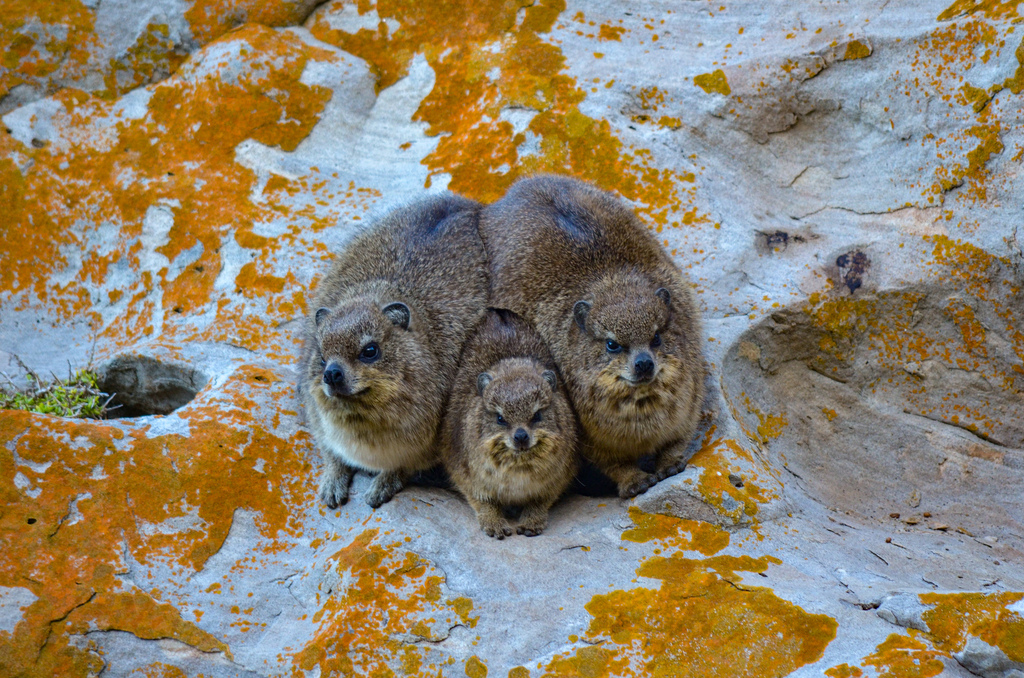
Rock Hyrax
Procavia capensis
The rock hyrax (; Procavia capensis), also called dassie, Rickaz, Cape hyrax, rock rabbit, or coney (in early English Bible translations), is a medium-sized terrestrial hyrax native to Africa and the Middle East. Commonly called the dassie in South Africa (; Afrikaans: klipdassie), it is one of the five living species of the order Hyracoidea, and the only one in the genus Procavia.
Rock hyraxes weigh 4–5 kg (8.8–11.0 lb) and have short ears.
From the article Rock hyrax on Wikipedia (CC BY-SA), quoted section by section
Description
Rock hyraxes are squat and heavily built, with adults reaching a length of 50 cm (20 in) and weighing around 4 kg (8.8 lb), with a slight sexual dimorphism, males being about 10% heavier than females. Their fur is thick and grey-brown, although this varies strongly between different environments, from dark brown in wetter habitats, to light gray in desert-living individuals. Hyrax size (as measured by skull length and humerus diameter) is correlated to precipitation, probably because of the effect on preferred hyrax forage. Prominent in and apparently unique to hyraxes is the dorsal gland, which excretes an odour used for social communication and territorial marking. The gland is most clearly visible in dominant males. The rock hyrax has a pointed head, short neck, and rounded ears. It has long, black whiskers on its muzzle. The rock hyrax has a prominent pair of long, pointed tusk-like upper incisors, which are reminiscent of the elephant, to which the hyrax is distantly related. The fore feet are plantigrade, and the hind feet are semi-digitigrade. The soles of the feet have large, soft pads that are kept moist with sweat-like secretions. …
Wikipedia: “Characteristics”
Range & habitat
The rock hyrax occurs widely across sub-Saharan Africa in disjunct northern and southern populations; it is absent from the Congo Basin and Madagascar. The distribution encompasses southern Algeria, Libya, Egypt, and the Middle East, with populations in Israel, Jordan, Lebanon, and the Arabian Peninsula. The northern subspecies was introduced to Jebel Hafeet, which is on the border of Oman and the United Arab Emirates. The shade of their pelts varies individually and regionally. In particular, the dorsal patches (present in both sexes) of the central populations are very variable, ranging from yellow to black, or flecked. In outlying populations, these are more constant in colour, black in P. c. capensis, cream in P. c. welwitschii, and orange in P. c. ruficeps. A larger, longer-haired population is abundant in the moraines in the alpine zone of Mount Kenya.
Subspecies. The subspecies, which are sometimes elevated to full species, are:
P. c. capensis (Pallas, 1766) – Cape rock hyrax, native to South Africa and Namibia P. c. habessinicus (Hemprich and Ehrenberg, 1832) – Ethiopian rock hyrax, native to northeastern Africa and Arabia P. c. johnstoni Thomas, 1894 – black-necked rock hyrax, native to central and East Africa P. c. ruficeps (Hemprich and Ehrenberg, 1832) – red-headed rock hyrax, native to the southern Sahara P. c. …
Wikipedia: “Distribution and geographic variation”
What it does
Rock hyraxes build dwelling holes in any type of rock with suitable cavities, such as sedimentary rocks and soil. In Mount Kenya, rock hyraxes live in colonies comprising an adult male, several adult females, and immatures. They are active during the day, and sometimes during moonlit nights. The dominant male defends and watches over the group. The male also marks his territory. In Africa, hyraxes are preyed on by leopards, Egyptian cobras, puff adders, rock pythons, caracals, wild dogs, hawks, and owls. Verreaux's eagle in particular is a specialist hunter of hyraxes. In the Middle East, the rock hyrax is reportedly rarely preyed upon by terrestrial predators, as their system of sentries and reliable refuges provides considerable protection. Hyrax remains are almost absent from the droppings of wolves in the Judaean Desert.
Feeding and foraging. Hyraxes feed on a wide variety of plant species, including Lobelia and broad-leafed plants. They also have been reported to eat insects and grubs. They forage for food up to about 50 m from their refuge, usually feeding as a group and with one or more acting as sentries from a prominent lookout position. …
Wikipedia: “Ecology and behavior”
In human culture
The rock hyrax is classified as treif (not kosher; unclean) according to kashrut – Jewish food hygiene rules – due to statements in the Torah: "And the coney, because he cheweth the cud, but divideth not the hoof; he is unclean unto you" (Leviticus 11:5). Hyraxes are also mentioned in Proverbs 30:26 as one of a number of remarkable animals for being small but exceedingly wise, in this case because "the conies are a people not mighty, yet they make their homes in the cliffs". In Joy Adamson's books and the film Born Free, a rock hyrax called Pati-Pati was her companion for six years before Elsa and her siblings came along; Pati-Pati reportedly took the role of nanny and watched over them with great care. The 2013 animated film Khumba features a number of rock hyraxes that sacrifice one of their own to a white Verreaux's eagle.
Wikipedia: “In culture”
Listen
Looking for field recordings…
Where it lives
Recorded sightings
—
geo-referenced records in GBIF, from museums, herbaria and field observers.
Drag the globe to turn it. Dots are where records exist, not a range map; darker means more records.
In the stacks
Searching the stacks…
Every page naming Procavia capensis in the Biodiversity Heritage Library →
This page is assembled live from iNaturalist, GBIF, Wikipedia, the Source Library and the Internet Archive. It is not yet part of the hand-edited codex. iNaturalist taxon 43086.