- Animals
- ›Chordates
- ›Vertebrates
- ›Mammals
- ›Therians
- ›Placental Mammals
- ›Primates, Rodents, and Allies
- ›Primates
- ›Monkeys, Apes, and Tarsiers
- ›Monkeys and Apes
- ›Apes and Old World Monkeys
- ›Old World Monkeys
- ›Colobines
- ›Langurs, Surilis, and Lutungs
- ›Presbytis
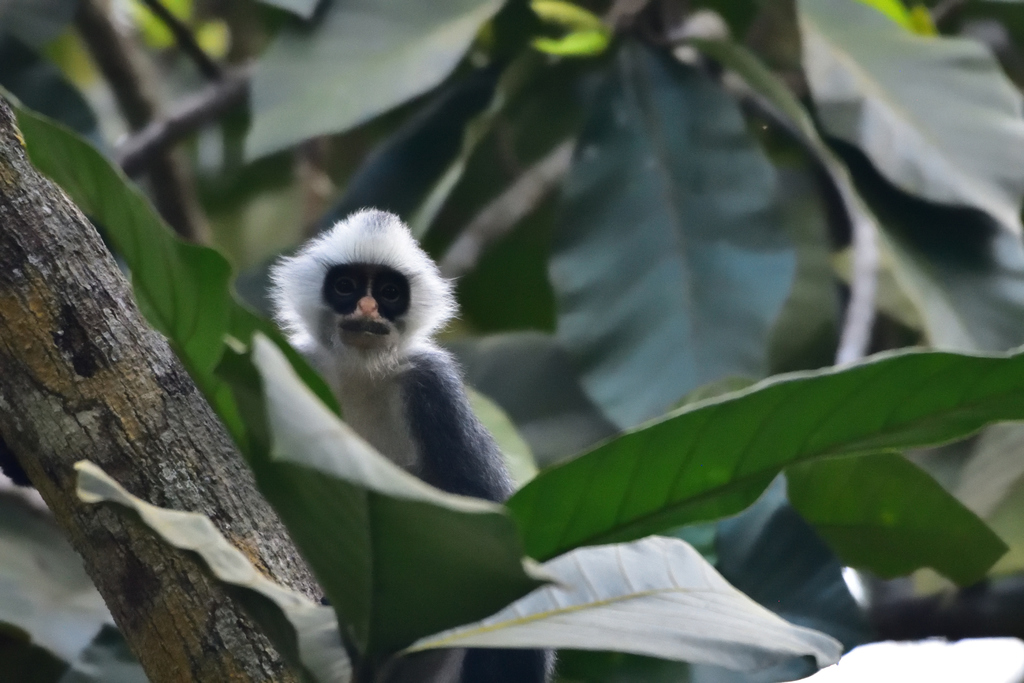
Bornean Grey Langur
Presbytis hosei
Hose's langur (Presbytis hosei) is a species of primate in the family Cercopithecidae endemic to the island of Borneo, including Brunei, Kalimantan (Indonesia), and East Malaysia. Its natural habitat is subtropical or tropical dry forests. It is threatened by habitat loss. It was first identified in Kutai National Park and Sangkulirang Peninsula, East Kalimantan, Indonesia, in 1985.
Miller's langur (P. canicrus) and the Saban grizzled langur (P. sabana) were previously considered subspecies of Hose's langur. There used to also be two additional forms that were considered separate subspecies, P. h. hosei and P. h. everetti. However, P. h. everetti is no longer considered to be a separate subspecies as the original identification of it as a separate subspecies appears to be the result of comparing a subadult female with an adult male.
From the article Hose's langur on Wikipedia (CC BY-SA), quoted section by section
Description
Hose's langur has grey-ish fur all over their bodies except for white tuffs of fur on their head that forms a point at the top of the head and points on either sides of their face. Also, their grey-ish fur turns a darker shade then into black fur on their backs, hands, feet and on their face. The black fur forms a "bandit mask" over their pink skin, much like a raccoon.
Wikipedia: “Appearance”
Range & habitat
Hose's langur is commonly found in the northern and eastern regions of Malaysia as well as the northern part of Borneo. They are most likely to be found in coastal regions with forests. These forests regions called dipterocarp forests are known for their tall trees, in which the Hose's langur spends its entire life. The Hose's langur's territory is small spanning no larger than 0.14 square miles. It has been observed that they rarely leave this small area.
Wikipedia: “Habitat”
What it does
Hose's langur primarily eat leaves but have been observed to sometimes eat fruits. Because of their high cellulose diet, they have a four chambered stomach, similar to a cow, giving them a "pot-belly" like body shape. They also have been observed in rare occasions to climb down from the canopy of the forest to eat mud at mineral springs. When they eat this mud its minerals form what's called a bezoar stones in their stomachs. In some cultures, these stones are believed to have a medicinal effect for humans.
Wikipedia: “Diet”
Listen
Looking for field recordings…
Where it lives
Recorded sightings
—
geo-referenced records in GBIF, from museums, herbaria and field observers.
Drag the globe to turn it. Dots are where records exist, not a range map; darker means more records.
In the stacks
Searching the stacks…
Every page naming Presbytis hosei in the Biodiversity Heritage Library →
This page is assembled live from iNaturalist, GBIF, Wikipedia, the Source Library and the Internet Archive. It is not yet part of the hand-edited codex. iNaturalist taxon 43500.