- Animals
- ›Chordates
- ›Vertebrates
- ›Mammals
- ›Therians
- ›Placental Mammals
- ›Primates, Rodents, and Allies
- ›Primates
- ›Monkeys, Apes, and Tarsiers
- ›Monkeys and Apes
- ›Apes and Old World Monkeys
- ›Old World Monkeys
- ›Cercopithecines
- ›Baboons, Macaques, and Mangabeys
- ›Mandrillus
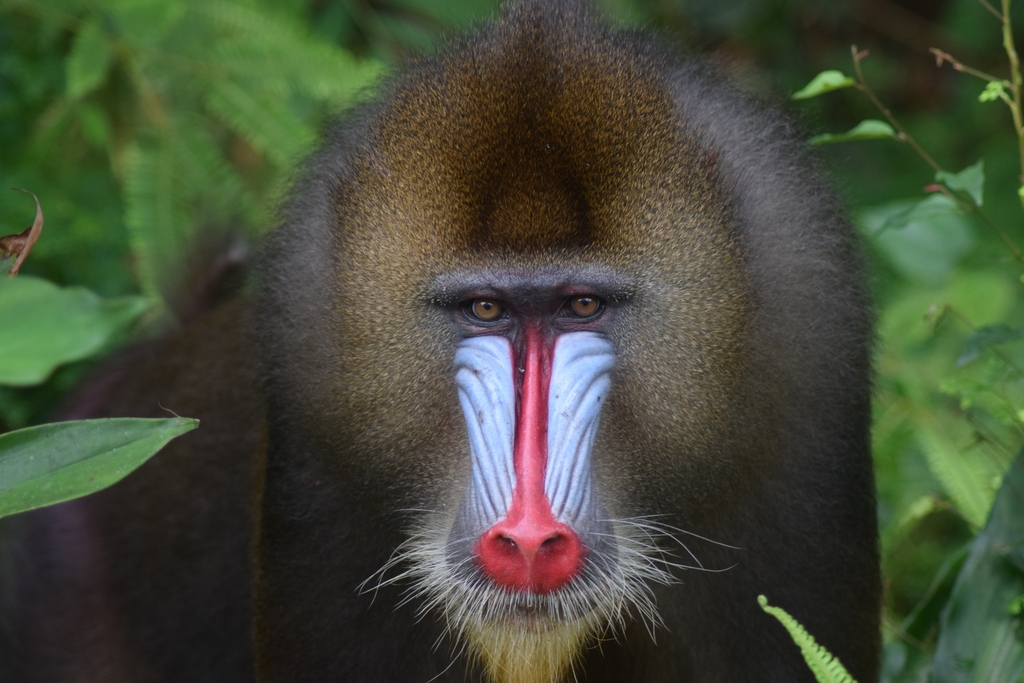
Mandrill
Mandrillus sphinx
The mandrill (Mandrillus sphinx) is a large Old World monkey native to west central Africa. It is one of the most colorful mammals in the world, with red and blue skin on its face and posterior. The species is sexually dimorphic, as males have a larger body, longer canine teeth and brighter coloring. Its closest living relative is the drill, with which it shares the genus Mandrillus. Both species were traditionally thought to be baboons, but further evidence has shown that they are more closely related to white-eyelid mangabeys.
Mandrills mainly live in tropical rainforests but will also travel across savannas. They are active during the day and spend most of their time on the ground. Their preferred foods are fruit and seeds, but mandrills will consume leaves, piths, mushrooms, and animals from insects to juvenile bay duiker. Mandrills live in large, stable groups known as "hordes" which can number in the hundreds. Females form the core of these groups, while adult males are solitary and only reunite with the larger groups during the breeding season. Dominant males have the most vibrant colors and fattest flanks and rumps, and have the most success siring young.
From the article Mandrill on Wikipedia (CC BY-SA), quoted section by section
Description
The mandrill has a stocky body with a large head and muzzle, as well as a short and stumpy tail. The limbs are evenly sized and the fingers and toes are more elongated than those in baboons, with a more opposable big toe on the feet. The mandrill is the most sexually dimorphic primate, and it is the largest monkey. Females are less stocky and have shorter, flatter snouts. Males have a 70–95 cm (28–37 in) head-body length and weigh 19–30 kg (42–66 lb) while females have a 55–70 cm (22–28 in) head-body length and weigh 10–15 kg (22–33 lb). Most of the teeth are larger in males, and the canine teeth reach up to 4.5 cm (1.8 in) and 1 cm (0.39 in) long for males and females respectively. Both sexes have 7–10 cm (2.8–3.9 in) long tails.
The coat of the mandrill is primarily grizzled or banded olive-brown with a yellow-orange beard and sparse, light hairs on its underside. The lips are surrounded by stiff white whiskers, and white bare skin exists behind the ears. Male mandrills have a "crest" of long hairs on the head and neck, while both sexes have chest glands which are covered by long hairs. The face, rump and genitals have less hair. The mandrill has a red line running down the middle of their face which connects to their red nose. On either side of the line, the skin is blue and grooved. In males, the blue skin is supported by ridged bone swellings. …
Wikipedia: “Characteristics”
What it does
The mandrill lives in west-central Africa, including southern Cameroon, mainland Equatorial Guinea (Río Muni), Gabon and parts of the Republic of the Congo. Its range is bounded by the Sanaga River to the north and the Ogooué and Ivindo Rivers to the east. It does not appear to share habitat with the drill, as the two species are separated by the Sanaga River. Mandrills live in tropical rainforests, generally preferring primary forests over secondary forests. They also live in patchy gallery forests surrounded by savanna and travel across grass areas within their forest habitats. They have also been recorded in mountainous areas, near rivers and in cultivated fields. Mandrills prefer thick bush dominated by perennial plants like gingers and plants of the genera Brillantaisia and Phaulopsis. They mainly dwell on the ground, but feed as high as the canopy. Both mandrills and drills are more arboreal than baboons. Mandrills may aggregate or compete with other primates such as talapoins, guenons, mangabeys, black-and-white colobuses, chimpanzees, and gorillas.
Diet. The mandrill is an omnivore. The core of its diet consists of plants, of which it eats over a hundred species. In Lopé National Park, the mandrill's diet was composed of fruit (50.7%), seeds (26.0%), leaves (8.2%), pith (6.8%), flowers (2.7%), and animal matter (4.1%), with other foods making up the remaining 1.4%. …
Wikipedia: “Ecology”
In human culture
The word mandrill is derived from the English words man and drill—the latter meaning 'baboon' or 'ape' and being West African in origin—and dated to 1744. The name appears to have originally referred to chimpanzees. The first scholar to record the name for the colorful monkey was Georges-Louis Buffon in 1766. It was called the "tufted ape", "great baboon" and "ribbernosed baboon" by Thomas Pennant in A Synopsis of Quadrupeds (1771) and A History of Quadrupeds (1781).
Wikipedia: “Etymology”
Listen
Looking for field recordings…
Where it lives
Recorded sightings
—
geo-referenced records in GBIF, from museums, herbaria and field observers.
Drag the globe to turn it. Dots are where records exist, not a range map; darker means more records.
In the old herbals & bestiaries

In the stacks
Searching the stacks…
Every page naming Mandrillus sphinx in the Biodiversity Heritage Library →
This page is assembled live from iNaturalist, GBIF, Wikipedia, the Source Library and the Internet Archive. It is not yet part of the hand-edited codex. iNaturalist taxon 43533.