- Animals
- ›Chordates
- ›Vertebrates
- ›Mammals
- ›Therians
- ›Placental Mammals
- ›Ungulates, Carnivorans, and Allies
- ›Bats
- ›Yangochiroptera
- ›Noctilionoid Bats
- ›Ghost-faced and Moustached Bats
- ›Pteronotus
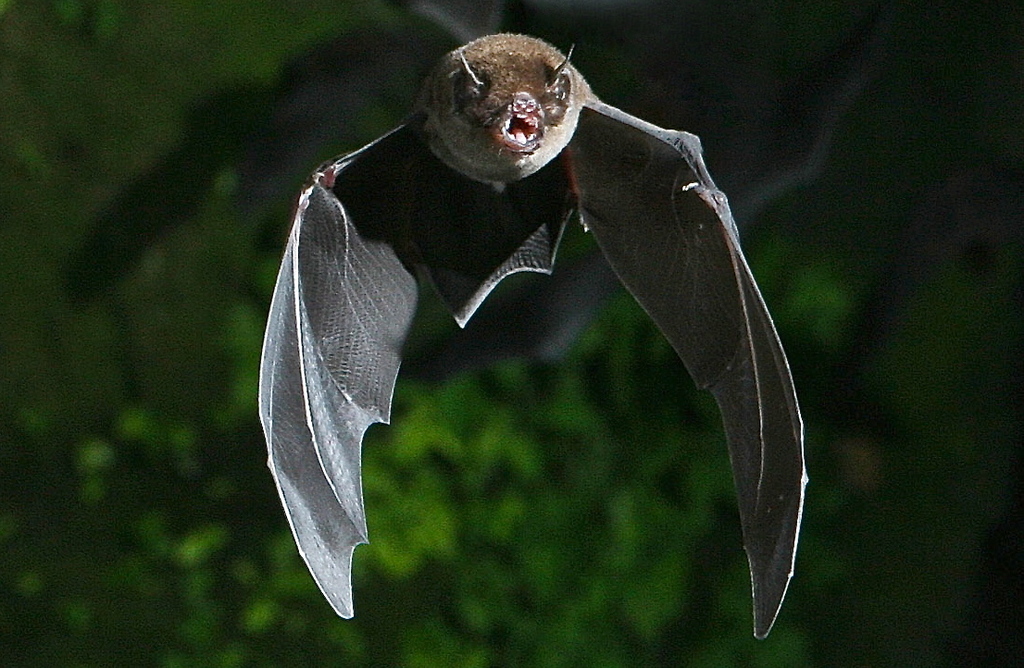
Davy's naked-backed bat
Pteronotus davyi
Davy's (Lesser) naked-backed bat (species Pteronotus davyi) is a small, insect-eating, cave-dwelling bat of the Order Chiroptera and Family Mormoopidae. It is found throughout South and Central America, including Trinidad, but not Tobago, Guyana, Suriname, or French Guiana. Specimens of this bat had been found infected with rabies in Trinidad during the height of that's island's vampire-bat transmitted rabies epidemic of the early half of the 20th century, but not in recent times. (Trinibats. Gomes, Pers....
From the article Davy's naked-backed bat on Wikipedia (CC BY-SA), quoted section by section
Range & habitat
These bats are found most commonly in moist habitats that sustain a high volume of insects. Nighttime roosts of these animals are most commonly found in warm, dark, moist caves. P. davyi are found as far north as Mexico and as far south as South America and Honduras. They typically prefer low elevations, but some individuals have been observed at elevations as high as 2,000 meters above sea level. There has been no recorded observance of this species in Guyana, Suriname, or French Guiana. Studies of this species have revealed genetic divergence between the Southeastern P. davyi population, and the Pacific and Gulf Coast populations. This is believed to be a result of geographical barriers that separate these populations. These geographical barriers are Sierra Madre Occidental, Sierra Madre Oriental, and Sierra Madre del Sur.
Wikipedia: “Ecology and distribution”
What it does
Pteronotus davyi are nocturnal, insectivorous bats that tend to roost in communities within their own species. Daytime roosts are seen to be shared between other species within the family Mormoopidae. This species uses echolocation to target prey in the dark, deciduous forests they reside in. Insects preyed upon include moths, flies and earwigs. Pteronotus davyi are known to be seasonally monogamous, and usually mate in the months of January and February. These bats have one offspring per mating season. The birth of the offspring occurs during the rainy season. The rainy season provides a surge in the insect population, which proves to be important for these insectivorous bats, allowing the young to mature at a fast rate. Due to their high wing-aspect ratio, these bats can fly at quick burst speeds for long distances, although their long wingspan inhibits them from having great agility. They are also sufficient climbers. It is believed that they climb high to the top of their roost in order to quickly fly away from the entrance and avoid any nearby predators. During nighttime foraging for insects, flight usually occurs near the ground. Although predation has not been intensely observed in this species, researchers have found that P. davyi has been hunted by American kestrels (Falco sparverius) a very common North American falcon. …
Wikipedia: “Behavior”
Listen
Looking for field recordings…
Where it lives
Recorded sightings
—
geo-referenced records in GBIF, from museums, herbaria and field observers.
Drag the globe to turn it. Dots are where records exist, not a range map; darker means more records.
In the stacks
Searching the stacks…
Every page naming Pteronotus davyi in the Biodiversity Heritage Library →
This page is assembled live from iNaturalist, GBIF, Wikipedia, the Source Library and the Internet Archive. It is not yet part of the hand-edited codex. iNaturalist taxon 41219.